Ichami Stephen M, Shepherd Keith D, Sila Andrew M, Stoorvogel Jetse J, Hoffland Ellis
Department of Land Resource Management and Agricultural Technology, College of Agriculture and Veterinary Sciences, Faculty of Agriculture, University of Nairobi, P.O. Box 29053 - 00625, Kabete, Nairobi, Kenya.
World Agroforestry Centre (ICRAF), United Nations Avenue, Gigiri, P.O. Box 30677 - 00100, Nairobi, Kenya.
Nutr Cycl Agroecosyst. 2019;113(1):1-19. doi: 10.1007/s10705-018-9958-y. Epub 2018 Nov 15.
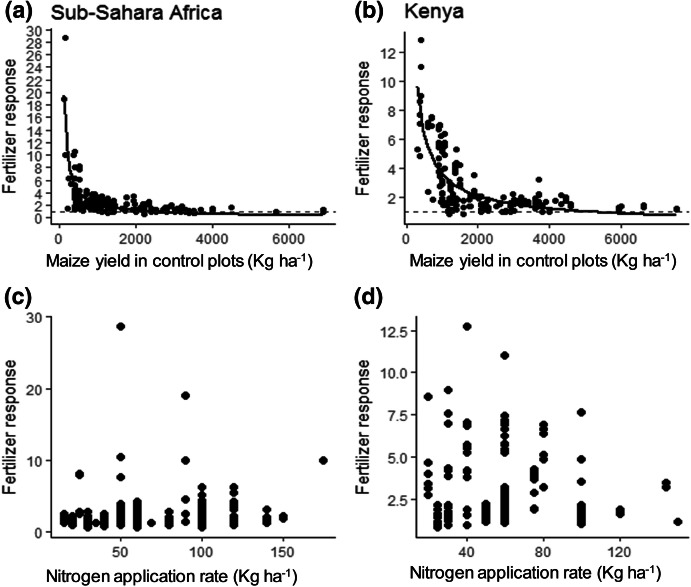
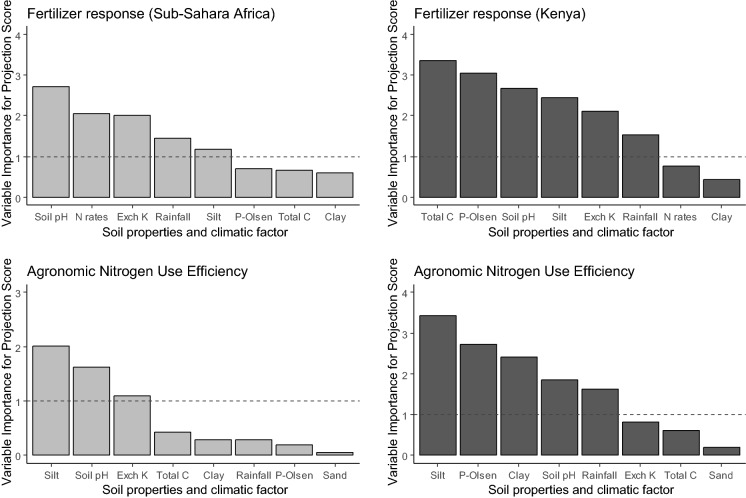
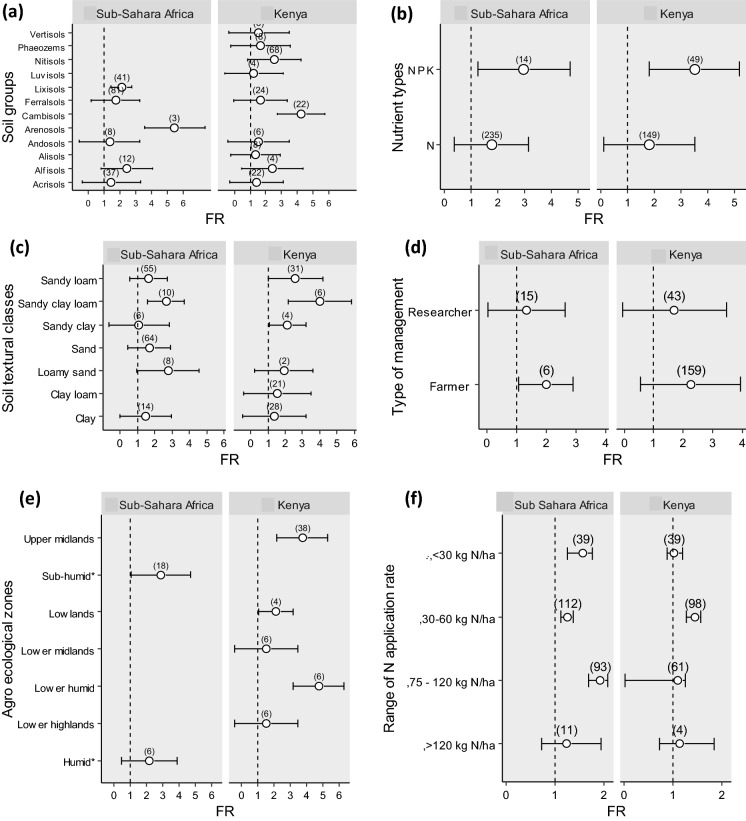
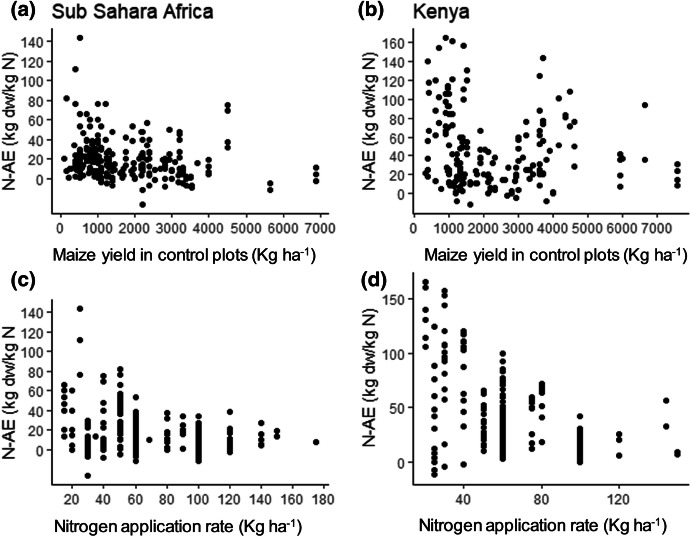
Improving fertilizer recommendations for farmers is essential to increase food security in smallholder landscapes. Currently, blanket recommendations are provided across agro-ecological zones, although fertilizer response and nutrient use efficiency by maize crop are spatially variable. We aimed to identify factors that could help to refine fertilizer recommendation by analyzing the variability in fertilizer response (FR) and the agronomic nitrogen use efficiency (N-AE). A literature search for on-farm studies across Kenya and Sub-Sahara Africa (SSA), excluding Kenya, yielded 71 publications. The variability in FR was studied using a meta-analysis whereas key factors that influence FR and N-AE were studied with linear regression models. On average, the FR was 2, but it varied considerably from 1 to 28.5 (excluding outliers). In SSA, 18% of the plots were non-responsive plots with an FR < 1. The main factors affecting N-AE for Kenya were P-Olsen, silt content, soil pH, clay and rainfall, whereas only soil pH, exchangeable K and texture were important for SSA. However, our study indicates that available data on soil, climate and management factors could explain only a small part (< 33%) of the variation in FR and N-AE. Soil pH, P-Olsen, silt content, and rainfall had significant but low levels of power in explaining variation in FR and N-AE. Our findings indicate that strategies to refine fertilizer recommendation should include information on soil types and soil properties.
改进针对农民的肥料推荐对于提高小农户地区的粮食安全至关重要。目前,尽管玉米作物对肥料的反应和养分利用效率存在空间差异,但仍在各农业生态区提供统一的推荐。我们旨在通过分析肥料反应(FR)和农艺氮利用效率(N-AE)的变异性,确定有助于优化肥料推荐的因素。对肯尼亚和撒哈拉以南非洲(不包括肯尼亚)的田间研究进行文献检索,共获得71篇出版物。使用荟萃分析研究FR的变异性,而使用线性回归模型研究影响FR和N-AE的关键因素。平均而言,FR为2,但从1到28.5变化很大(不包括异常值)。在撒哈拉以南非洲,18%的地块是无反应地块,FR<1。影响肯尼亚N-AE的主要因素是 Olsen 磷、粉砂含量、土壤pH值、黏土和降雨量,而对于撒哈拉以南非洲,只有土壤pH值、交换性钾和质地是重要的。然而,我们的研究表明,关于土壤、气候和管理因素的现有数据只能解释FR和N-AE变异的一小部分(<33%)。土壤pH值、Olsen磷、粉砂含量和降雨量在解释FR和N-AE变异方面具有显著但较低的影响力。我们的研究结果表明,优化肥料推荐的策略应包括土壤类型和土壤性质的信息。