Papadopoulos Dimitrios, Magliozzi Roberta, Mitsikostas Dimos D, Gorgoulis Vassilis G, Nicholas Richard S
Molecular Carcinogenesis Group, Laboratory of Histology and Embryology, School of Health Sciences, National and Kapodistrian University of Athens, Athens, Greece.
Department of Neuroscience, Biomedicine and Movement, University of Verona, Verona, Italy.
Front Cell Neurosci. 2020 Jun 30;14:178. doi: 10.3389/fncel.2020.00178. eCollection 2020.
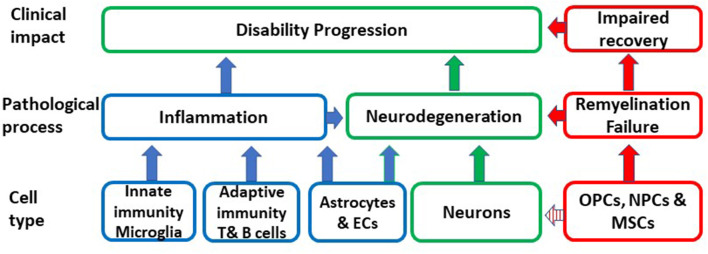
Aging is one of the most important risk factors for the development of several neurodegenerative diseases including progressive multiple sclerosis (MS). Cellular senescence (CS) is a key biological process underlying aging. Several stressors associated with aging and MS pathology, such as oxidative stress, mitochondrial dysfunction, cytokines and replicative exhaustion are known triggers of cellular senescence. Senescent cells exhibit stereotypical metabolic and functional changes, which include cell-cycle arrest and acquiring a pro-inflammatory phenotype secreting cytokines, growth factors, metalloproteinases and reactive oxygen species. They accumulate with aging and can convert neighboring cells to senescence in a paracrine manner. In MS, accelerated cellular senescence may drive disease progression by promoting chronic non-remitting inflammation, loss or altered immune, glial and neuronal function, failure of remyelination, impaired blood-brain barrier integrity and ultimately neurodegeneration. Here we discuss the evidence linking cellular senescence to the pathogenesis of MS and the putative role of senolytic and senomorphic agents as neuroprotective therapies in tackling disease progression.
衰老 是包括进展性多发性硬化症(MS)在内的几种神经退行性疾病发展的最重要风险因素之一。细胞衰老(CS)是衰老背后的关键生物学过程。与衰老和MS病理相关的几种应激源,如氧化应激、线粒体功能障碍、细胞因子和复制性耗竭,是已知的细胞衰老触发因素。衰老细胞表现出典型的代谢和功能变化,包括细胞周期停滞,并获得分泌细胞因子、生长因子、金属蛋白酶和活性氧的促炎表型。它们随着衰老而积累,并可以旁分泌方式将邻近细胞转化为衰老细胞。在MS中,加速的细胞衰老可能通过促进慢性持续炎症、免疫、神经胶质和神经元功能丧失或改变、髓鞘再生失败、血脑屏障完整性受损以及最终的神经退行性变来推动疾病进展。在这里,我们讨论将细胞衰老与MS发病机制联系起来的证据,以及溶细胞和衰老形态药物作为神经保护疗法在应对疾病进展中的假定作用。