Zhang Ting-Ting, Zhang Na-Yao, Li Wei, Zhou Xiao-Jian, Pei Xiao-Yu, Liu Yan-Gai, Ren Zhong-Ying, He Kun-Lun, Zhang Wen-Sheng, Zhou Ke-Hai, Zhang Fei, Ma Xiong-Feng, Yang Dai-Gang, Li Zhong-Hu
Key Laboratory of Resource Biology and Biotechnology in Western China, Ministry of Education, College of Life Sciences, Northwest University, Xi'an, 710069, China.
State Key Laboratory of Cotton Biology, Institute of Cotton Research, Chinese Academy of Agricultural Sciences, Anyang, 455000, China.
Plant Divers. 2020 Mar 19;42(3):189-197. doi: 10.1016/j.pld.2020.03.001. eCollection 2020 Jun.
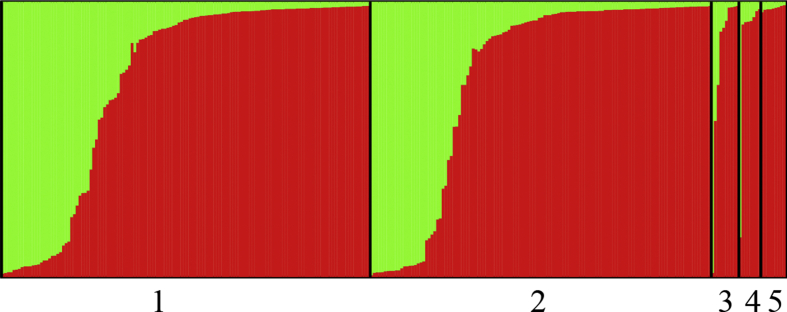
Gene flow patterns and the genetic structure of domesticated crops like cotton are not well understood. Furthermore, marker-assisted breeding of cotton has lagged far behind that of other major crops because the loci associated with cotton traits such as fiber yield and quality have scarcely been identified. In this study, we used 19 microsatellites to first determine the population genetic structure and patterns of gene flow of superior germplasm resources in upland cotton. We then used association analysis to identify which markers were associated with 15 agronomic traits (including ten yield and five fiber quality traits). The results showed that the upland cotton accessions have low levels of genetic diversity (polymorphism information content = 0.427), although extensive gene flow occurred among different ecological and geographic regions. Bayesian clustering analysis indicated that the cotton resources used in this study did not belong to obvious geographic populations, which may be the consequence of a single source of domestication followed by frequent genetic introgression mediated by human transference. A total of 82 maker-trait associations were examined in association analysis and the related ratios for phenotypic variations ranged from 3.04% to 47.14%. Interestingly, nine SSR markers were detected in more than one environmental condition. In addition, 14 SSR markers were co-associated with two or more different traits. It was noteworthy that NAU4860 and NAU5077 markers detected at least in two environments were simultaneously associated with three fiber quality traits (uniformity index, specific breaking strength and micronaire value). In conclusion, these findings provide new insights into the population structure and genetic exchange pattern of cultivated cotton accessions. The quantitative trait loci of domesticated cotton identified will also be very useful for improvement of yield and fiber quality of cotton in molecular breeding programs.
像棉花这样的驯化作物的基因流动模式和遗传结构尚未得到很好的理解。此外,棉花的标记辅助育种远远落后于其他主要作物,因为与棉花性状如纤维产量和品质相关的基因座几乎未被鉴定出来。在本研究中,我们首先使用19个微卫星来确定陆地棉优良种质资源的群体遗传结构和基因流动模式。然后我们使用关联分析来确定哪些标记与15个农艺性状(包括10个产量性状和5个纤维品质性状)相关。结果表明,陆地棉种质的遗传多样性水平较低(多态性信息含量 = 0.427),尽管在不同生态和地理区域之间发生了广泛的基因流动。贝叶斯聚类分析表明,本研究中使用的棉花资源不属于明显的地理群体,这可能是单一驯化来源后由人类迁移介导的频繁基因渐渗的结果。在关联分析中共检测到82个标记-性状关联,表型变异的相关比例范围为3.04%至47.14%。有趣的是,在不止一种环境条件下检测到9个SSR标记。此外,14个SSR标记与两个或更多不同性状共同关联。值得注意的是,至少在两种环境中检测到的NAU4860和NAU5077标记同时与三个纤维品质性状(整齐度指数、比强度和马克隆值)相关。总之,这些发现为栽培棉花种质的群体结构和遗传交换模式提供了新的见解。所鉴定的驯化棉花的数量性状基因座对于分子育种计划中棉花产量和纤维品质的改良也将非常有用。