Vita-Salute San Raffaele University, Milan, Italy.
Sleep Disorders Center, Division of Neuroscience, San Raffaele Scientific Institute, Milan, Italy.
J Neurol. 2021 Feb;268(2):409-419. doi: 10.1007/s00415-020-10070-8. Epub 2020 Jul 21.
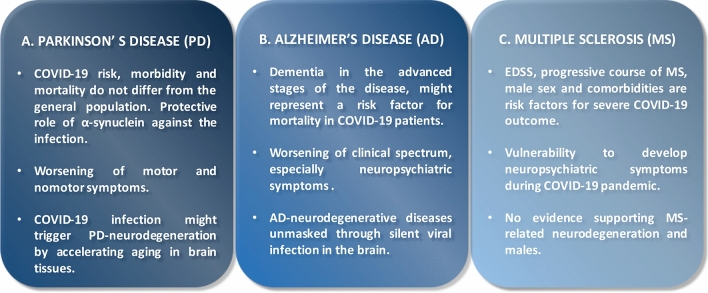
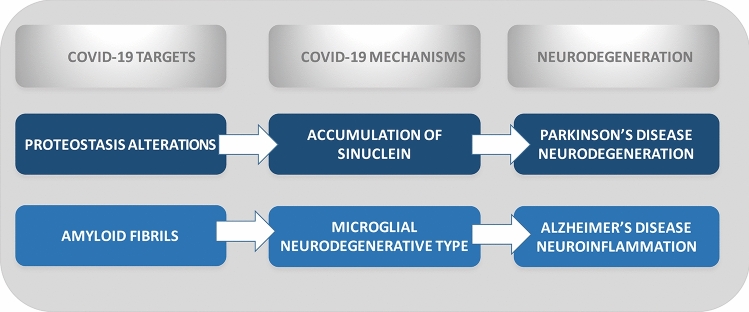
Neurological disorders and coronavirus 2019 (COVID-19) pandemic are two conditions with a recent well-documented association. Intriguing evidences showed that COVID-19 infection can modify clinical spectrum of manifested neurological disorders but also it plays a crucial role in the development of future diseases as long-tem consequences. In this viewpoint review, we aimed to assess the vulnerability to SARS-CoV-2 infection and development of COVID-19 among neurological disorders. With this in mind, we tested the hypothesis that age rather than neuropathology itself could be decisive in neurodegenerative diseases such as Parkinson's disease, whereas neuropathology rather than age may be critical in neuroimmunological diseases such as Multiple Sclerosis. Highlighting the role of potential susceptibility or protection factors from this disastrous infection, we also stratify the risk for future neurodegeneration.
神经紊乱与 2019 年冠状病毒(COVID-19)大流行是两种具有近期大量记录关联的病症。有趣的是,有证据表明,COVID-19 感染不仅会改变已表现出的神经紊乱的临床表现,还会在长期影响下在未来疾病的发展中发挥关键作用。在本次观点综述中,我们旨在评估神经紊乱患者易感染 SARS-CoV-2 病毒和罹患 COVID-19 的风险。考虑到这一点,我们提出了一个假设,即年龄而非神经病理学本身可能在帕金森病等神经退行性疾病中起决定性作用,而在多发性硬化症等神经免疫性疾病中,可能是神经病理学而非年龄起关键作用。为了突出这种灾难性感染的潜在易感性或保护因素的作用,我们还对未来的神经退行性病变风险进行了分层。