Human Evolution, Department of Organismal Biology, Evolutionary Biology Centre, Uppsala University, Uppsala, Sweden.
Palaeo-Research Institute, University of Johannesburg, Auckland Park, South Africa.
Mol Biol Evol. 2020 Oct 1;37(10):2944-2954. doi: 10.1093/molbev/msaa140.
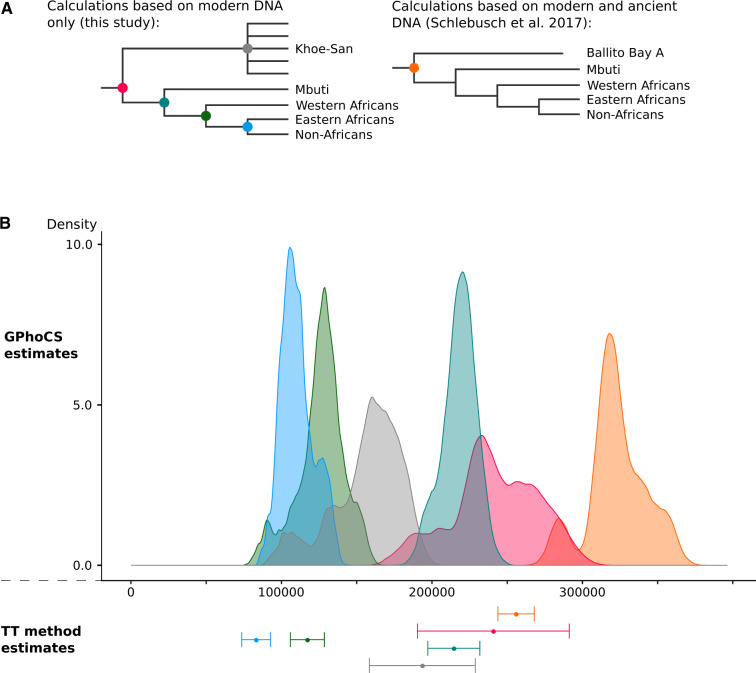
The southern African indigenous Khoe-San populations harbor the most divergent lineages of all living peoples. Exploring their genomes is key to understanding deep human history. We sequenced 25 full genomes from five Khoe-San populations, revealing many novel variants, that 25% of variants are unique to the Khoe-San, and that the Khoe-San group harbors the greatest level of diversity across the globe. In line with previous studies, we found several gene regions with extreme values in genome-wide scans for selection, potentially caused by natural selection in the lineage leading to Homo sapiens and more recent in time. These gene regions included immunity-, sperm-, brain-, diet-, and muscle-related genes. When accounting for recent admixture, all Khoe-San groups display genetic diversity approaching the levels in other African groups and a reduction in effective population size starting around 100,000 years ago. Hence, all human groups show a reduction in effective population size commencing around the time of the Out-of-Africa migrations, which coincides with changes in the paleoclimate records, changes that potentially impacted all humans at the time.
南部非洲的土著科伊桑人群拥有所有现存人类中最具差异的谱系。探索他们的基因组是了解人类深远历史的关键。我们对来自五个科伊桑人群的 25 个人类全基因组进行了测序,揭示了许多新的变异,其中 25%的变异是科伊桑人群所特有的,而且科伊桑人群在全球范围内拥有最高水平的多样性。与之前的研究一致,我们在全基因组范围内的选择扫描中发现了几个基因区域的极值,这些极值可能是由导致智人的谱系中的自然选择引起的,而且时间更近。这些基因区域包括免疫、精子、大脑、饮食和肌肉相关基因。当考虑到最近的混合时,所有科伊桑人群的遗传多样性都接近其他非洲人群的水平,并且有效种群数量从大约 10 万年前开始减少。因此,所有人类群体的有效种群数量都在减少,这一减少发生在走出非洲的迁徙时期,与古气候记录的变化相吻合,这些变化在当时可能影响了所有人类。