College of Horticulture, Nanjing Agricultural University, No.1 Weigang, Nanjing, 210095, Jiangsu, China.
Institute of Tea Sciences, Guizhou Academy of Agricultural Sciences, Guiyang, 417100, China.
Sci Rep. 2020 Jul 22;10(1):12240. doi: 10.1038/s41598-020-69253-y.
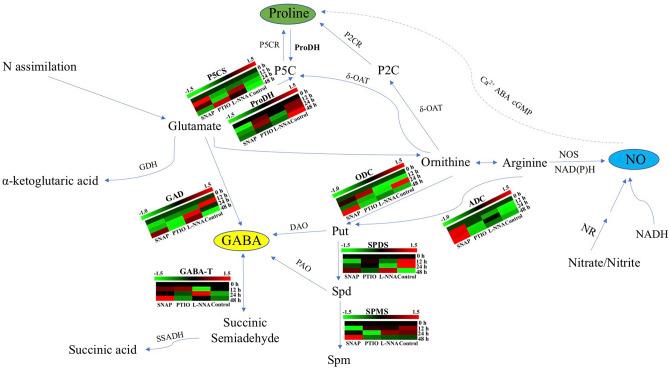
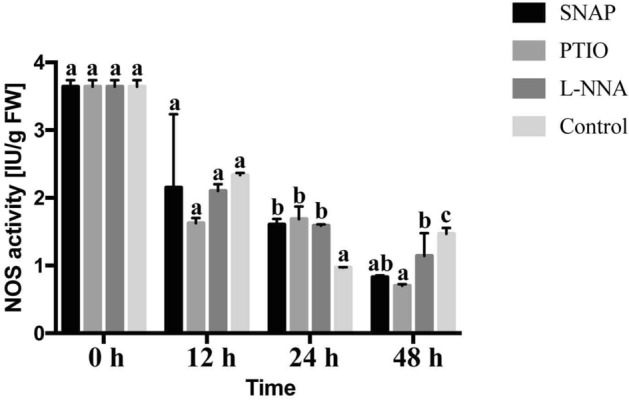
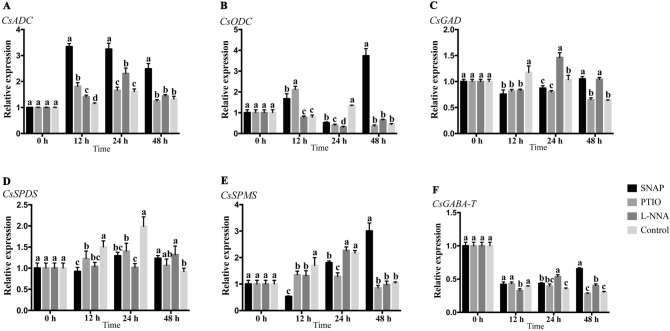
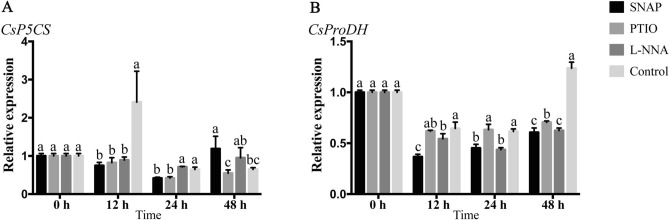
Tea plant often suffers from low temperature induced damage during its growth. How to improve the cold resistance of tea plant is an urgent problem to be solved. Nitric oxide (NO), γ-aminobutyric acid (GABA) and proline have been proved that can improve the cold resistance of tea plants, and signal transfer and biosynthesis link between them may enhance their function. NO is an important gas signal material in plant growth, but our understanding of the effects of NO on the GABA shunt, proline and NO biosynthesis are limited. In this study, the tea roots were treated with a NO donor (SNAP), NO scavenger (PTIO), and NO synthase inhibitor (L-NNA). SNAP could improve activities of arginine decarboxylase, ornithine decarboxylase, glutamate decarboxylase, GABA transaminase and Δ1-pyrroline-5-carboxylate synthetase and the expression level of related genes during the treatments. The contents of putrescine and spermidine under SNAP treatment were 45.3% and 37.3% higher compared to control at 24 h, and the spermine content under PTIO treatment were 57.6% lower compare to control at 12 h. Accumulation of proline of SNAP and L-NNA treatments was 52.2% and 43.2% higher than control at 48 h, indicating other pathway of NO biosynthesis in tea roots. In addition, the NO accelerated the consumption of GABA during cold storage. These facts indicate that NO enhanced the cold tolerance of tea, which might regulate the metabolism of the GABA shunt and of proline, associated with NO biosynthesis.
茶树在生长过程中经常遭受低温诱导的损伤。如何提高茶树的抗寒性是亟待解决的问题。一氧化氮(NO)、γ-氨基丁酸(GABA)和脯氨酸已被证明可以提高茶树的抗寒性,并且它们之间的信号转导和生物合成环节可能会增强它们的功能。NO 是植物生长过程中的一种重要气体信号物质,但我们对 NO 对 GABA 支路、脯氨酸和 NO 生物合成的影响的了解有限。在这项研究中,用一氧化氮供体(SNAP)、一氧化氮清除剂(PTIO)和一氧化氮合酶抑制剂(L-NNA)处理茶树根。SNAP 处理可提高精氨酸脱羧酶、鸟氨酸脱羧酶、谷氨酸脱羧酶、GABA 转氨酶和 Δ1-吡咯啉-5-羧酸合酶的活性,以及相关基因的表达水平。与对照相比,SNAP 处理 24 小时后腐胺和亚精胺的含量分别提高了 45.3%和 37.3%,PTIO 处理 12 小时后精胺的含量比对照低 57.6%。SNAP 和 L-NNA 处理的脯氨酸积累分别比对照高 52.2%和 43.2%,48 小时,表明茶树根中存在其他的 NO 生物合成途径。此外,NO 加速了冷储存过程中 GABA 的消耗。这些事实表明,NO 增强了茶树的耐寒性,这可能与 NO 生物合成有关,调节 GABA 支路和脯氨酸的代谢。