Departments of Neurology, Neuroscience and Ophthalmology, Neuroscience Center and Department of Ophthalmology, Louisiana State University Health Sciences Center, New Orleans, LA 70112, USA.
LSU Neuroscience Center, Louisiana State University Health Sciences Center, New Orleans, LA 70112, USA.
Int J Mol Sci. 2020 Jul 18;21(14):5078. doi: 10.3390/ijms21145078.
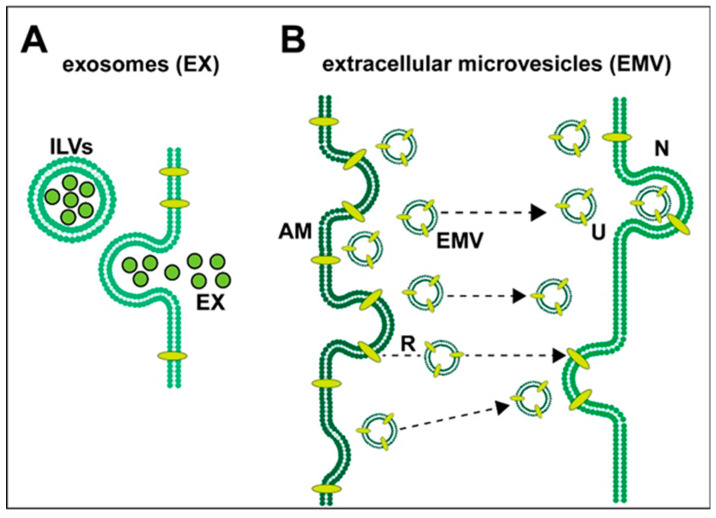
Exosomes (EXs) and extracellular microvesicles (EMVs) represent a diverse assortment of plasma membrane-derived nanovesicles, 30-1000 nm in diameter, released by all cell lineages of the central nervous system (CNS). They are examples of a very active and dynamic form of extracellular communication and the conveyance of biological information transfer essential to maintain homeostatic neurological functions and contain complex molecular cargoes representative of the cytoplasm of their cells of origin. These molecular cargoes include various mixtures of proteins, lipids, proteolipids, cytokines, chemokines, carbohydrates, microRNAs (miRNA) and messenger RNAs (mRNA) and other components, including end-stage neurotoxic and pathogenic metabolic products, such as amyloid beta (Aβ) peptides. Brain microglia, for example, respond to both acute CNS injuries and degenerative diseases with complex reactions via the induction of a pro-inflammatory phenotype, and secrete EXs and EMVs enriched in selective pathogenic microRNAs (miRNAs) such as miRNA-34a, miRNA-125b, miRNA-146a, miRNA-155, and others that are known to promote neuro-inflammation, induce complement activation, disrupt innate-immune signaling and deregulate the expression of neuron-specific phosphoproteins involved in neurotropism and synaptic signaling. This communication will review our current understanding of the trafficking of miRNA-containing EXs and EMVs from astrocytes and "activated pro-inflammatory" microglia to target neurons in neurodegenerative diseases with an emphasis on Alzheimer's disease wherever possible.
外泌体(EXs)和细胞外微泡(EMVs)代表了一组不同的、直径为 30-1000nm 的源自细胞膜的纳米囊泡,由中枢神经系统(CNS)的所有细胞谱系释放。它们是细胞外通讯的一种非常活跃和动态的形式,是传递对维持神经内稳态功能至关重要的生物信息的载体,其中包含了起源细胞细胞质的复杂分子货物。这些分子货物包括各种蛋白质、脂质、蛋白脂、细胞因子、趋化因子、碳水化合物、microRNAs(miRNA)和信使 RNA(mRNA)和其他成分,包括终末神经毒性和致病代谢产物,如淀粉样β(Aβ)肽。例如,脑小胶质细胞对急性中枢神经系统损伤和退行性疾病的反应是通过诱导促炎表型来实现的,它们分泌富含选择性致病 miRNA(miRNA)的 EXs 和 EMVs,如 miRNA-34a、miRNA-125b、miRNA-146a、miRNA-155 等,这些 miRNA 已知可促进神经炎症、诱导补体激活、破坏先天免疫信号转导并下调参与神经向性和突触信号转导的神经元特异性磷酸蛋白的表达。本文综述了我们目前对外泌体和 EMVs 中 miRNA 转运的理解,这些 miRNA 源自星形胶质细胞和“激活的促炎”小胶质细胞,并靶向神经退行性疾病中的靶神经元,重点是尽可能强调阿尔茨海默病。