Department of Community Medicine and School of Public Health, Post Graduate Institute of Medical Education and Research (PGIMER), Chandigarh, 160012, India.
Department of Pediatrics, Post Graduate Institute of Medical Education and Research (PGIMER), Chandigarh, 160012, India.
Environ Sci Pollut Res Int. 2020 Nov;27(33):42115-42123. doi: 10.1007/s11356-020-10132-4. Epub 2020 Jul 24.
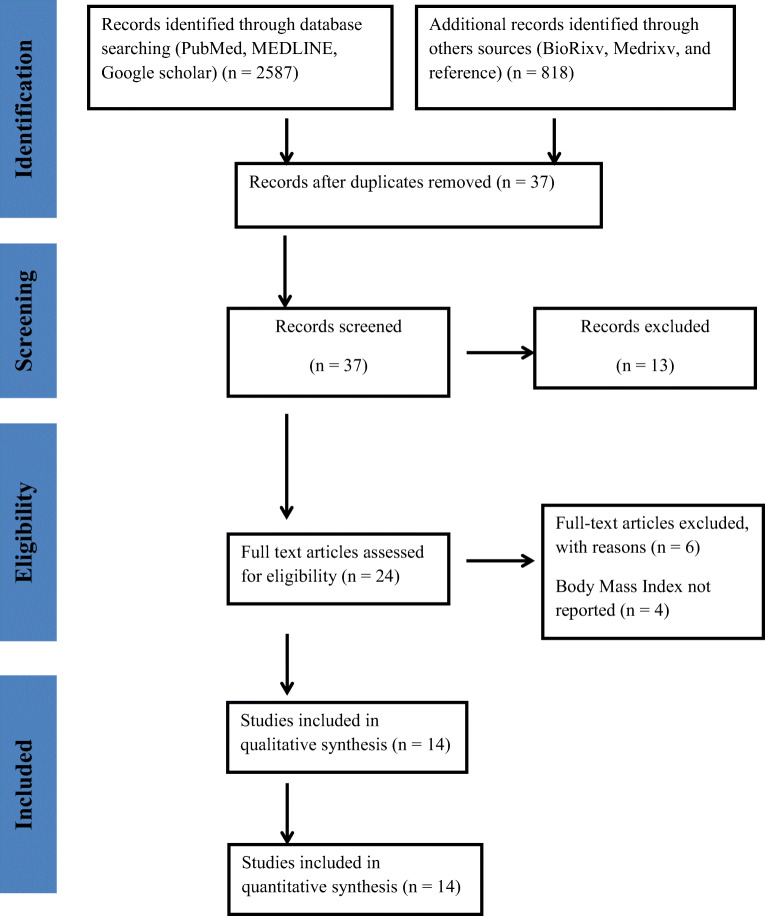
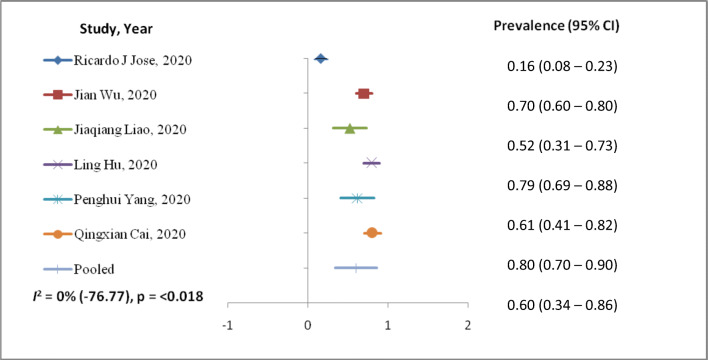
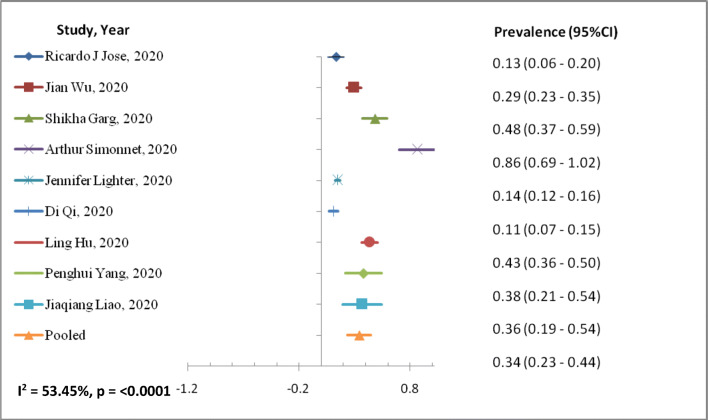
Globally, both obesity and underweight are severe health risks for various diseases. The current study systematically examined the emerging evidence to identify an association between body mass index (BMI) and COVID-19 disease outcome. Online literature databases (e.g., Google Scholar, PubMed, MEDLINE, EMBASE, Scopus, Medrixv and BioRixv) were screened following standard search strategy having the appropriate keyword such as "Obesity", "Underweight", "BMI", "Body Mass Index", "2019-nCov", "COVID-19, "novel coronavirus", "coronavirus disease". Studies published till 20 April 2020 were included without language restriction. These studies include case reports, case series, cohort, and any other which reported BMI, overweight/obesity or underweight, and its complication with COVID-19 disease. This study observed COVID-19 infection among BMI < 25 kg/m with prevalence of 0.60 (95%CI: 0.34-0.86, I = - 76.77) as compared to the 0.34 (95%CI: 0.23-0.44, I = 53.45% heterogeneity) having BMI > 25 kg/m. The results of the current study show that BMI plays a significant role in COVID-19 severity in all age groups, especially the older individuals. A panel of doctors and nursing staff should review COVID-19 patients with higher BMI with other co-morbidities (diabetes and hypertension), and they should be given increased vigilance, priority in testing, and treatment to control the associated co-morbidities. Further, the COVID-19 patients whose illness entered 7-10 days, age > 50 years, and elevated CRP levels should be given additional medical considerations. Our finding showed that the population and patients with high BMI have moderate to high risk of medical complications with COVID-19, and hence, their health status should be monitored more frequently including monitoring of blood pressure and blood glucose.
全球范围内,肥胖和体重过轻都是各种疾病的严重健康风险。本研究系统地检查了新出现的证据,以确定身体质量指数(BMI)与 COVID-19 疾病结果之间的关联。按照标准搜索策略,在线文献数据库(例如 Google Scholar、PubMed、MEDLINE、EMBASE、Scopus、Medrixv 和 BioRixv)进行了筛选,使用了适当的关键词,如“肥胖”、“体重过轻”、“BMI”、“身体质量指数”、“2019-nCov”、“COVID-19”、“新型冠状病毒”、“冠状病毒病”。纳入了截至 2020 年 4 月 20 日发表的研究,无语言限制。这些研究包括病例报告、病例系列、队列研究,以及任何报告 BMI、超重/肥胖或体重过轻及其与 COVID-19 疾病并发症的研究。本研究观察到 BMI<25kg/m2 的 COVID-19 感染率为 0.60(95%CI:0.34-0.86,I=-76.77),而 BMI>25kg/m2 的 COVID-19 感染率为 0.34(95%CI:0.23-0.44,I=53.45%异质性)。本研究结果表明,BMI 在所有年龄段的 COVID-19 严重程度中都起着重要作用,尤其是在老年人中。一组医生和护理人员应该审查 BMI 较高的 COVID-19 患者是否存在其他合并症(糖尿病和高血压),并应给予他们更高的警惕性、优先检测和治疗以控制相关合并症。此外,对于病程进入 7-10 天、年龄>50 岁和 CRP 水平升高的 COVID-19 患者,应给予额外的医疗考虑。我们的发现表明,高 BMI 的人群和患者患有 COVID-19 相关并发症的风险中等偏高,因此应更频繁地监测他们的健康状况,包括监测血压和血糖。