Druege Uwe
Erfurt Research Centre for Horticultural Crops (FGK), University of Applied Sciences Erfurt, Erfurt, Germany.
Front Plant Sci. 2020 Jun 30;11:907. doi: 10.3389/fpls.2020.00907. eCollection 2020.
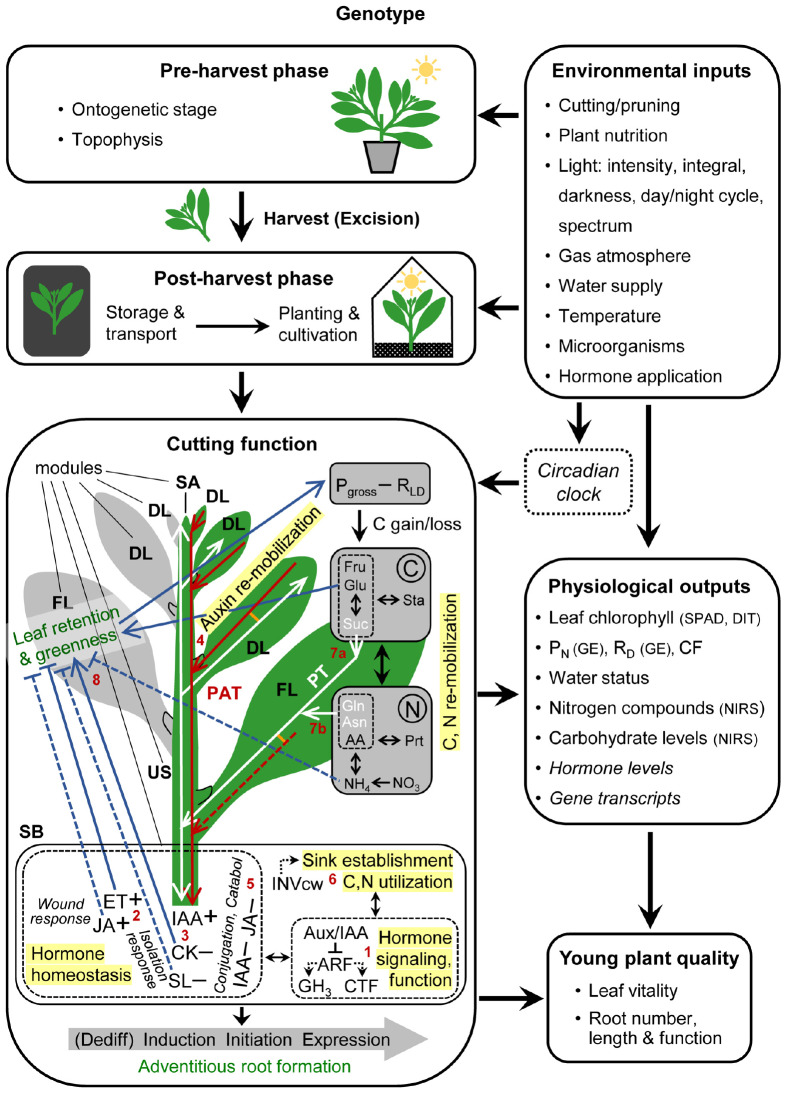
Each year, billions of ornamental young plants are produced worldwide from cuttings that are harvested from stock plants and planted to form adventitious roots. Depending on the plant genotype, the maturation of the cutting, and the particular environment, which is complex and often involves intermediate storage of cuttings under dark conditions and shipping between different climate regions, induced senescence or abscission of leaves and insufficient root development can impair the success of propagation and the quality of generated young plants. Recent findings on the molecular and physiological control of leaf vitality and adventitious root formation are integrated into a systemic perspective on improved physiologically-based control of cutting propagation. The homeostasis and signal transduction of the wound responsive plant hormones ethylene and jasmonic acid, of auxin, cytokinins and strigolactones, and the carbon-nitrogen source-sink balance in cuttings are considered as important processes that are both, highly responsive to environmental inputs and decisive for the development of cuttings. Important modules and bottlenecks of cutting function are identified. Critical environmental inputs at stock plant and cutting level are highlighted and physiological outputs that can be used as quality attributes to monitor the functional capacity of cuttings and as response parameters to optimize the cutting environment are discussed. Facing the great genetic diversity of ornamental crops, a physiologically targeted approach is proposed to define bottleneck-specific plant groups. Components from the field of machine learning may help to mathematically describe the complex environmental response of specific plant species.
每年,全球数十亿株观赏植物幼苗通过从母株上采集插条并扦插以形成不定根来繁殖。根据植物基因型、插条成熟度以及特定环境(这种环境复杂,通常涉及在黑暗条件下对插条进行中间储存以及在不同气候区域之间运输),叶片的诱导衰老或脱落以及根系发育不足会影响繁殖成功率和所培育幼苗的质量。关于叶片活力和不定根形成的分子与生理控制的最新研究成果被整合到一个系统视角中,以改进基于生理学的扦插繁殖控制。伤口响应植物激素乙烯和茉莉酸、生长素、细胞分裂素和独脚金内酯的稳态和信号转导,以及插条中的碳氮源 - 库平衡被视为既对环境输入高度敏感又对插条发育起决定性作用的重要过程。确定了扦插功能的重要模块和瓶颈。强调了母株和插条水平的关键环境输入,并讨论了可作为质量属性用于监测插条功能能力以及作为优化扦插环境的响应参数的生理输出。面对观赏作物的巨大遗传多样性,提出了一种以生理学为目标的方法来定义特定瓶颈的植物群体。机器学习领域的组件可能有助于从数学上描述特定植物物种复杂的环境响应。