Damiano Valentina, Spessotto Paola, Vanin Giulia, Perin Tiziana, Maestro Roberta, Santarosa Manuela
Unit of Oncogenetics and Functional Oncogenomics, Centro di Riferimento Oncologico di Aviano (CRO) IRCCS, Aviano, Italy.
Unit of Molecular Oncology, Centro di Riferimento Oncologico di Aviano (CRO) IRCCS, Aviano, Italy.
Front Cell Dev Biol. 2020 Jun 30;8:545. doi: 10.3389/fcell.2020.00545. eCollection 2020.
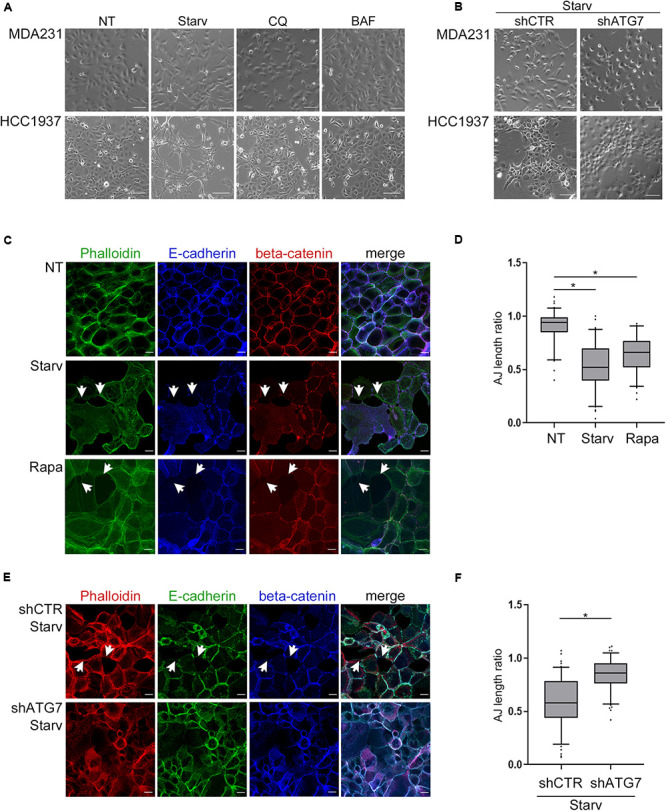
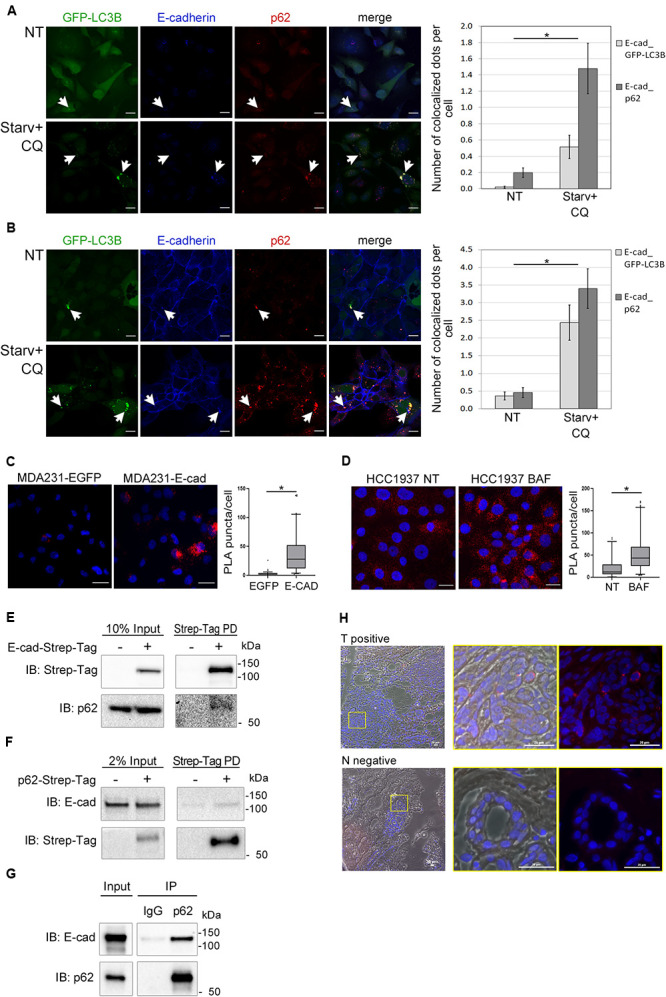
Autophagy is an intracellular catabolic process that is increasingly being recognized as a crucial factor in several human diseases including cancers. Mounting evidence suggests that autophagy allows tumor cells to overcome otherwise fatal stresses and to increase dissemination. Nevertheless, how autophagy controls these processes and in particular how it impinges on cell-cell adhesion is still poorly understood. Here, we investigate the role of autophagy in the turnover of the epithelial adhesion molecule E-cadherin in the context of breast cancer. We demonstrated in breast cancer cell lines that autophagy impinges on E-cadherin expression and in the configuration of adherens junctions. Besides, we showed that E-cadherin colocalizes with LC3B and SQSTM1/p62, two components of the autophagosome machinery. Pull down and immunoprecipitation analyses provided evidence that E-cadherin and SQSTM1/p62 physically interact. Moreover, the physical closeness of E-cadherin and SQSTM1/p62 was demonstrated by proximity ligation assays in breast cancer cell lines and primary tumors. Finally, we proved that the silencing of SQSTM1/p62 diminished the E-cadherin/LC3B colocalization, further supporting the role of SQSTM1/p62 in E-cadherin delivery to autophagosomes. These findings suggest that the activation of autophagy, reported in breast cancers with poor prognosis and in dormant breast cancer cells, may contribute to the control of tumor progression via downmodulation of E-cadherin protein levels.
自噬是一种细胞内分解代谢过程,越来越被认为是包括癌症在内的多种人类疾病的关键因素。越来越多的证据表明,自噬使肿瘤细胞能够克服原本致命的压力并增加扩散。然而,自噬如何控制这些过程,尤其是它如何影响细胞间粘附,仍然知之甚少。在这里,我们研究了自噬在乳腺癌背景下上皮粘附分子E-钙粘蛋白周转中的作用。我们在乳腺癌细胞系中证明,自噬影响E-钙粘蛋白的表达以及粘着连接的构型。此外,我们表明E-钙粘蛋白与自噬体机制的两个组成部分LC3B和SQSTM1/p62共定位。下拉和免疫沉淀分析提供了E-钙粘蛋白和SQSTM1/p62发生物理相互作用的证据。此外,通过乳腺癌细胞系和原发性肿瘤中的邻近连接分析证明了E-钙粘蛋白和SQSTM1/p62的物理接近性。最后,我们证明沉默SQSTM1/p62会减少E-钙粘蛋白/LC3B的共定位,进一步支持SQSTM1/p62在将E-钙粘蛋白递送至自噬体中的作用。这些发现表明,在预后不良的乳腺癌和休眠乳腺癌细胞中报道的自噬激活可能通过下调E-钙粘蛋白蛋白水平来控制肿瘤进展。