Aslam Hassaan Bin, Alarcon Pablo, Yaqub Tahir, Iqbal Munir, Häsler Barbara
Veterinary Epidemiology, Economics and Public Health Group, Department of Pathobiology and Population Sciences, Royal Veterinary College (RVC), London, United Kingdom.
Avian Influenza Virus Group, The Pirbright Institute, Woking, United Kingdom.
Front Vet Sci. 2020 Jul 3;7:361. doi: 10.3389/fvets.2020.00361. eCollection 2020.
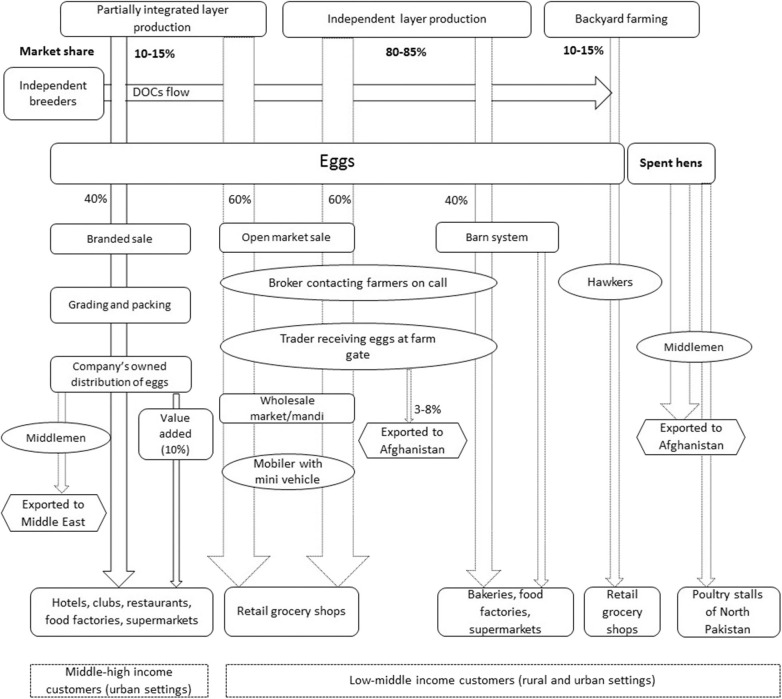
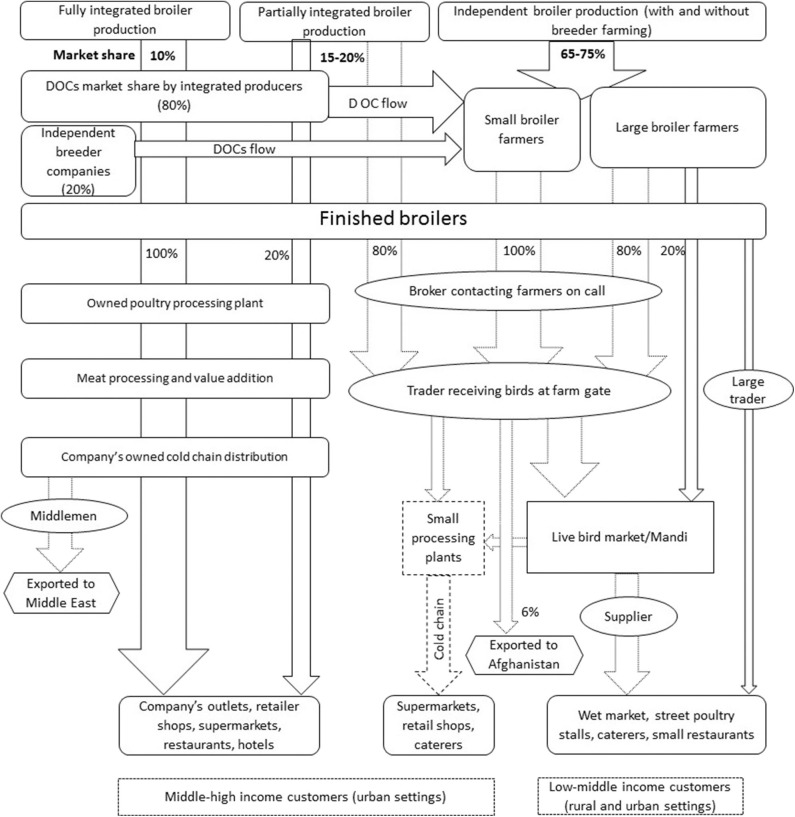
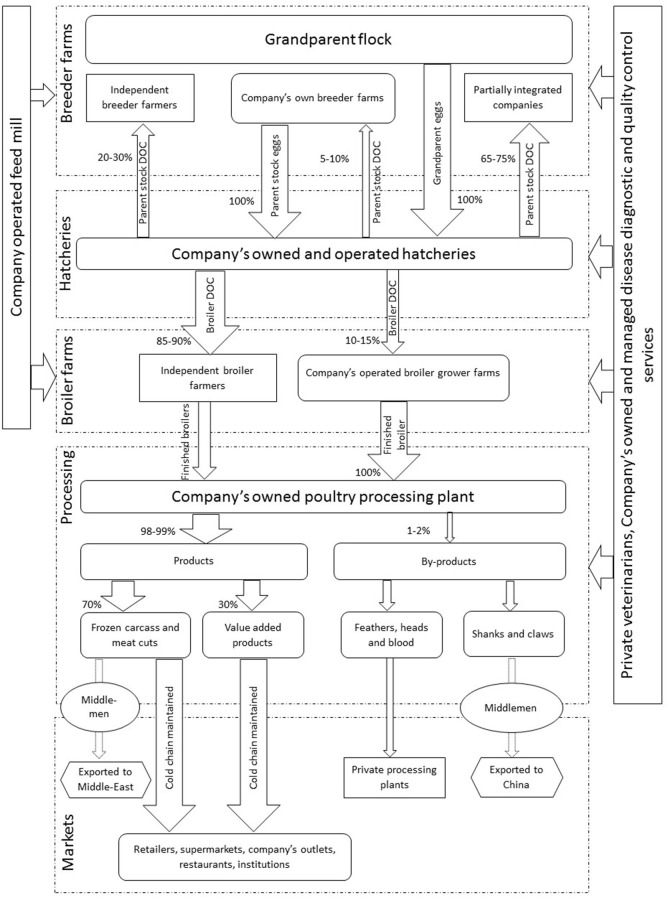
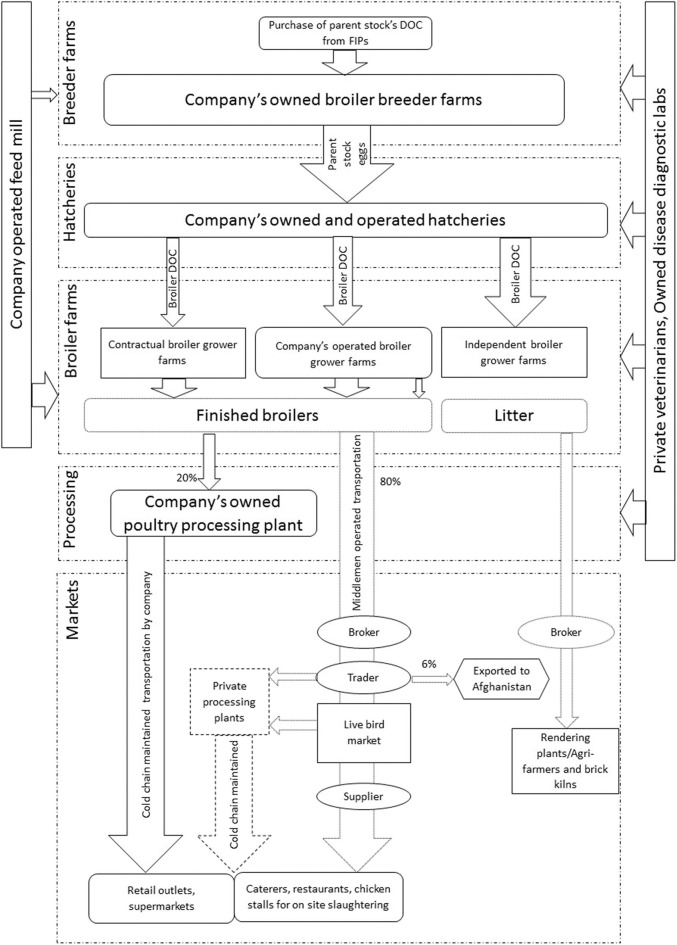
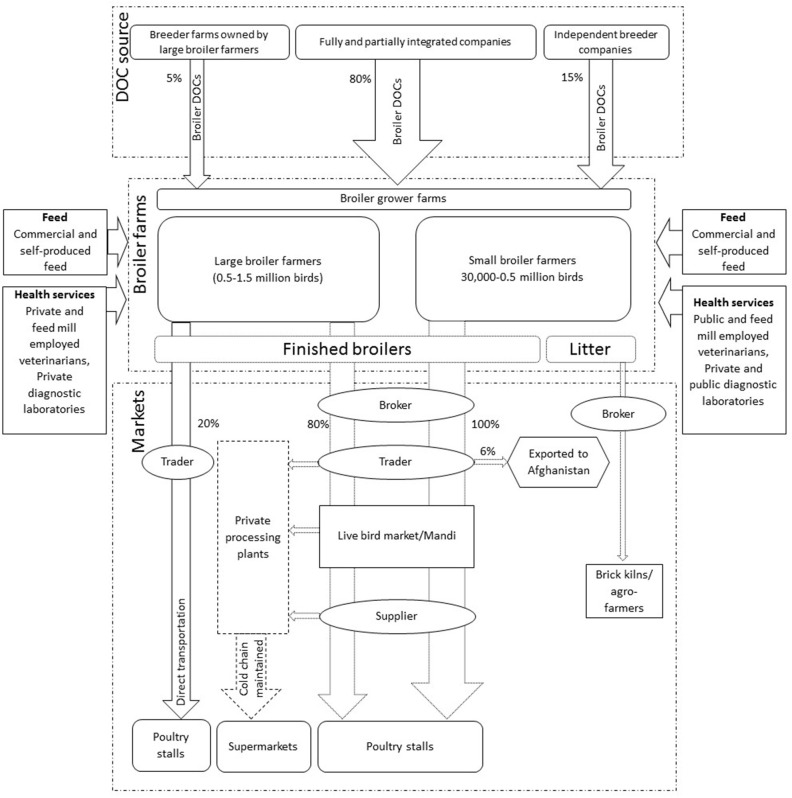
The chicken industry of Pakistan is a major livestock sub-sector, playing a pivotal role in economic growth and rural development. This study aimed to characterize and map the structure of broiler and layer production systems, associated value chains, and chicken disease management in Pakistan. Qualitative data were collected in 23 key informant interviews and one focus group discussion on the types of production systems, inputs, outputs, value addition, market dynamics, and disease management. Quantitative data on proportions of commodity flows were also obtained. Value chain maps were generated to illustrate stakeholder groups and their linkages, as well as flows of birds and products. Thematic analysis was conducted to explain the functionality of the processes, governance, and disease management. Major chicken production systems were: (1) Environmentally controlled production (97-98%) and (2) Open-sided house production (2-3%). Broiler management systems were classified as (I) Independent broiler production; (II) Partially integrated broiler production; and (III) Fully integrated broiler production, accounting for 65-75, 15-20, and 10-15% of commercial broiler meat supply, respectively. The management systems for layers were classified as (I) Partially integrated layer production and (II) Independent layer production, accounting for 10 and 80-85% in the egg production, respectively. The share of backyard birds for meat and eggs was 10-15%. Independent, and integrated systems for chicken production could be categorized in terms of value chain management, dominance of actors, type of finished product and target customers involved. Integrated systems predominantly targeted high-income customers and used formal infrastructure. Numerous informal chains were identified in independent and some partially integrated systems, with middlemen playing a key role in the distribution of finished birds and eggs. Structural deficiencies in terms of poor farm management, lack of regulations for ensuring good farming practices and price fixing of products were key themes identified. Both private and public stakeholders were found to have essential roles in passive disease surveillance, strategy development and provision of health consultancies. This study provides a foundation for policy-makers and stakeholders to investigate disease transmission, its impact and control and the structural deficiencies identified could inform interventions to improve performance of the poultry sector in Pakistan.
巴基斯坦的养鸡业是主要的畜牧子部门,在经济增长和农村发展中发挥着关键作用。本研究旨在描述和绘制巴基斯坦肉鸡和蛋鸡生产系统的结构、相关价值链以及鸡病管理情况。通过对23次关键 informant 访谈和一次焦点小组讨论收集了关于生产系统类型、投入、产出、增值、市场动态和疾病管理的定性数据。还获得了商品流比例的定量数据。生成了价值链图以说明利益相关者群体及其联系,以及禽鸟和产品的流动情况。进行了主题分析以解释流程、治理和疾病管理的功能。主要的养鸡生产系统为:(1)环境控制生产(97 - 98%)和(2)开放式鸡舍生产(2 - 3%)。肉鸡管理系统分为:(I)独立肉鸡生产;(II)部分一体化肉鸡生产;和(III)完全一体化肉鸡生产,分别占商业肉鸡供应的65 - 75%、15 - 20%和10 - 15%。蛋鸡管理系统分为:(I)部分一体化蛋鸡生产和(II)独立蛋鸡生产,分别占鸡蛋生产的10%和80 - 85%。后院禽鸟用于产肉和产蛋的比例为10 - 15%。养鸡生产的独立和一体化系统可根据价值链管理、行为主体的主导地位、成品类型和涉及的目标客户进行分类。一体化系统主要针对高收入客户并使用正规基础设施。在独立和一些部分一体化系统中发现了许多非正式链条,中间商在成品禽鸟和鸡蛋的分销中起关键作用。农场管理不善、缺乏确保良好养殖规范的法规以及产品定价方面的结构缺陷是确定的关键主题。发现私营和公共利益相关者在被动疾病监测、战略制定和提供健康咨询方面都发挥着重要作用。本研究为政策制定者和利益相关者调查疾病传播、其影响和控制提供了基础,所确定的结构缺陷可为改善巴基斯坦家禽业表现的干预措施提供参考。