Interfaculty Institute of Biochemistry, University of Tübingen, Tübingen, Germany.
Center for Infection and Immunity, Columbia University, New York, New York, USA.
mBio. 2020 Jul 28;11(4):e00745-20. doi: 10.1128/mBio.00745-20.
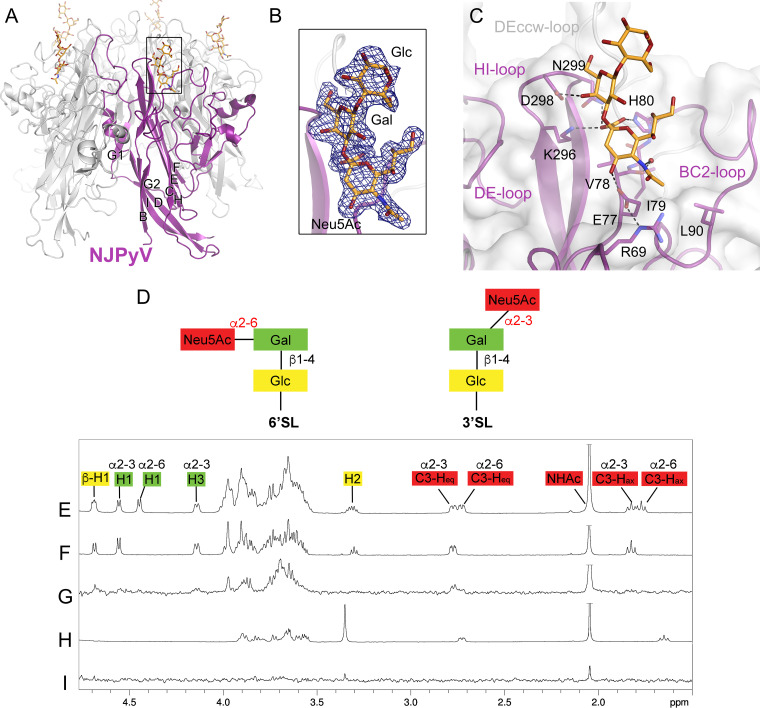
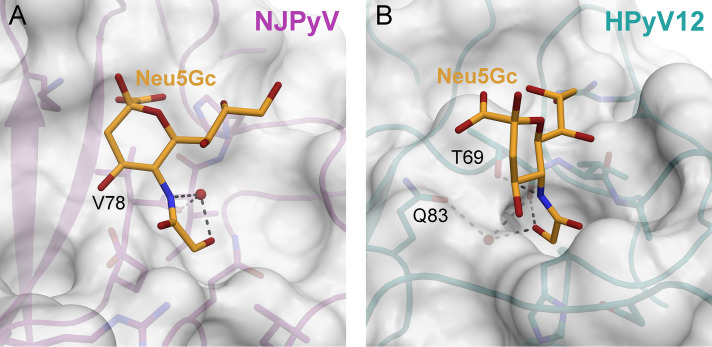
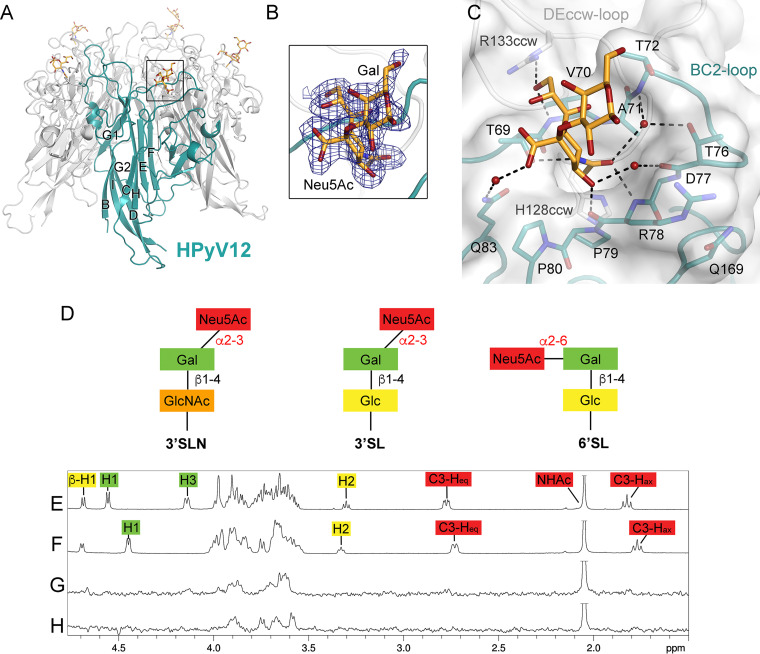
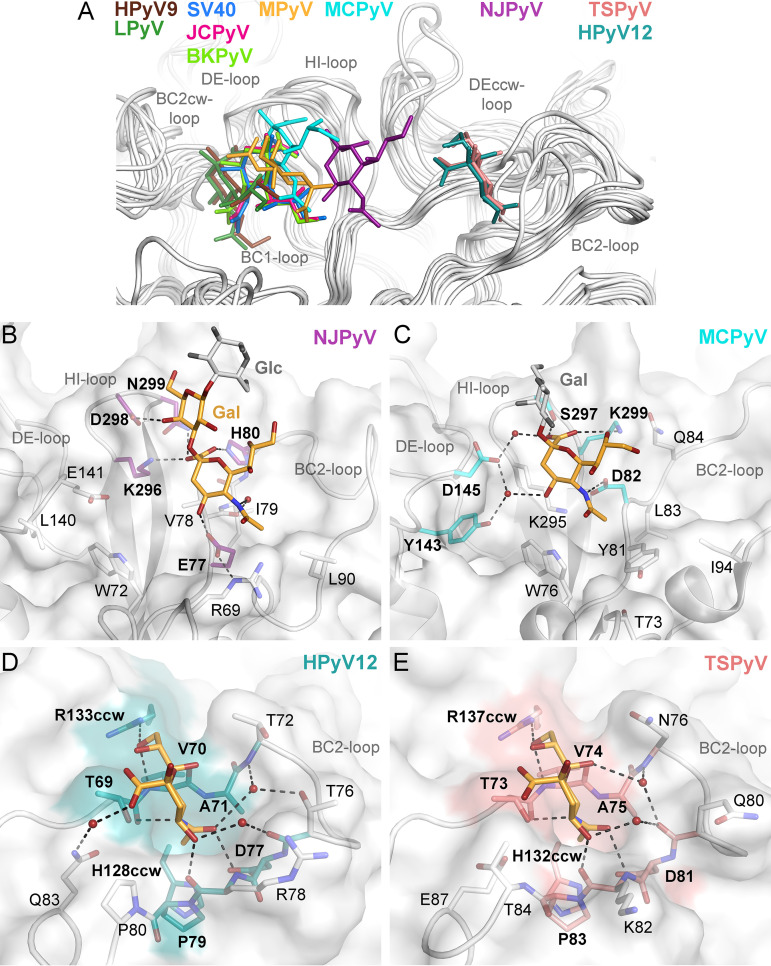
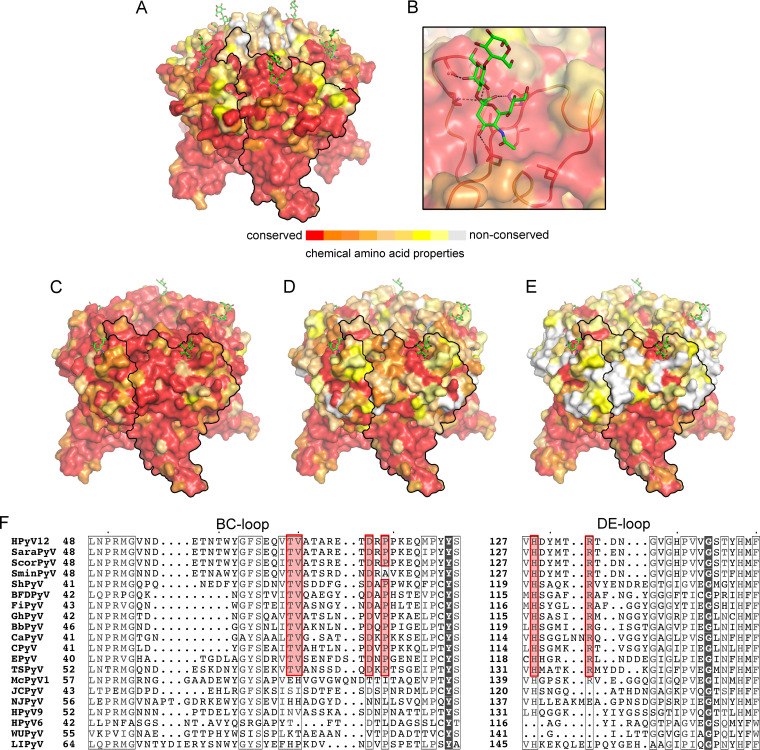
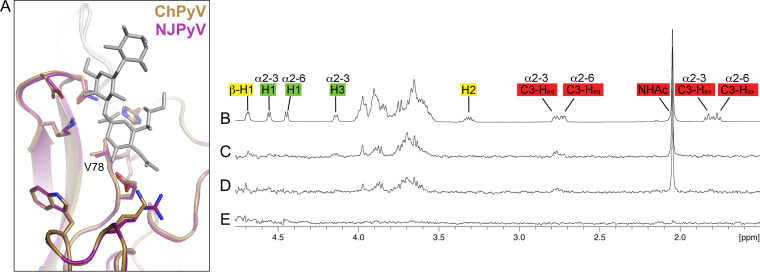
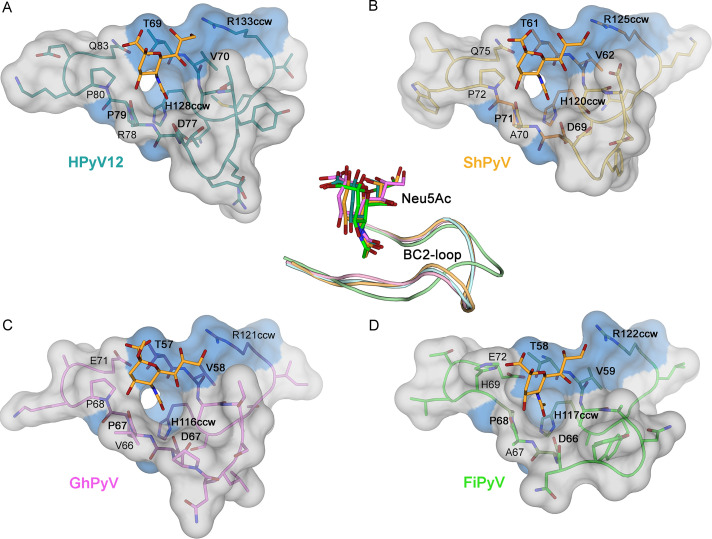
Asymptomatic infections with polyomaviruses in humans are common, but these small viruses can cause severe diseases in immunocompromised hosts. New Jersey polyomavirus (NJPyV) was identified via a muscle biopsy in an organ transplant recipient with systemic vasculitis, myositis, and retinal blindness, and human polyomavirus 12 (HPyV12) was detected in human liver tissue. The evolutionary origins and potential diseases are not well understood for either virus. In order to define their receptor engagement strategies, we first used nuclear magnetic resonance (NMR) spectroscopy to establish that the major capsid proteins (VP1) of both viruses bind to sialic acid in solution. We then solved crystal structures of NJPyV and HPyV12 VP1 alone and in complex with sialylated glycans. NJPyV employs a novel binding site for a α2,3-linked sialic acid, whereas HPyV12 engages terminal α2,3- or α2,6-linked sialic acids in an exposed site similar to that found in -associated polyomavirus (TSPyV). Gangliosides or glycoproteins, featuring in mammals usually terminal sialic acids, are therefore receptor candidates for both viruses. Structural analyses show that the sialic acid-binding site of NJPyV is conserved in chimpanzee polyomavirus (ChPyV) and that the sialic acid-binding site of HPyV12 is widely used across the entire polyomavirus family, including mammalian and avian polyomaviruses. A comparison with other polyomavirus-receptor complex structures shows that their capsids have evolved to generate several physically distinct virus-specific receptor-binding sites that can all specifically engage sialylated glycans through a limited number of contacts. Small changes in each site may have enabled host-switching events during the evolution of polyomaviruses. Virus attachment to cell surface receptors is critical for productive infection. In this study, we have used a structure-based approach to investigate the cell surface recognition event for New Jersey polyomavirus (NJPyV) and human polyomavirus 12 (HPyV12). These viruses belong to the polyomavirus family, whose members target different tissues and hosts, including mammals, birds, fish, and invertebrates. Polyomaviruses are nonenveloped viruses, and the receptor-binding site is located in their capsid protein VP1. The NJPyV capsid features a novel sialic acid-binding site that is shifted in comparison to other structurally characterized polyomaviruses but shared with a closely related simian virus. In contrast, HPyV12 VP1 engages terminal sialic acids in a manner similar to the human -associated polyomavirus. Our structure-based phylogenetic analysis highlights that even distantly related avian polyomaviruses possess the same exposed sialic acid-binding site. These findings complement phylogenetic models of host-virus codivergence and may also reflect past host-switching events.
人类中多瘤病毒的无症状感染很常见,但这些小病毒会在免疫功能低下的宿主中引起严重疾病。新泽西多瘤病毒(NJPyV)是通过对一名患有全身血管炎、肌炎和视网膜盲的器官移植受者的肌肉活检发现的,人类多瘤病毒 12(HPyV12)则在人肝组织中被检测到。这两种病毒的进化起源和潜在疾病都不太清楚。为了确定它们的受体结合策略,我们首先使用核磁共振(NMR)光谱法证实,这两种病毒的主要衣壳蛋白(VP1)在溶液中均与唾液酸结合。然后,我们解析了 NJPyV 和 HPyV12 VP1 的晶体结构,包括单独的和与唾液酸化聚糖复合的结构。NJPyV 采用了一种用于结合 α2,3 连接唾液酸的新型结合位点,而 HPyV12 则在一个暴露的位点上结合末端 α2,3-或 α2,6-连接的唾液酸,该位点与与 T 相关的多瘤病毒(TSPyV)中发现的位点相似。因此,神经节苷脂或糖蛋白,通常在哺乳动物中带有末端唾液酸,是这两种病毒的受体候选物。结构分析表明,NJPyV 的唾液酸结合位点在黑猩猩多瘤病毒(ChPyV)中保守,而 HPyV12 的唾液酸结合位点在整个多瘤病毒家族中广泛使用,包括哺乳动物和禽类多瘤病毒。与其他多瘤病毒受体复合物结构的比较表明,它们的衣壳已经进化出了几个物理上不同的病毒特异性受体结合位点,这些位点都可以通过有限数量的接触特异性地与唾液酸化聚糖结合。每个位点的微小变化可能在多瘤病毒的进化过程中导致了宿主转换事件。病毒附着在细胞表面受体上是感染的关键。在这项研究中,我们使用基于结构的方法研究了新泽西多瘤病毒(NJPyV)和人类多瘤病毒 12(HPyV12)的细胞表面识别事件。这些病毒属于多瘤病毒科,其成员针对不同的组织和宿主,包括哺乳动物、鸟类、鱼类和无脊椎动物。多瘤病毒是非包膜病毒,其受体结合位点位于其衣壳蛋白 VP1 中。NJPyV 衣壳具有一个新型的唾液酸结合位点,与其他结构特征明确的多瘤病毒相比有所移位,但与密切相关的猿猴病毒共享。相比之下,HPyV12 VP1 以类似于人类 T 相关多瘤病毒的方式结合末端唾液酸。我们基于结构的系统发育分析强调,即使是亲缘关系较远的禽类多瘤病毒也具有相同的暴露唾液酸结合位点。这些发现补充了宿主-病毒共同进化的系统发育模型,也可能反映了过去的宿主转换事件。