Michael Smith Laboratories, Department of Microbiology and Immunology, University of British Columbia, Vancouver, British Columbia, Canada.
Department of Systems Biotechnology, Chung-Ang University, Anseong, Republic of Korea.
mBio. 2020 Jul 28;11(4):e00986-20. doi: 10.1128/mBio.00986-20.
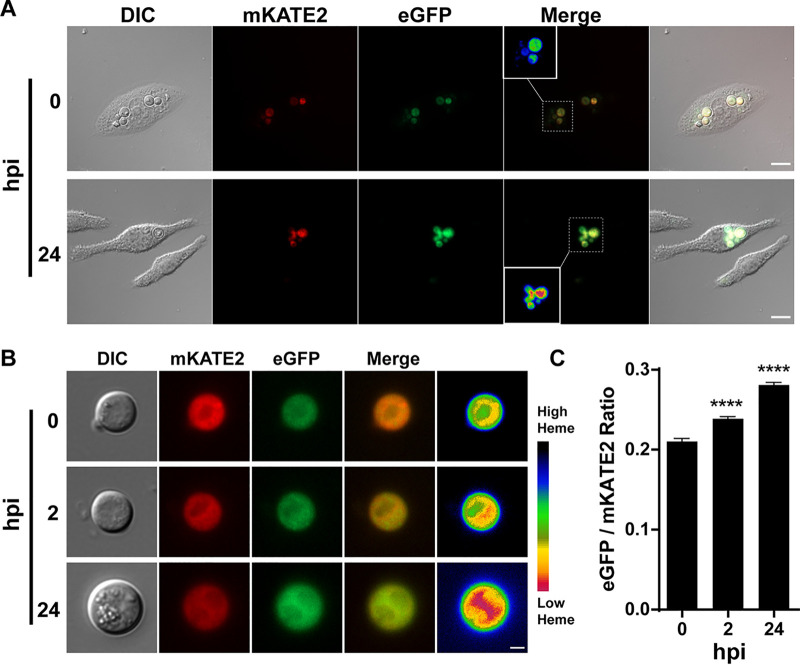
Pathogens must compete with hosts to acquire sufficient iron for proliferation during pathogenesis. The pathogenic fungus is capable of acquiring iron from heme, the most abundant source in vertebrate hosts, although the mechanisms of heme sensing and acquisition are not entirely understood. In this study, we adopted a chromosomally encoded heme sensor developed for to examine cytosolic heme levels in using fluorescence microscopy, fluorimetry, and flow cytometry. We validated the responsiveness of the sensor upon treatment with exogenous hemin, during proliferation in macrophages, and in strains defective for endocytosis. We then used the sensor to show that vacuolar and mitochondrial dysregulation and oxidative stress reduced the labile heme pool in the cytosol. Importantly, the sensor provided a tool to further demonstrate that the drugs artemisinin and metformin have heme-related activities and the potential to be repurposed for antifungal therapy. Overall, this study provides insights into heme sensing by and establishes a powerful tool to further investigate mechanisms of heme-iron acquisition in the context of fungal pathogenesis. Invasive fungal diseases are increasing in frequency, and new drug targets and antifungal drugs are needed to bolster therapy. The mechanisms by which pathogens obtain critical nutrients such as iron from heme during host colonization represent a promising target for therapy. In this study, we employed a fluorescent heme sensor to investigate heme homeostasis in We demonstrated that endocytosis is a key aspect of heme acquisition and that vacuolar and mitochondrial functions are important in regulating the pool of available heme in cells. Stress generated by oxidative conditions impacts the heme pool, as do the drugs artemisinin and metformin; these drugs have heme-related activities and are in clinical use for malaria and diabetes, respectively. Overall, our study provides insights into mechanisms of fungal heme acquisition and demonstrates the utility of the heme sensor for drug characterization in support of new therapies for fungal diseases.
病原体必须与宿主竞争以获取足够的铁来进行发病过程中的增殖。尽管对血红素感应和获取的机制尚未完全了解,但致病真菌能够从脊椎动物宿主中最丰富的血红素来源中获取铁。在这项研究中,我们采用了专为 开发的染色体编码血红素传感器,通过荧光显微镜、荧光计和流式细胞术来检测细胞溶质中的血红素水平。我们验证了该传感器在使用外源性血红素处理、在巨噬细胞中增殖以及在胞吞作用缺陷的菌株中时的响应性。然后,我们使用该传感器表明,液泡和线粒体失调以及氧化应激会降低细胞质中不稳定的血红素池。重要的是,该传感器提供了一种工具,可以进一步证明青蒿素和二甲双胍等药物具有与血红素相关的活性,并有可能被重新用于抗真菌治疗。总体而言,这项研究提供了对 血红素感应的深入了解,并建立了一种强大的工具,可进一步研究真菌感染发病机制中血红素铁获取的机制。侵袭性真菌病的发病率正在增加,需要新的药物靶点和抗真菌药物来加强治疗。病原体在宿主定植过程中从血红素中获取关键营养物质(如铁)的机制代表了一种有前途的治疗靶标。在这项研究中,我们使用荧光血红素传感器研究了 中的血红素动态平衡。我们证明了胞吞作用是血红素获取的关键方面,液泡和线粒体功能在调节细胞中可用血红素池方面很重要。氧化条件产生的应激以及青蒿素和二甲双胍等药物都会影响血红素池;这些药物具有与血红素相关的活性,分别用于治疗疟疾和糖尿病。总体而言,我们的研究提供了对真菌血红素获取机制的深入了解,并展示了血红素传感器在支持新的真菌疾病治疗方法的药物特征描述中的实用性。