Xia Dongqing, Min Cuiting, Chen Yinhua, Ling Ru, Chen Mengying, Li Xiaonan
Department of Child Health Care, Children's Hospital of Nanjing Medical University, Nanjing, China.
Front Neurosci. 2020 Jul 8;14:722. doi: 10.3389/fnins.2020.00722. eCollection 2020.
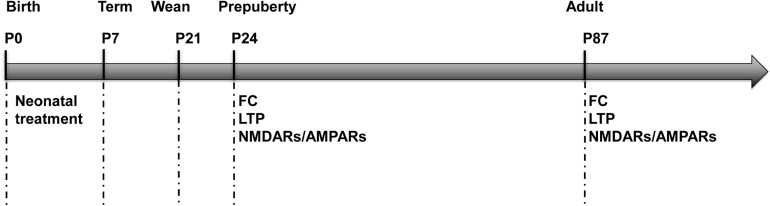
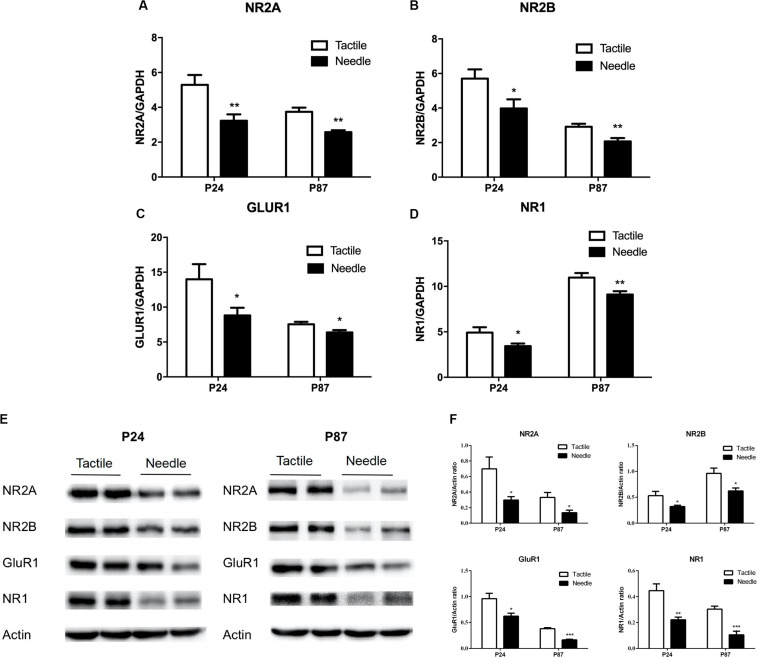
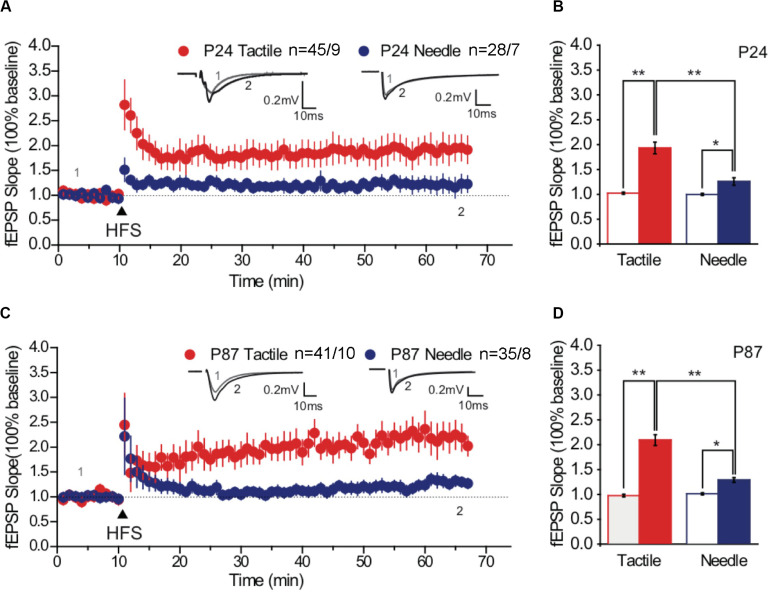
Preterm infants in neonatal intensive care units are inevitably subjected to numerous painful procedures. However, little is known about the consequences of early pain experience on fear memory formation later in life. We hypothesized that exposure to repetitive pain in early life triggered hippocampal synaptic plasticity and resulted in memory deficiency in prepubertal and adult rats. From the day of birth (P0) to postnatal day 7 (P7), neonatal male rat pups were randomly assigned to either needle pricks or tactile touches repetitively every 6 h. Trace fear conditioning was performed on rats on P24-P26 and P87-P89. On P24 and P87, rats were sacrificed for molecular and electrophysiological studies. On P24-26 and P87-89, rats that experienced neonatal needle treatment showed a significant reduction in freezing time in the contextual fear conditioning ( < 0.05) and trace fear conditioning tests ( < 0.05). Moreover, repetitive neonatal procedural pain caused a significant decrease in the magnitude of hippocampal long-term potentiation induced by high-frequency stimulation. Furthermore, rats that experienced neonatal needle treatment demonstrated sustained downregulation of NR1, NR2A, NR2B, and GluR1 expression in the hippocampus. Therefore, neonatal pain is related to deficits in hippocampus-related fear memory later in life and might be caused by impairments in hippocampal synaptic plasticity.
新生儿重症监护病房中的早产儿不可避免地要接受众多痛苦的操作。然而,对于早期疼痛经历对日后生活中恐惧记忆形成的影响却知之甚少。我们推测,早年暴露于重复性疼痛会引发海马体突触可塑性,并导致青春期前和成年大鼠出现记忆缺陷。从出生日(P0)到出生后第7天(P7),新生雄性大鼠幼崽每6小时被随机分配接受针刺或触觉抚摸。在P24 - P26和P87 - P89对大鼠进行痕迹恐惧条件反射实验。在P24和P87,处死大鼠进行分子和电生理研究。在P24 - 26和P87 - 89,经历过新生期针刺处理的大鼠在情境恐惧条件反射实验(<0.05)和痕迹恐惧条件反射实验(<0.05)中的僵住时间显著减少。此外,重复性新生期程序性疼痛导致高频刺激诱导的海马体长时程增强幅度显著降低。而且,经历过新生期针刺处理的大鼠海马体中NR1、NR2A、NR2B和GluR1的表达持续下调。因此,新生儿疼痛与日后生活中与海马体相关的恐惧记忆缺陷有关,可能是由海马体突触可塑性受损所致。