• 文献检索
  • 文档翻译
  • 深度研究
  • 学术资讯
  • Suppr Zotero 插件Zotero 插件
  • 邀请有礼
  • 套餐&价格
  • 历史记录
应用&插件
Suppr Zotero 插件Zotero 插件浏览器插件Mac 客户端Windows 客户端微信小程序
定价
高级版会员购买积分包购买API积分包
服务
文献检索文档翻译深度研究API 文档MCP 服务
关于我们
关于 Suppr公司介绍联系我们用户协议隐私条款
关注我们

Suppr 超能文献

核心技术专利:CN118964589B侵权必究
粤ICP备2023148730 号-1Suppr @ 2026

文献检索

告别复杂PubMed语法,用中文像聊天一样搜索,搜遍4000万医学文献。AI智能推荐,让科研检索更轻松。

立即免费搜索

文件翻译

保留排版,准确专业,支持PDF/Word/PPT等文件格式,支持 12+语言互译。

免费翻译文档

深度研究

AI帮你快速写综述,25分钟生成高质量综述,智能提取关键信息,辅助科研写作。

立即免费体验

传感器放置部位和受试者姿势对使用三轴加速度计测量呼吸频率的影响。

Influences of Sensor Placement Site and Subject Posture on Measurement of Respiratory Frequency Using Triaxial Accelerometers.

作者信息

Hughes Stephen, Liu Haipeng, Zheng Dingchang

机构信息

Medical Devices Research Group, Anglia Ruskin University, Chelmsford, United Kingdom.

Faculty Research Centre for Intelligent Healthcare, Coventry University, Coventry, United Kingdom.

出版信息

Front Physiol. 2020 Jul 9;11:823. doi: 10.3389/fphys.2020.00823. eCollection 2020.

DOI:10.3389/fphys.2020.00823
PMID:32733286
原文链接:https://pmc.ncbi.nlm.nih.gov/articles/PMC7363979/
Abstract

INTRODUCTION

Respiration frequency (RF) could be derived from the respiratory signals recorded by accelerometers which detect chest wall movements. The optimum direction of acceleration for accurate RF measurement is still uncertain. We aim to investigate the effect of measure site, posture, and direction of acceleration on the accuracy of accelerometer-based RF estimation.

METHODS

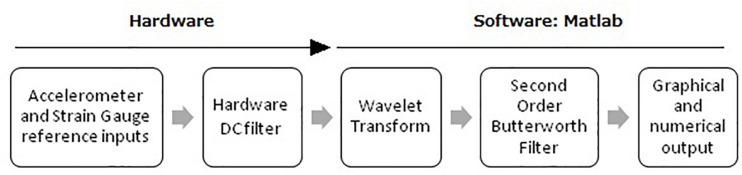
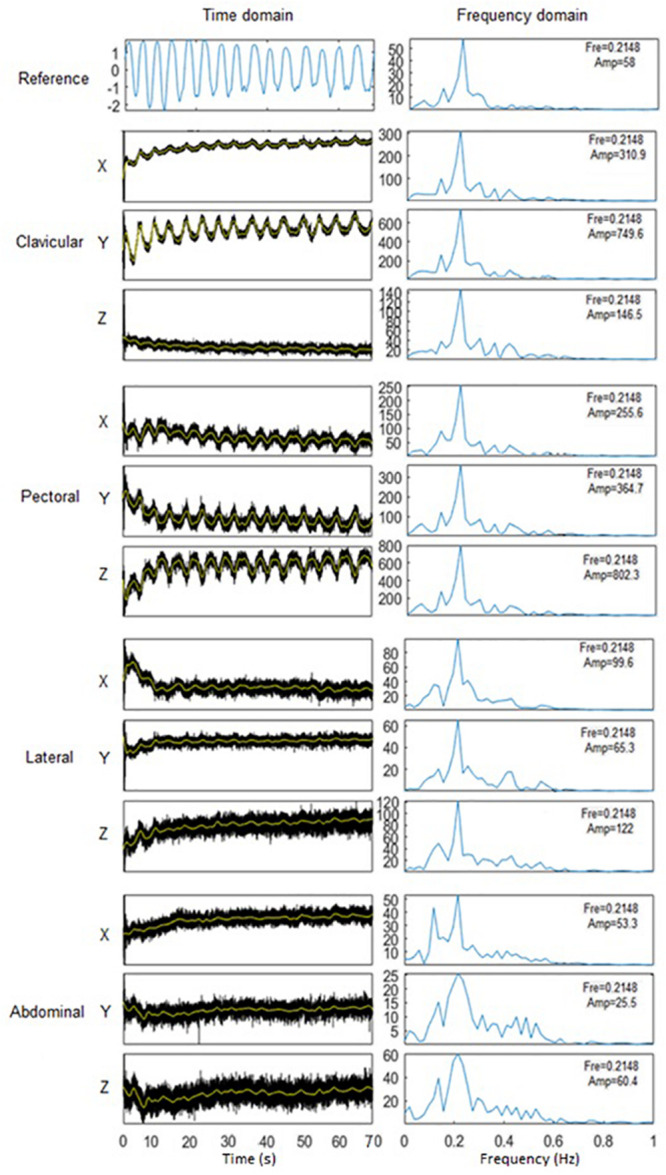
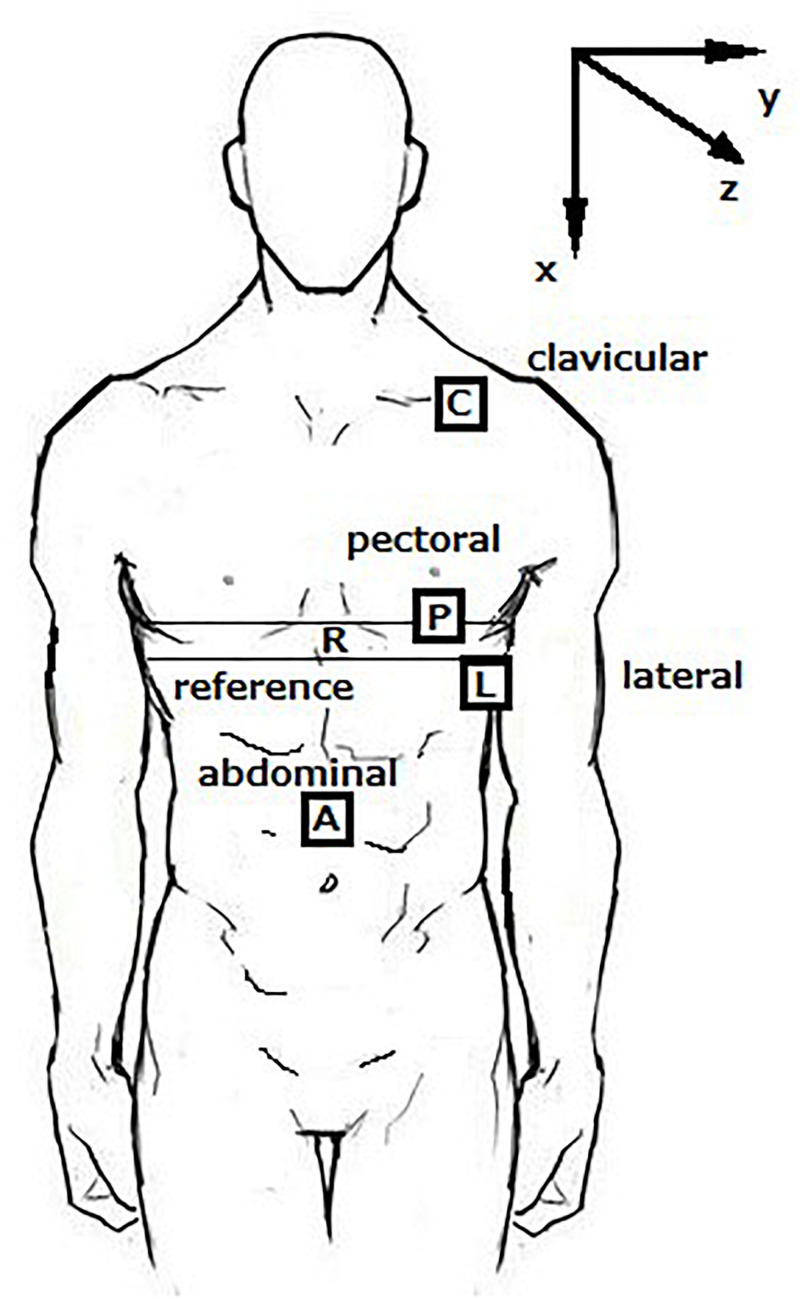
In supine and seated postures respectively, respiratory signals were measured from 34 healthy subjects in 70 s by triaxial accelerometers located at four sites on the body wall (over the clavicle, laterally on the chest wall, over the pectoral part of the anterior chest wall, on the abdomen in the midline at the umbilicus), with the reference respiratory signal simultaneously recorded by a strain gauge chest belt. RFs were extracted from the accelerometer and reference respiratory signals using wavelet transformation. To investigate the effect of measure site, posture, and direction of acceleration on the accuracy of accelerometer-based RF estimation, repeated measures multivariate analysis of variance, linear regression, Bland-Altman analysis, and Scheirer-Ray-Hare test were performed between reference and accelerometer-based RFs.

RESULTS

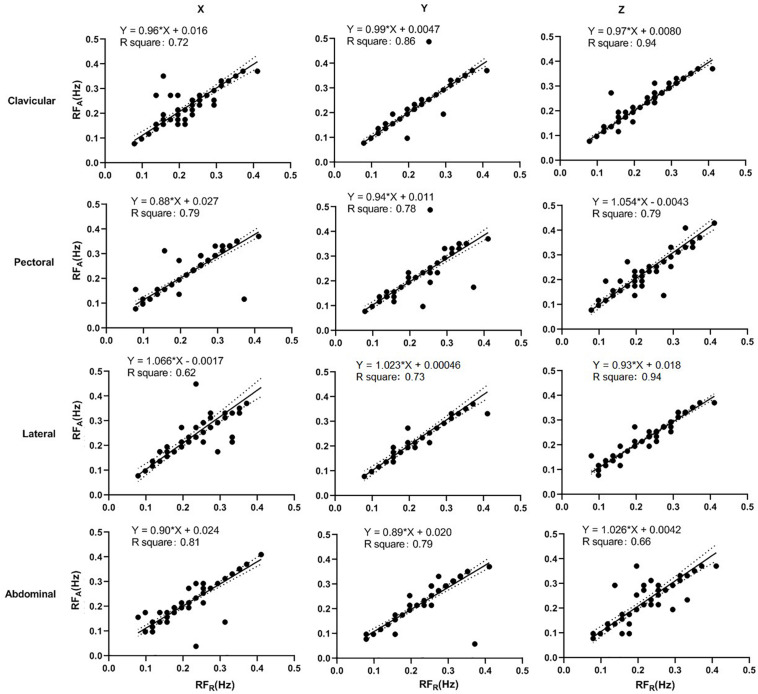
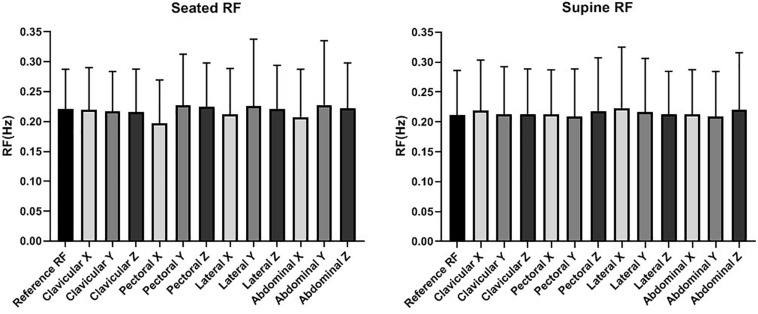
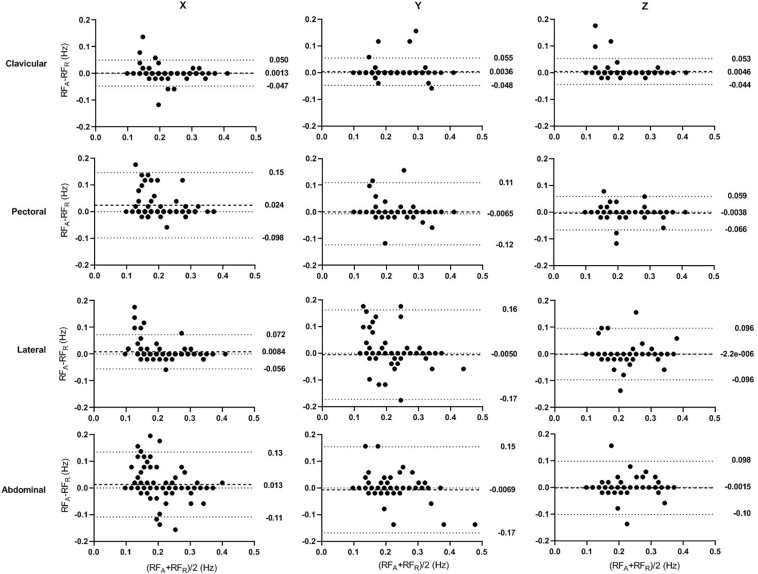
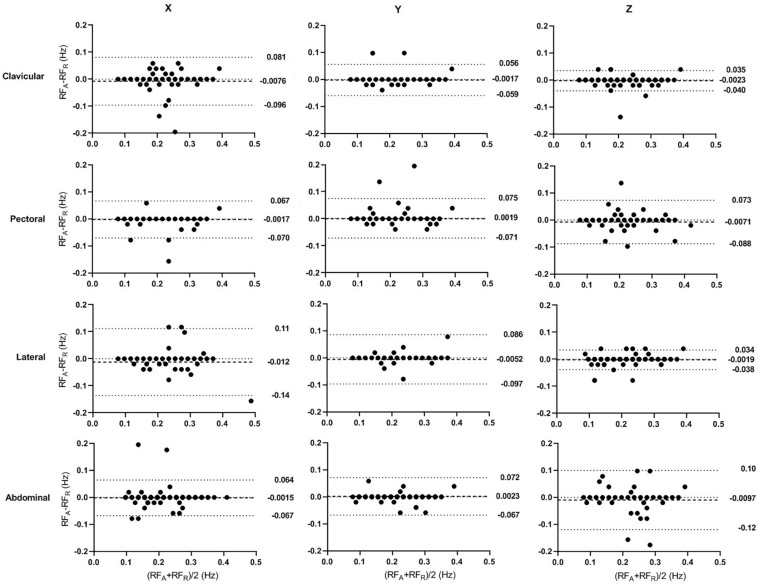
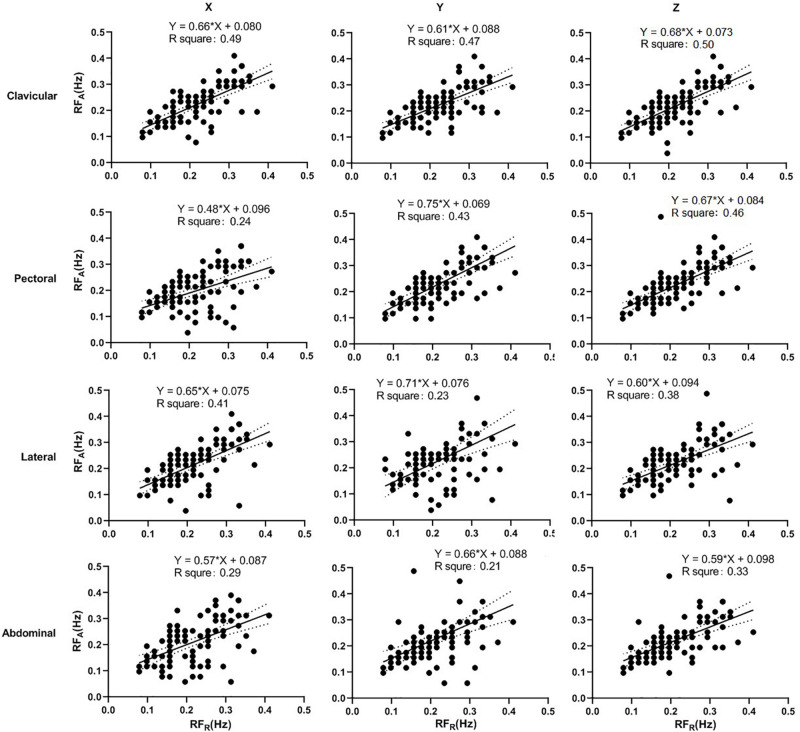
There was no significant difference in accelerometer-based RF estimation between seated and supine postures, among four accelerometer sites, or between seated or supine postures ( > 0.05 for all). The error of accelerometer-based RF estimation was less than 0.03 Hz (two breaths per minute) at any site or posture, but was significantly smaller in supine posture than in seated posture ( < 0.05), with narrower limits of agreement in Bland-Altman analysis and higher accuracy in linear regression ( > 0.61 vs. < 0.51).

CONCLUSION

Respiration frequency can be accurately measured from the acceleration of any direction using triaxial accelerometers placed at the clavicular, pectoral and lateral sites on the chest as well the mid abdominal site. More accurate RF estimation could be achieved in supine posture compared with seated posture.

摘要

引言

呼吸频率(RF)可从检测胸壁运动的加速度计记录的呼吸信号中得出。用于准确测量RF的最佳加速度方向仍不确定。我们旨在研究测量部位、姿势和加速度方向对基于加速度计的RF估计准确性的影响。

方法

分别在仰卧位和坐位时,通过位于胸壁四个部位(锁骨上方、胸壁外侧、前胸壁胸肌部位、脐部中线腹部)的三轴加速度计,对34名健康受试者进行70秒的呼吸信号测量,同时用应变片胸带记录参考呼吸信号。使用小波变换从加速度计和参考呼吸信号中提取RF。为了研究测量部位、姿势和加速度方向对基于加速度计的RF估计准确性的影响,在参考RF和基于加速度计的RF之间进行了重复测量多变量方差分析、线性回归、布兰德-奥特曼分析和谢勒-雷-黑尔检验。

结果

基于加速度计的RF估计在坐位和仰卧位之间、四个加速度计部位之间或坐位与仰卧位之间均无显著差异(所有P>0.05)。在任何部位或姿势下,基于加速度计的RF估计误差均小于0.03Hz(每分钟两口气),但仰卧位时的误差明显小于坐位(P<0.05),布兰德-奥特曼分析中的一致性界限更窄,线性回归中的准确性更高(r>0.61对r<0.51)。

结论

使用放置在胸部锁骨、胸肌和外侧部位以及腹部中线部位的三轴加速度计,可以从任何方向的加速度准确测量呼吸频率。与坐位相比,仰卧位可实现更准确的RF估计。
https://cdn.ncbi.nlm.nih.gov/pmc/blobs/7586/7363979/49019f153bb8/fphys-11-00823-g008.jpg
https://cdn.ncbi.nlm.nih.gov/pmc/blobs/7586/7363979/f47d3f8604c6/fphys-11-00823-g001.jpg
https://cdn.ncbi.nlm.nih.gov/pmc/blobs/7586/7363979/b7b71ee559bf/fphys-11-00823-g002.jpg
https://cdn.ncbi.nlm.nih.gov/pmc/blobs/7586/7363979/12765d187248/fphys-11-00823-g003.jpg
https://cdn.ncbi.nlm.nih.gov/pmc/blobs/7586/7363979/497d56baf6a3/fphys-11-00823-g004.jpg
https://cdn.ncbi.nlm.nih.gov/pmc/blobs/7586/7363979/f808bbae9418/fphys-11-00823-g005.jpg
https://cdn.ncbi.nlm.nih.gov/pmc/blobs/7586/7363979/538c9f522160/fphys-11-00823-g006.jpg
https://cdn.ncbi.nlm.nih.gov/pmc/blobs/7586/7363979/d5a35fd006e6/fphys-11-00823-g007.jpg
https://cdn.ncbi.nlm.nih.gov/pmc/blobs/7586/7363979/49019f153bb8/fphys-11-00823-g008.jpg
https://cdn.ncbi.nlm.nih.gov/pmc/blobs/7586/7363979/f47d3f8604c6/fphys-11-00823-g001.jpg
https://cdn.ncbi.nlm.nih.gov/pmc/blobs/7586/7363979/b7b71ee559bf/fphys-11-00823-g002.jpg
https://cdn.ncbi.nlm.nih.gov/pmc/blobs/7586/7363979/12765d187248/fphys-11-00823-g003.jpg
https://cdn.ncbi.nlm.nih.gov/pmc/blobs/7586/7363979/497d56baf6a3/fphys-11-00823-g004.jpg
https://cdn.ncbi.nlm.nih.gov/pmc/blobs/7586/7363979/f808bbae9418/fphys-11-00823-g005.jpg
https://cdn.ncbi.nlm.nih.gov/pmc/blobs/7586/7363979/538c9f522160/fphys-11-00823-g006.jpg
https://cdn.ncbi.nlm.nih.gov/pmc/blobs/7586/7363979/d5a35fd006e6/fphys-11-00823-g007.jpg
https://cdn.ncbi.nlm.nih.gov/pmc/blobs/7586/7363979/49019f153bb8/fphys-11-00823-g008.jpg

相似文献

1
Influences of Sensor Placement Site and Subject Posture on Measurement of Respiratory Frequency Using Triaxial Accelerometers.传感器放置部位和受试者姿势对使用三轴加速度计测量呼吸频率的影响。
Front Physiol. 2020 Jul 9;11:823. doi: 10.3389/fphys.2020.00823. eCollection 2020.
2
Toward Accurate Extraction of Respiratory Frequency From the Photoplethysmogram: Effect of Measurement Site.迈向从光电容积脉搏波中准确提取呼吸频率:测量部位的影响。
Front Physiol. 2019 Jun 18;10:732. doi: 10.3389/fphys.2019.00732. eCollection 2019.
3
Comparison of 7 Different Sensors for Detecting Low Respiratory Rates Using a Single Breath Detection Algorithm in Nonintubated, Sedated Volunteers.比较使用单呼吸检测算法在非插管、镇静志愿者中检测低呼吸率的 7 种不同传感器。
Anesth Analg. 2019 Aug;129(2):399-408. doi: 10.1213/ANE.0000000000003793.
4
Estimation of respiratory rate and effort from a chest-worn accelerometer using constrained and recursive principal component analysis.使用约束和递归主成分分析从胸部佩戴的加速度计估计呼吸率和呼吸努力度。
Physiol Meas. 2021 May 11;42(4). doi: 10.1088/1361-6579/abf01f.
5
Respiration Rate Estimation Based on Independent Component Analysis of Accelerometer Data: Pilot Single-Arm Intervention Study.基于加速度计数据独立分量分析的呼吸率估计:初步单臂干预研究。
JMIR Mhealth Uhealth. 2020 Aug 10;8(8):e17803. doi: 10.2196/17803.
6
Comparison of different modulations of photoplethysmography in extracting respiratory rate: from a physiological perspective.从生理学角度比较光电容积脉搏波不同调制方式提取呼吸率的效果。
Physiol Meas. 2020 Oct 5;41(9):094001. doi: 10.1088/1361-6579/abaaf0.
7
Effect of posture on lung and regional chest wall mechanics.姿势对肺部及局部胸壁力学的影响。
Anesthesiology. 1993 Feb;78(2):251-9. doi: 10.1097/00000542-199302000-00007.
8
Respiratory signal derived from the smartphone built-in accelerometer during a Respiratory Load Protocol.在呼吸负荷试验期间,从智能手机内置加速度计获取的呼吸信号。
Annu Int Conf IEEE Eng Med Biol Soc. 2015;2015:6768-71. doi: 10.1109/EMBC.2015.7319947.
9
Reliable recognition of lying, sitting, and standing with a hip-worn accelerometer.使用佩戴在髋部的加速度计可靠地识别躺、坐和站。
Scand J Med Sci Sports. 2018 Mar;28(3):1092-1102. doi: 10.1111/sms.13017. Epub 2017 Dec 13.
10
Posture and movement classification: the comparison of tri-axial accelerometer numbers and anatomical placement.姿势与运动分类:三轴加速度计数量及解剖学放置的比较
J Biomech Eng. 2014 May;136(5):051003. doi: 10.1115/1.4026230.

引用本文的文献

1
Prospective observational study of 2 wearable strain sensors for measuring the respiratory rate.2 款可穿戴应变传感器测量呼吸频率的前瞻性观察研究。
Medicine (Baltimore). 2024 Jul 19;103(29):e38818. doi: 10.1097/MD.0000000000038818.
2
NAPping PAnts (NAPPA): An open wearable solution for monitoring Infant's sleeping rhythms, respiration and posture.用于监测婴儿睡眠节律、呼吸和姿势的开放式可穿戴解决方案——NAPping PAnts(新生儿活动与姿势监测裤)
Heliyon. 2024 Jun 21;10(13):e33295. doi: 10.1016/j.heliyon.2024.e33295. eCollection 2024 Jul 15.
3
An Inertial-Based Wearable System for Monitoring Vital Signs during Sleep.

本文引用的文献

1
The effects of hypoxia and fatigue on skeletal muscle electromechanical delay.缺氧和疲劳对骨骼肌机电延迟的影响。
Exp Physiol. 2020 May;105(5):842-851. doi: 10.1113/EP088180. Epub 2020 Apr 1.
2
Clinical evaluation of stretchable and wearable inkjet-printed strain gauge sensor for respiratory rate monitoring at different measurements locations.用于不同测量位置的呼吸率监测的可拉伸和可穿戴喷墨打印应变计传感器的临床评估。
J Clin Monit Comput. 2021 May;35(3):453-462. doi: 10.1007/s10877-020-00481-3. Epub 2020 Feb 22.
3
Correlational data concerning body centre of mass acceleration, muscle activity, and forces exerted during a suspended lunge under different stability conditions in high-standard track and field athletes.
基于惯性的可穿戴系统,用于监测睡眠期间的生命体征。
Sensors (Basel). 2024 Jun 26;24(13):4139. doi: 10.3390/s24134139.
4
Flexible Textile Sensors-Based Smart T-Shirt for Respiratory Monitoring: Design, Development, and Preliminary Validation.基于柔性纺织传感器的智能 T 恤用于呼吸监测:设计、开发和初步验证。
Sensors (Basel). 2024 Mar 21;24(6):2018. doi: 10.3390/s24062018.
5
Real-Time Evaluation of Time-Domain Pulse Rate Variability Parameters in Different Postures and Breathing Patterns Using Wireless Photoplethysmography Sensor: Towards Remote Healthcare in Low-Resource Communities.利用无线光体积描记传感器实时评估不同体位和呼吸模式下的时域心率变异性参数:迈向低资源社区的远程医疗保健。
Sensors (Basel). 2023 Apr 24;23(9):4246. doi: 10.3390/s23094246.
6
A Differential Inertial Wearable Device for Breathing Parameter Detection: Hardware and Firmware Development, Experimental Characterization.一种用于呼吸参数检测的差分惯性可穿戴设备:硬件和固件开发、实验特性描述。
Sensors (Basel). 2022 Dec 16;22(24):9953. doi: 10.3390/s22249953.
7
Wearable Sensors for Remote Health Monitoring: Potential Applications for Early Diagnosis of Covid-19.用于远程健康监测的可穿戴传感器:COVID-19早期诊断的潜在应用
Adv Mater Technol. 2022 Jan;7(1):2100545. doi: 10.1002/admt.202100545. Epub 2021 Sep 3.
8
Assessing the Transferability of Physical Activity Type Detection Models: Influence of Age Group Is Underappreciated.评估身体活动类型检测模型的可转移性:年龄组的影响未得到充分重视。
Front Physiol. 2021 Oct 22;12:738939. doi: 10.3389/fphys.2021.738939. eCollection 2021.
关于高水平田径运动员在不同稳定性条件下进行悬垂弓步动作时身体质心加速度、肌肉活动和施加力的相关数据。
Data Brief. 2019 Nov 30;28:104912. doi: 10.1016/j.dib.2019.104912. eCollection 2020 Feb.
4
Toward Accurate Extraction of Respiratory Frequency From the Photoplethysmogram: Effect of Measurement Site.迈向从光电容积脉搏波中准确提取呼吸频率:测量部位的影响。
Front Physiol. 2019 Jun 18;10:732. doi: 10.3389/fphys.2019.00732. eCollection 2019.
5
Recent development of respiratory rate measurement technologies.呼吸率测量技术的最新发展。
Physiol Meas. 2019 Aug 2;40(7):07TR01. doi: 10.1088/1361-6579/ab299e.
6
Respiratory Waveform Estimation From Multiple Accelerometers: An Optimal Sensor Number and Placement Analysis.从多个加速度计估算呼吸波形:最佳传感器数量和位置分析。
IEEE J Biomed Health Inform. 2019 Jul;23(4):1507-1515. doi: 10.1109/JBHI.2018.2867727. Epub 2018 Aug 29.
7
Is everyone really breathing 20 times a minute? Assessing epidemiology and variation in recorded respiratory rate in hospitalised adults.每个人每分钟真的呼吸 20 次吗?评估住院成年人记录的呼吸频率的流行病学和变化。
BMJ Qual Saf. 2017 Oct;26(10):832-836. doi: 10.1136/bmjqs-2017-006671. Epub 2017 Jun 26.
8
Measuring Children's Physical Activity: Compliance Using Skin-Taped Accelerometers.测量儿童的身体活动:使用皮肤粘贴式加速度计的依从性
Med Sci Sports Exerc. 2017 Jun;49(6):1261-1269. doi: 10.1249/MSS.0000000000001222.
9
Respiratory rates measured by a standardised clinical approach, ward staff, and a wireless device.通过标准化临床方法、病房工作人员以及无线设备测量的呼吸频率。
Acta Anaesthesiol Scand. 2016 Nov;60(10):1444-1452. doi: 10.1111/aas.12784. Epub 2016 Sep 4.
10
Rapid and stable measurement of respiratory rate from Doppler radar signals using time domain autocorrelation model.使用时域自相关模型从多普勒雷达信号中快速稳定地测量呼吸率。
Annu Int Conf IEEE Eng Med Biol Soc. 2015;2015:5985-8. doi: 10.1109/EMBC.2015.7319755.