Journiac Jonathan, Vioulac Christel, Jacob Anne, Escarnot Coline, Untas Aurélie
Université de Paris, LPPS, Boulogne-Billancourt, France.
Front Psychol. 2020 Jul 7;11:1119. doi: 10.3389/fpsyg.2020.01119. eCollection 2020.
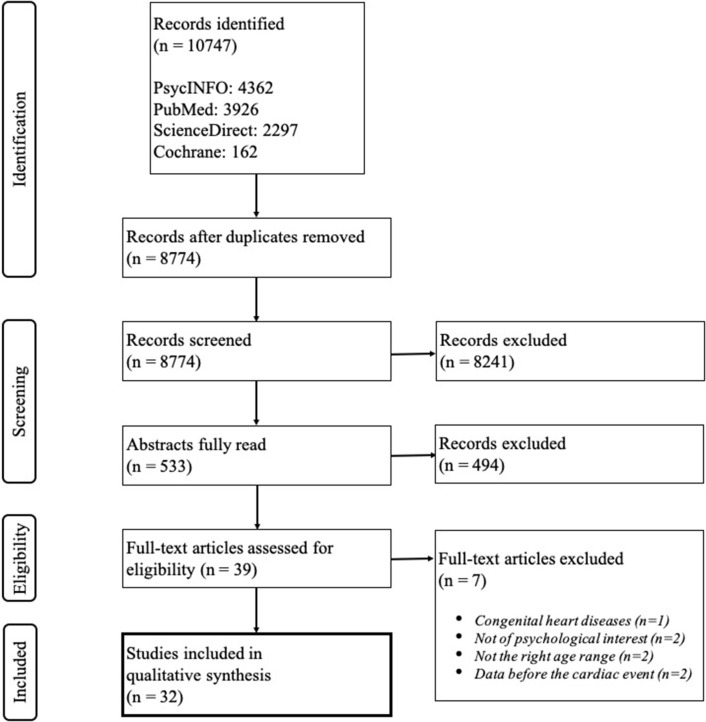
Studies interested in patients coping with a cardiac illness usually focus on children, teenagers, and adults above the age of 55. Apart from the field of congenital heart diseases, there is a general lack of literature regarding young adult cardiac patients (18-55 years old) who seem to cope with psychosocial issues. Therefore, the objective of this paper was to gather all the research carried out concerning the psychological experiences of young adult cardiac patients. A comprehensive, systematic review was conducted on quantitative, qualitative, and mixed-method studies in PsycINFO, PubMed, ScienceDirect, and Cochrane Library databases. Out of the 10,747 articles found, 32 were included. While we aimed to include many cardiac diseases, coronary patients dominated the data. Five main themes emerged: emotional states (depression, anxiety, emotional distress, and stress), quality of life (health-related quality of life, physical functioning, and sexuality), adjusting to the medical environment (coping with the disease, health behavior change, financial barriers, and interactions with medical professionals), social life (social support and work), and identity (parenthood, new challenges, and new meanings). The results highlighted that their levels of depression, anxiety, stress, and quality of life were sometimes worse than in the general population and than in older and younger patients coping with a cardiac illness. Social isolation, identity changes, work, and parenthood were the specific challenges that this population had to face. Furthermore, young adult cardiac patients showed worse health behavior profiles than the general population and felt that they lacked information from professionals, especially regarding sexuality. Compared to men, women had worse psychosocial outcomes, especially regarding depression, stress, emotional distress, and quality of life. Young adult cardiac patients are to be considered with their own identity and challenges. They may be in need of specific interventions, some dedicated to women, and better communication is necessary with their families and professional caregivers so as to improve the patient's mental health, quality of life, coping skills, and adherence.
关注心脏病患者应对情况的研究通常聚焦于儿童、青少年以及55岁以上的成年人。除了先天性心脏病领域,对于似乎要应对心理社会问题的年轻成年心脏病患者(18至55岁),普遍缺乏相关文献。因此,本文的目的是收集所有关于年轻成年心脏病患者心理体验的研究。我们在PsycINFO、PubMed、ScienceDirect和Cochrane图书馆数据库中对定量、定性和混合方法研究进行了全面、系统的综述。在找到的10747篇文章中,有32篇被纳入。虽然我们旨在纳入多种心脏病,但数据中冠心病患者占主导。出现了五个主要主题:情绪状态(抑郁、焦虑、情绪困扰和压力)、生活质量(与健康相关的生活质量、身体功能和性功能)、适应医疗环境(应对疾病、健康行为改变、经济障碍以及与医疗专业人员的互动)、社交生活(社会支持和工作)以及身份认同(为人父母、新挑战和新意义)。结果表明,他们的抑郁、焦虑、压力水平和生活质量有时比普通人群以及应对心脏病的老年和年轻患者更差。社会隔离、身份变化、工作和为人父母是这一人群必须面对的特定挑战。此外,年轻成年心脏病患者的健康行为状况比普通人群更差,并且觉得他们缺乏来自专业人员的信息,尤其是关于性方面的信息。与男性相比,女性的心理社会结果更差,尤其是在抑郁、压力、情绪困扰和生活质量方面。年轻成年心脏病患者应被视为有其自身身份认同和挑战的群体。他们可能需要特定的干预措施,有些是专门针对女性的,并且有必要与他们的家人和专业护理人员进行更好的沟通,以改善患者的心理健康、生活质量、应对技能和依从性。