Hou Zheng-Kun, Hu Wen, Liu Feng-Bin, Liang Ying-Yu, Huang Zhong-Yu, Huang Zhi-Bang
Department of Gastroenterology, First Affiliated Hospital, Guangzhou University of Chinese Medicine, Guangzhou 510405, Guangdong, China.
Intensive Care Unit, Huanggang Hospital of Traditional Chinese Medicine, Huanggang 438000, Hubei, China.
Evid Based Complement Alternat Med. 2020 Jul 14;2020:8643746. doi: 10.1155/2020/8643746. eCollection 2020.
Chinese Medicinal Properties (CMP) play a vital role in theoretical research and clinical practice. However, the traditional CMP system is subjective, qualitative, fixed, inconsistent, and obscured. Nowadays, quantifying CMP research achieved a notable progress. This study aims to review and reflect the relevance between qualitative CMP and quantitative material components.
A raw literature search was performed firstly in CNKI and Pubmed database to get a rough idea on the general advances in measuring CMP. Then, a strict literature search and data extraction from two dependent research studies were performed to analyze the relevance and discrimination between CMP and material components.
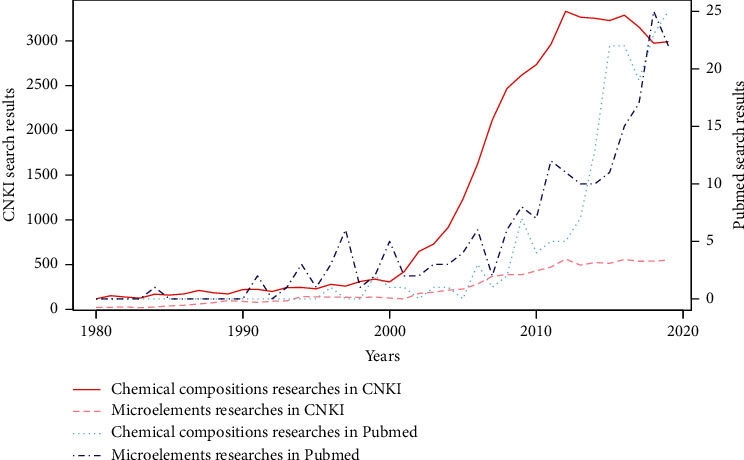
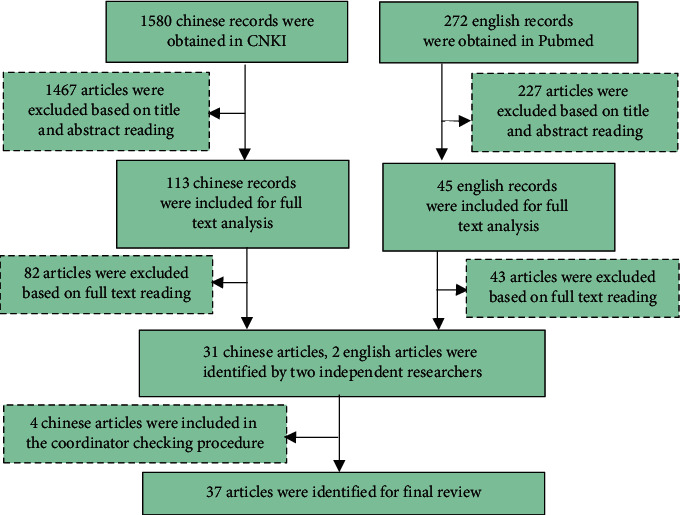
The quantitative CMP research mainly focused on the microelements and chemical compositions. The largest microelements research listed 747 Chinese Materia Medica (CMM) (6780 flavors) and 120,000 element data. The measurement of chemical composition of CMM has risen rapidly in the 1990s and continues till the present. Thirty-seven articles were finally identified for the relevance analysis of CMP and material components. Of these, 18 and 19 articles correspondingly focused on the chemical compositions and microelements, and 26 and 11 articles correspondingly focused on their correlation and discrimination relationship. The most commonly used method for correlation analysis is intuitive analysis. The support vector machine maybe highly efficient and would act as the preferred method in discriminant analysis. Twelve (67%) and 5 (26%) articles' data came from the literature search in chemical compositions and microelement research studies. Four studies indicated that the research objects are the basic substances and material basis of CMP, 15 articles claimed that the chemical compositions were significantly related to CMP, 12 research studies concluded that the regularity and causality were identified between the research objects and CMP, and 9 research studies successfully established discriminant models for CMP basing on the detected substances.
The relevance research between qualitative CMP and quantitative material components achieved a positive progress, though it is weak and defective. Standardizing the qualitative CMP system, establishing series comprehensive databases for the material components, innovating statistical and data mining methods, and integrating doctors' experiences are important and feasible for future research.
中药药性在理论研究和临床实践中发挥着至关重要的作用。然而,传统的中药药性体系具有主观性、定性性、固定性、不一致性和模糊性。如今,中药药性量化研究取得了显著进展。本研究旨在回顾和反思定性中药药性与定量物质成分之间的相关性。
首先在知网和PubMed数据库中进行文献检索,以大致了解中药药性测定的总体进展。然后,从两项相关研究中进行严格的文献检索和数据提取,以分析中药药性与物质成分之间的相关性和判别性。
中药药性量化研究主要集中在微量元素和化学成分方面。规模最大的微量元素研究列出了747味中药(6780种药味)和120000条元素数据。中药化学成分的测定在20世纪90年代迅速兴起并持续至今。最终确定了37篇文章用于中药药性与物质成分的相关性分析。其中,18篇和19篇文章分别关注化学成分和微量元素,26篇和11篇文章分别关注它们的相关性和判别关系。相关性分析最常用的方法是直观分析。支持向量机可能效率很高,将成为判别分析中的首选方法。12篇(67%)和5篇(26%)文章的数据分别来自化学成分和微量元素研究的文献检索。4项研究表明研究对象是中药药性的基本物质和物质基础,15篇文章称化学成分与中药药性显著相关,12项研究得出研究对象与中药药性之间存在规律性和因果关系的结论,9项研究基于检测到的物质成功建立了中药药性判别模型。
定性中药药性与定量物质成分之间的相关性研究取得了积极进展,尽管仍较为薄弱且存在缺陷。规范定性中药药性体系、建立物质成分系列综合数据库、创新统计和数据挖掘方法以及整合医生经验对未来研究具有重要意义且切实可行。