Department of Speech, Language, and Hearing Sciences, Purdue University, West Lafayette, Indiana, United States of America.
Department of Comparative Pathobiology, Purdue University, West Lafayette, Indiana, United States of America.
PLoS One. 2020 Jul 31;15(7):e0236348. doi: 10.1371/journal.pone.0236348. eCollection 2020.
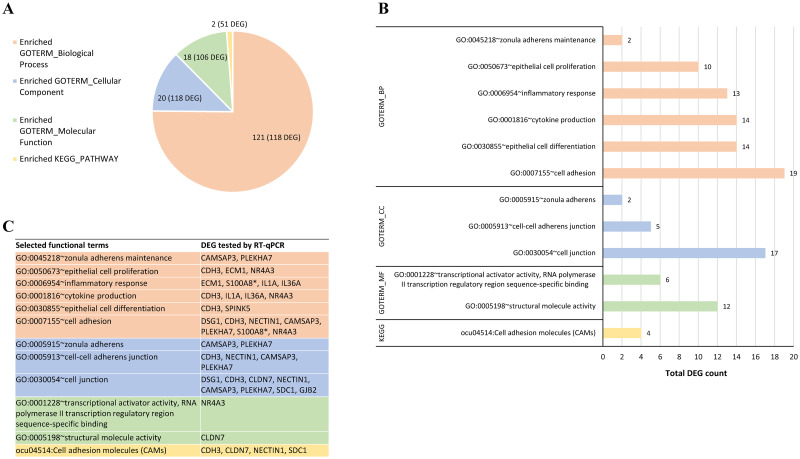
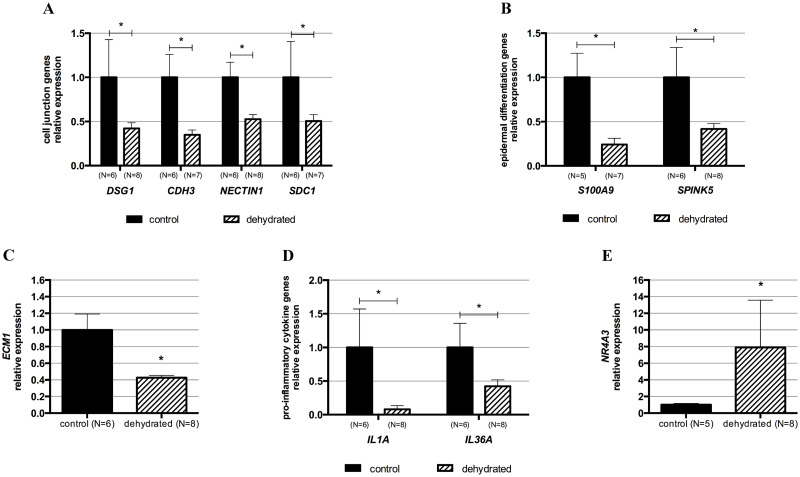
Vocal folds are a viscoelastic multilayered structure responsible for voice production. Vocal fold epithelial damage may weaken the protection of deeper layers of lamina propria and thyroarytenoid muscle and impair voice production. Systemic dehydration can adversely affect vocal function by creating suboptimal biomechanical conditions for vocal fold vibration. However, the molecular pathobiology of systemically dehydrated vocal folds is poorly understood. We used an in vivo rabbit model to investigate the complete gene expression profile of systemically dehydrated vocal folds. The RNA-Seq based transcriptome revealed 203 differentially expressed (DE) vocal fold genes due to systemic dehydration. Interestingly, function enrichment analysis showed downregulation of genes involved in cell adhesion, cell junction, inflammation, and upregulation of genes involved in cell proliferation. RT-qPCR validation was performed for a subset of DE genes and confirmed the downregulation of DSG1, CDH3, NECTIN1, SDC1, S100A9, SPINK5, ECM1, IL1A, and IL36A genes. In addition, the upregulation of the transcription factor NR4A3 gene involved in epithelial cell proliferation was validated. Taken together, these results suggest an alteration of the vocal fold epithelial barrier independent of inflammation, which could indicate a disruption and remodeling of the epithelial barrier integrity. This transcriptome provides a first global picture of the molecular changes in vocal fold tissue in response to systemic dehydration. The alterations observed at the transcriptional level help to understand the pathobiology of dehydration in voice function and highlight the benefits of hydration in voice therapy.
声带是一种黏弹的多层结构,负责发声。声带上皮损伤可能会削弱固有层和甲杓肌深层的保护作用,从而影响发声。全身脱水会通过为声带振动创造不理想的生物力学条件,对发声功能产生不利影响。然而,全身脱水声带的分子病理生物学尚不清楚。我们使用体内兔模型研究了全身脱水声带的完整基因表达谱。基于 RNA-Seq 的转录组揭示了 203 个因全身脱水而差异表达(DE)的声带基因。有趣的是,功能富集分析显示,参与细胞黏附、细胞连接、炎症的基因下调,而参与细胞增殖的基因上调。对部分 DE 基因进行了 RT-qPCR 验证,证实了 DSG1、CDH3、NECTIN1、SDC1、S100A9、SPINK5、ECM1、IL1A 和 IL36A 基因的下调。此外,还验证了参与上皮细胞增殖的转录因子 NR4A3 基因的上调。综上所述,这些结果表明,声带上皮屏障的改变独立于炎症,这可能表明上皮屏障完整性的破坏和重塑。该转录组提供了声带组织对全身脱水反应的分子变化的初步全貌。观察到的转录水平的改变有助于理解脱水对发声功能的病理生物学,并强调了在嗓音治疗中保持身体水分的益处。