Institute for Neuroscience, University of Texas at Austin, United States; Center for Learning and Memory, Department of Neuroscience, University of Texas at Austin, United States.
Department of Psychiatry, Dell Medical School, University of Texas at Austin, United States.
Neuropsychologia. 2020 Oct;147:107573. doi: 10.1016/j.neuropsychologia.2020.107573. Epub 2020 Jul 29.
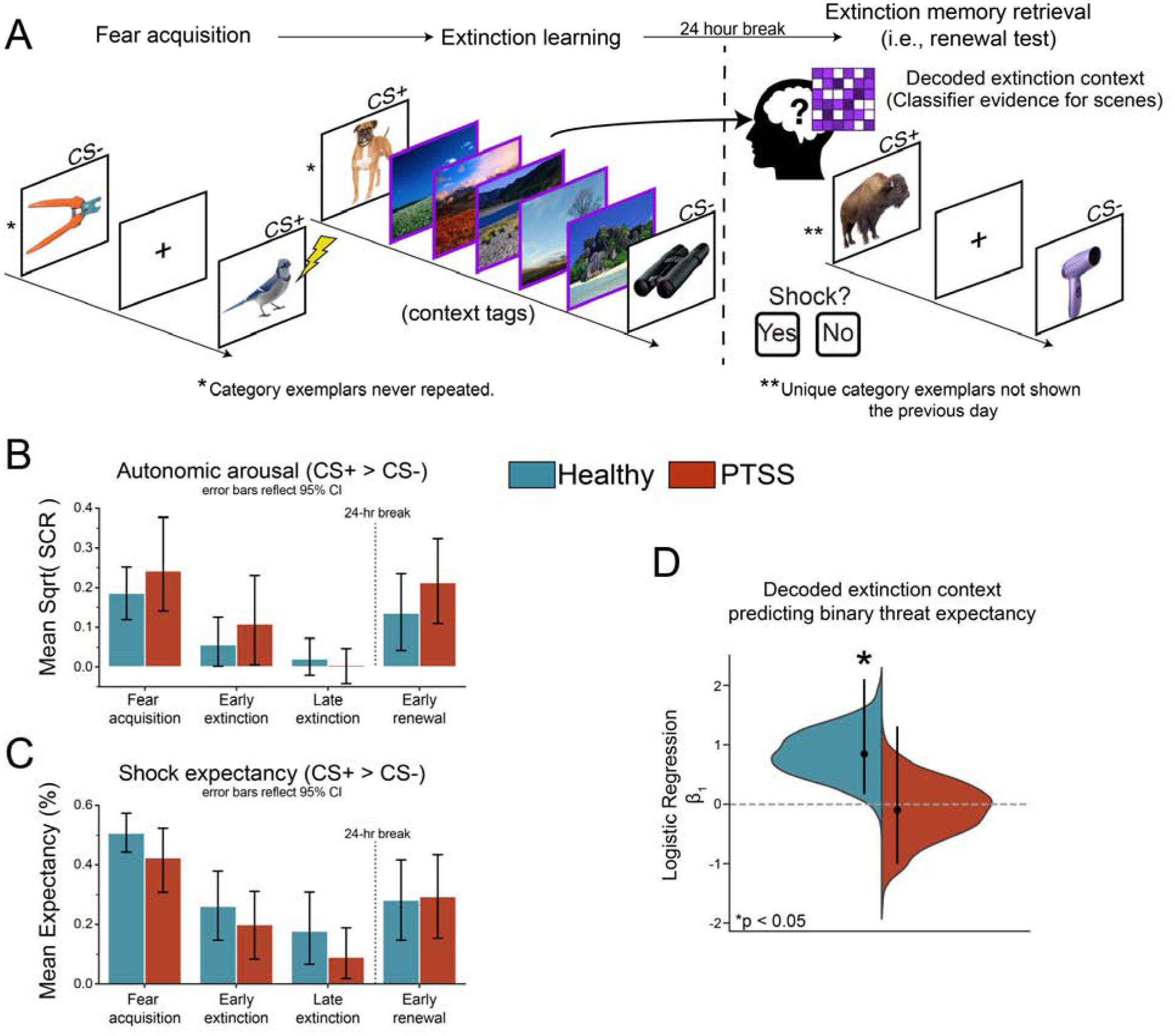
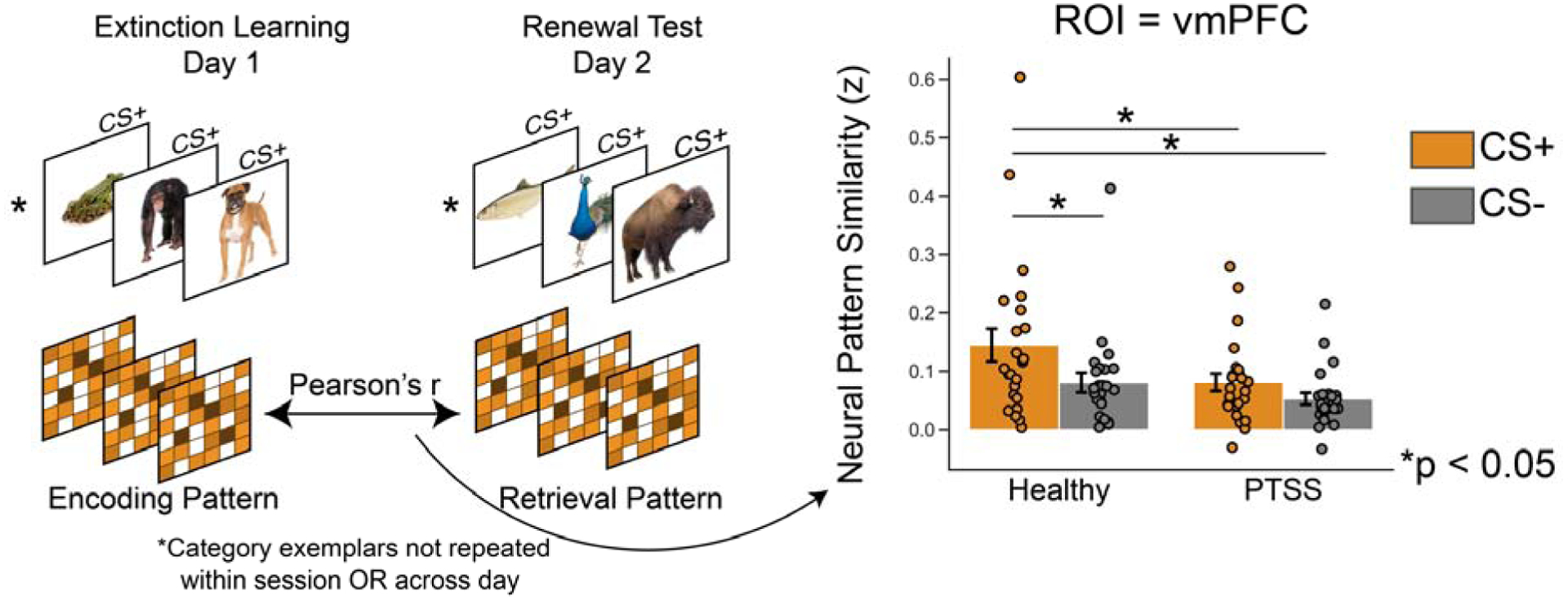
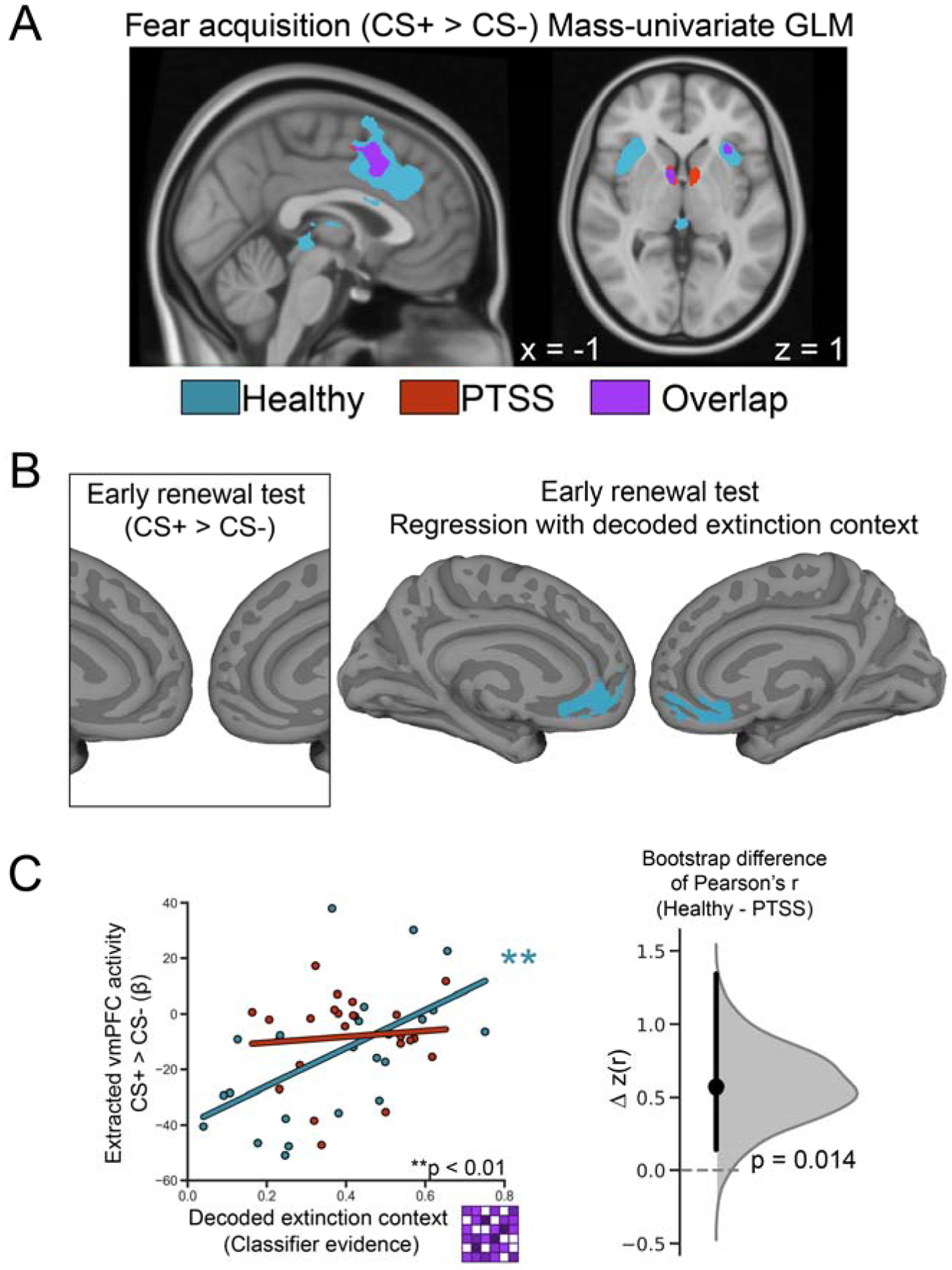
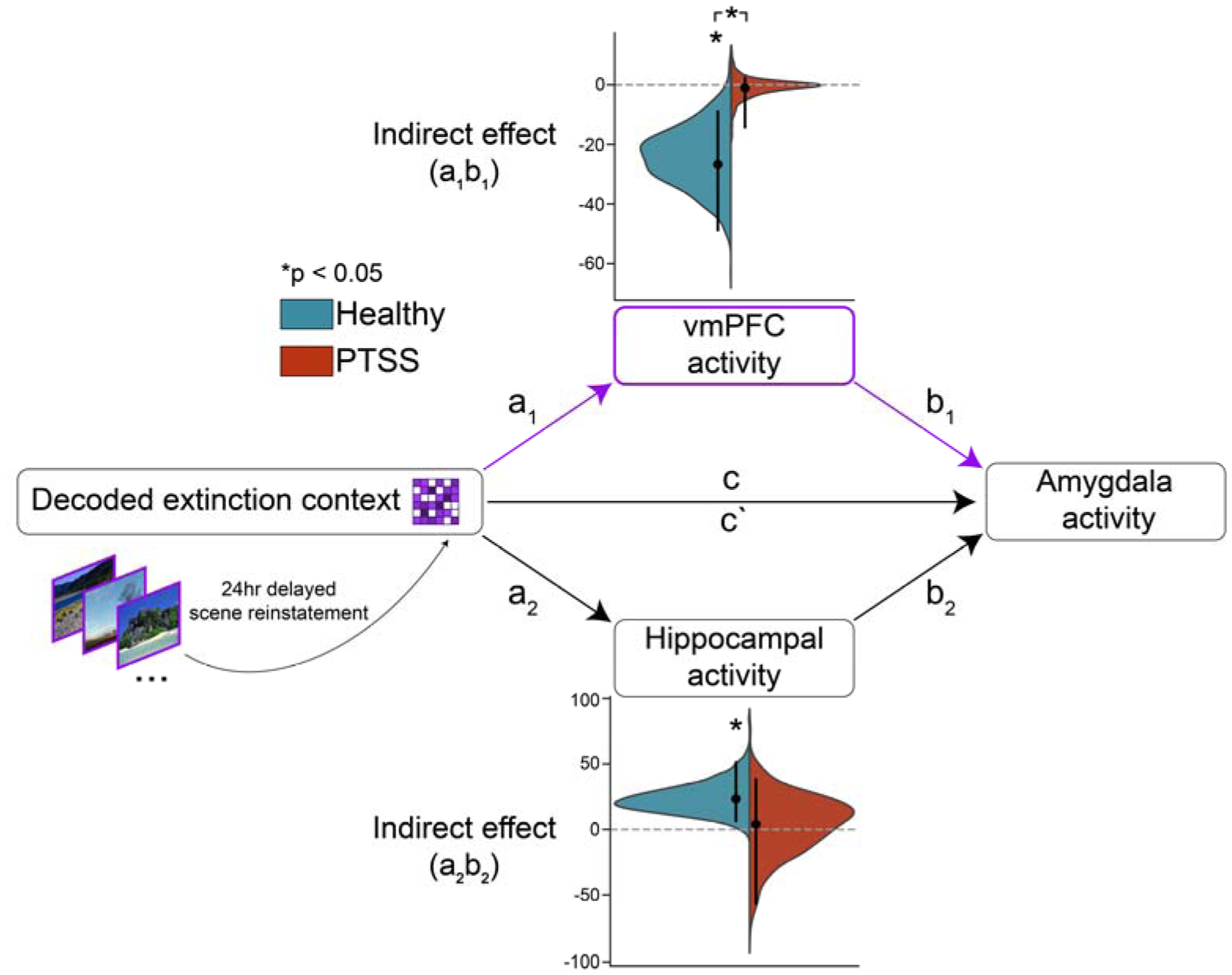
For episodic memories, reinstating the mental context of a past experience improves retrieval of memories formed during that experience. Does context reinstatement serve a similar role for implicit, associative memories such as fear and extinction? Here, we used a fear extinction paradigm to investigate whether the retrieval of extinction (safety) memories is associated with reactivation of the mental context from extinction memory formation. In a two-day Pavlovian conditioning, extinction, and renewal protocol, we collected functional MRI data while healthy adults and adults with PTSD symptoms learned that conditioned stimuli (CSs) signaled threat through association with an electrical shock. Following acquisition, conceptually related exemplars from the CS category no longer signaled threat (i.e., extinction). Critically, during extinction only, task-irrelevant stimuli were presented between each CS trial to serve as "context tags" for subsequent identification of the possible reinstatement of this extinction context during a test of fear renewal the next day. We found that healthy adults exhibited extinction context reinstatement, as measured via multivariate pattern analysis of fMRI data, in the medial temporal lobe that related to behavioral performance, such that greater reinstatement predicted CSs being rated as safe instead of threatening. Moreover, context reinstatement positively correlated with univariate activity in the ventromedial prefrontal cortex and hippocampus, regions which are thought to be important for extinction learning. These relationships were not observed in the PTSD symptom group. These findings provide new evidence of a contextual reinstatement mechanism that helps resolve competition between the retrieval of opposing associative memories of threat and safety in the healthy adult brain that is dysregulated in PTSD.
对于情景记忆,恢复过去经历的心理背景可以改善对该经历中形成的记忆的检索。对于隐性联想记忆,如恐惧和遗忘,背景恢复是否起到类似的作用?在这里,我们使用恐惧遗忘范式来研究遗忘(安全)记忆的检索是否与从遗忘记忆形成中重新激活心理背景有关。在为期两天的条件反射、遗忘和更新协议中,我们在健康成年人和 PTSD 症状成年人学习条件刺激(CS)通过与电击相关联来表示威胁时收集了功能磁共振成像数据。在获得后,CS 类别中的概念相关示例不再表示威胁(即,遗忘)。至关重要的是,仅在遗忘期间,在每个 CS 试验之间呈现任务无关的刺激,作为在第二天的恐惧更新测试中识别这种遗忘背景可能恢复的“上下文标记”。我们发现,健康成年人在中颞叶中表现出遗忘背景的恢复,这可以通过 fMRI 数据的多元模式分析来衡量,这与行为表现有关,即,更大的恢复预示着 CS 被评为安全而不是威胁。此外,背景恢复与腹侧前额叶皮层和海马体的单变量活动呈正相关,这些区域被认为对遗忘学习很重要。在 PTSD 症状组中没有观察到这些关系。这些发现为一种背景恢复机制提供了新的证据,该机制有助于解决健康成年人大脑中威胁和安全的相反联想记忆检索之间的竞争,而这种竞争在 PTSD 中是失调的。