Primary Care Health Sciences, University of Oxford, Oxford, UK
Adult Intensive Care Unit, John Radcliffe Hospital, Oxford, UK.
Heart. 2020 Oct;106(19):1503-1511. doi: 10.1136/heartjnl-2020-317393. Epub 2020 Jul 31.
There is uncertainty about the associations of angiotensive enzyme (ACE) inhibitor and angiotensin receptor blocker (ARB) drugs with COVID-19 disease. We studied whether patients prescribed these drugs had altered risks of contracting severe COVID-19 disease and receiving associated intensive care unit (ICU) admission.
This was a prospective cohort study using routinely collected data from 1205 general practices in England with 8.28 million participants aged 20-99 years. We used Cox proportional hazards models to derive adjusted HRs for exposure to ACE inhibitor and ARB drugs adjusted for sociodemographic factors, concurrent medications and geographical region. The primary outcomes were: (a) COVID-19 RT-PCR diagnosed disease and (b) COVID-19 disease resulting in ICU care.
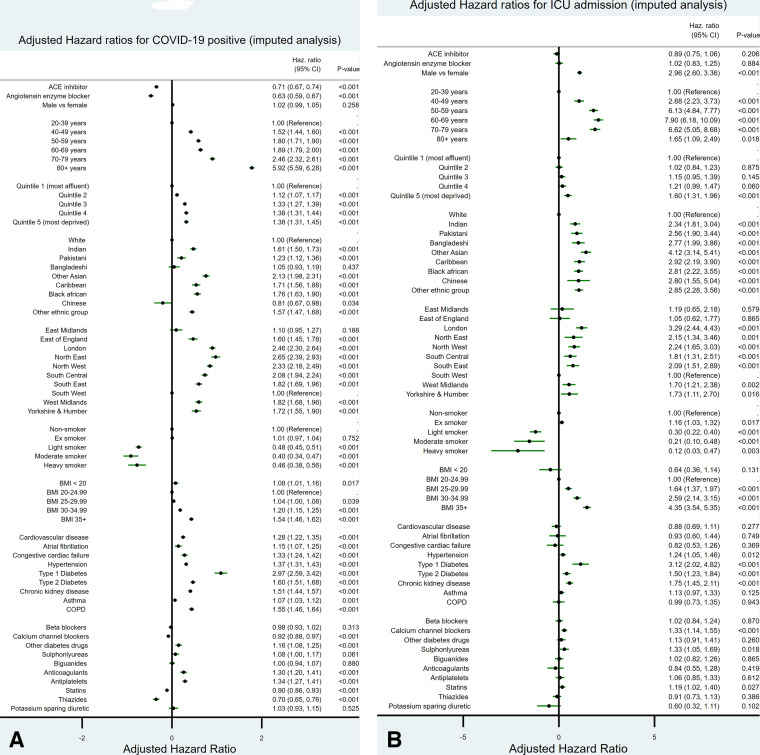
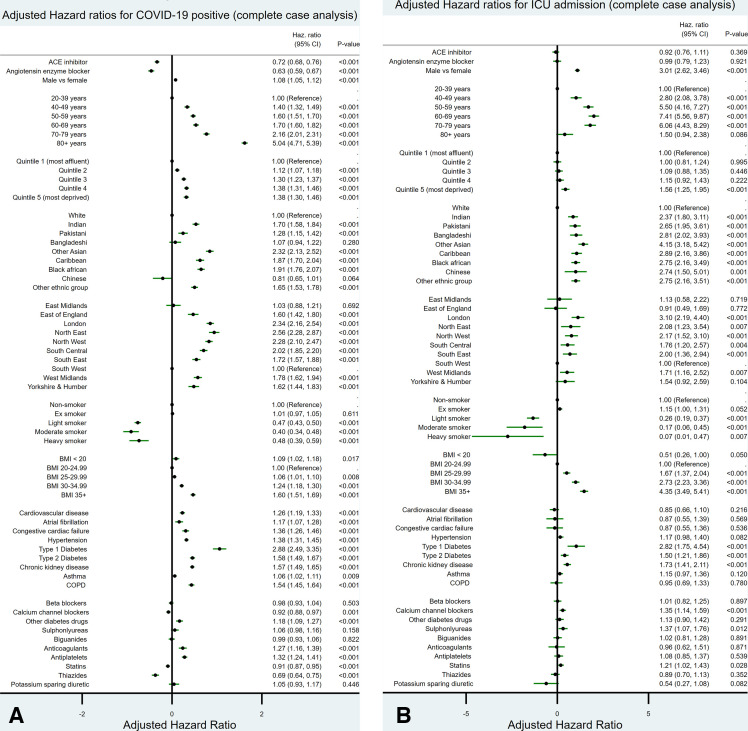
Of 19 486 patients who had COVID-19 disease, 1286 received ICU care. ACE inhibitors were associated with a significantly reduced risk of COVID-19 disease (adjusted HR 0.71, 95% CI 0.67 to 0.74) but no increased risk of ICU care (adjusted HR 0.89, 95% CI 0.75 to 1.06) after adjusting for a wide range of confounders. Adjusted HRs for ARBs were 0.63 (95% CI 0.59 to 0.67) for COVID-19 disease and 1.02 (95% CI 0.83 to 1.25) for ICU care.There were significant interactions between ethnicity and ACE inhibitors and ARBs for COVID-19 disease. The risk of COVID-19 disease associated with ACE inhibitors was higher in Caribbean (adjusted HR 1.05, 95% CI 0.87 to 1.28) and Black African (adjusted HR 1.31, 95% CI 1.08 to 1.59) groups than the white group (adjusted HR 0.66, 95% CI 0.63 to 0.70). A higher risk of COVID-19 with ARBs was seen for Black African (adjusted HR 1.24, 95% CI 0.99 to 1.58) than the white (adjusted HR 0.56, 95% CI 0.52 to 0.62) group.
ACE inhibitors and ARBs are associated with reduced risks of COVID-19 disease after adjusting for a wide range of variables. Neither ACE inhibitors nor ARBs are associated with significantly increased risks of receiving ICU care. Variations between different ethnic groups raise the possibility of ethnic-specific effects of ACE inhibitors/ARBs on COVID-19 disease susceptibility and severity which deserves further study.
血管紧张素转换酶(ACE)抑制剂和血管紧张素受体阻滞剂(ARB)类药物与 COVID-19 疾病之间的关联存在不确定性。我们研究了这些药物的使用是否会改变患者感染严重 COVID-19 疾病和接受相关重症监护病房(ICU)入院的风险。
这是一项前瞻性队列研究,使用英格兰 1205 家普通诊所的常规收集数据,共有 828 万 20-99 岁的参与者。我们使用 Cox 比例风险模型得出 ACE 抑制剂和 ARB 药物暴露的调整后的 HR,调整了社会人口统计学因素、同时使用的药物和地理位置。主要结局为:(a)COVID-19 RT-PCR 诊断疾病和(b)COVID-19 疾病导致 ICU 护理。
在 19486 名患有 COVID-19 疾病的患者中,有 1286 名患者接受了 ICU 护理。ACE 抑制剂与 COVID-19 疾病的风险显著降低相关(调整后的 HR 0.71,95%CI 0.67 至 0.74),但在调整了广泛的混杂因素后,ICU 护理的风险没有增加(调整后的 HR 0.89,95%CI 0.75 至 1.06)。ARB 的调整后 HR 为 COVID-19 疾病 0.63(95%CI 0.59 至 0.67)和 ICU 护理 1.02(95%CI 0.83 至 1.25)。ACE 抑制剂和 ARB 类药物与 COVID-19 疾病之间存在种族的显著交互作用。加勒比(调整后的 HR 1.05,95%CI 0.87 至 1.28)和黑非洲(调整后的 HR 1.31,95%CI 1.08 至 1.59)组与白人组(调整后的 HR 0.66,95%CI 0.63 至 0.70)相比,ACE 抑制剂与 COVID-19 疾病的关联风险更高。黑非洲(调整后的 HR 1.24,95%CI 0.99 至 1.58)与白人(调整后的 HR 0.56,95%CI 0.52 至 0.62)组相比,ARB 类药物与 COVID-19 疾病的风险更高。
在调整了广泛的变量后,ACE 抑制剂和 ARB 类药物与 COVID-19 疾病的风险降低有关。ACE 抑制剂和 ARB 类药物均与 ICU 护理的风险增加无关。不同种族群体之间的差异表明 ACE 抑制剂/ARB 对 COVID-19 疾病易感性和严重程度的种族特异性影响的可能性,这值得进一步研究。