Cai Yuwen, Huang Tianlun, Liu Xin, Xu Gaosi
Department of Nephrology, the Second Affiliated Hospital of Nanchang University, Nanchang University, Nanchang, China.
Second Clinical Medical College of Nanchang University, Nanchang, China.
PeerJ. 2020 Jul 21;8:e9578. doi: 10.7717/peerj.9578. eCollection 2020.
In December 2019, a novel coronavirus disease (COVID-19) broke out in Wuhan, China; however, the factors affecting the mortality of COVID-19 remain unclear.
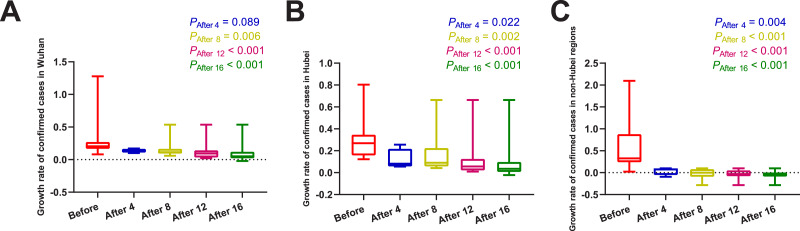
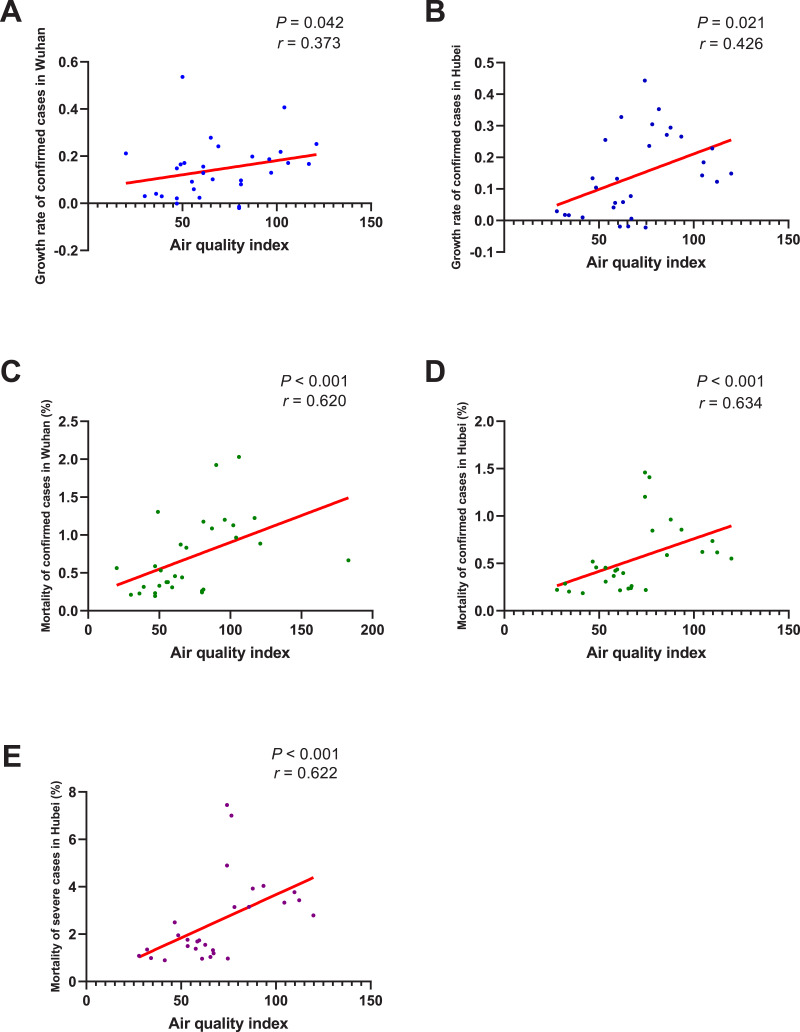
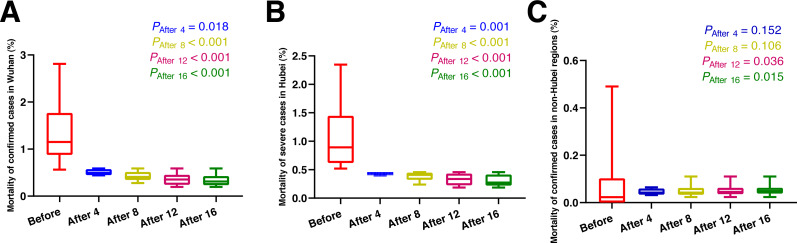
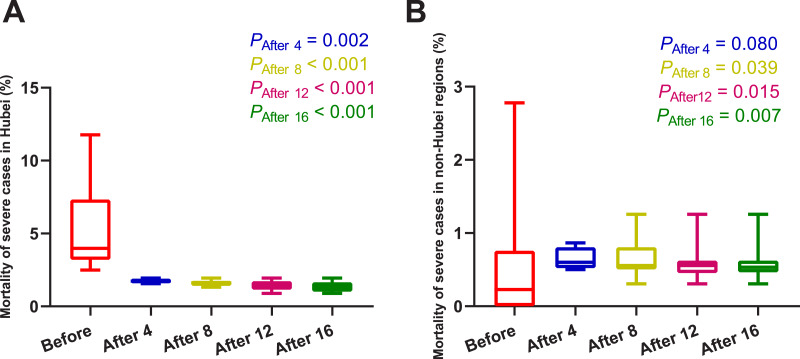
Thirty-two days of data (the growth rate/mortality of COVID-19 cases) that were shared by Chinese National Health Commission and Chinese Weather Net were collected by two authors independently. Student's t-test or Mann-Whitney U test was used to test the difference in the mortality of confirmed/severe cases before and after the use of "Fangcang, Huoshenshan, and Leishenshan" makeshift hospitals (MSHs). We also studied whether the above outcomes of COVID-19 cases were related to air temperature (AT), relative humidity (RH), or air quality index (AQI) by performing Pearson's analysis or Spearman's analysis.
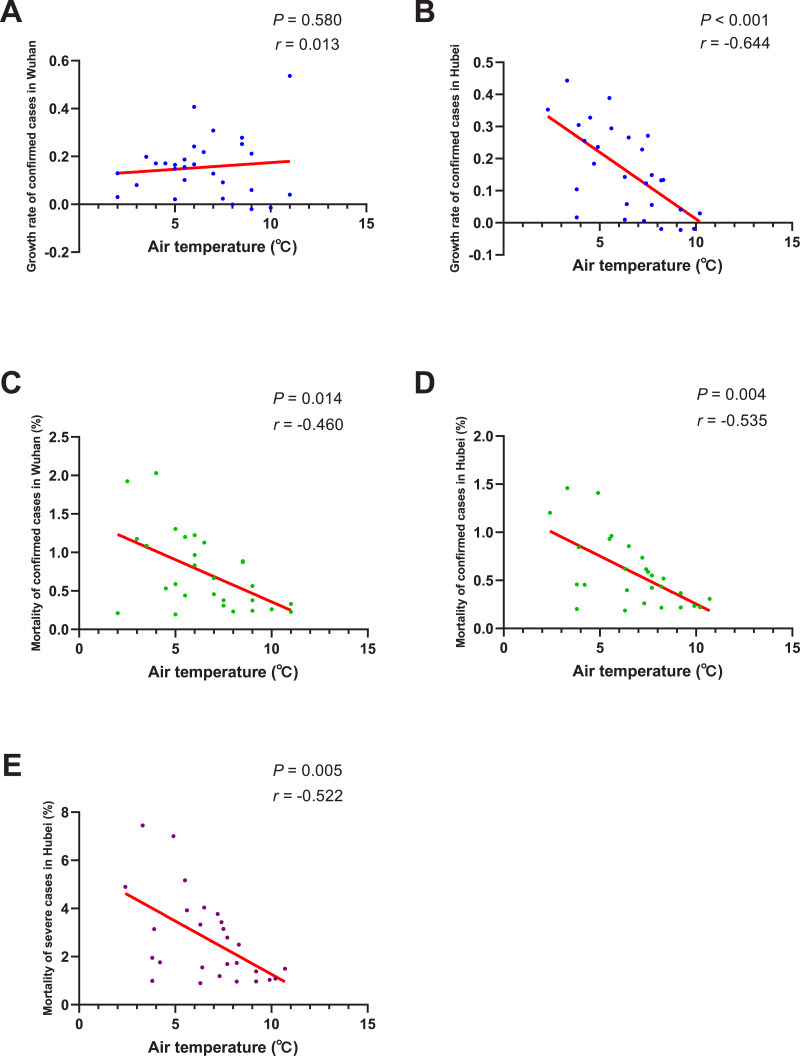
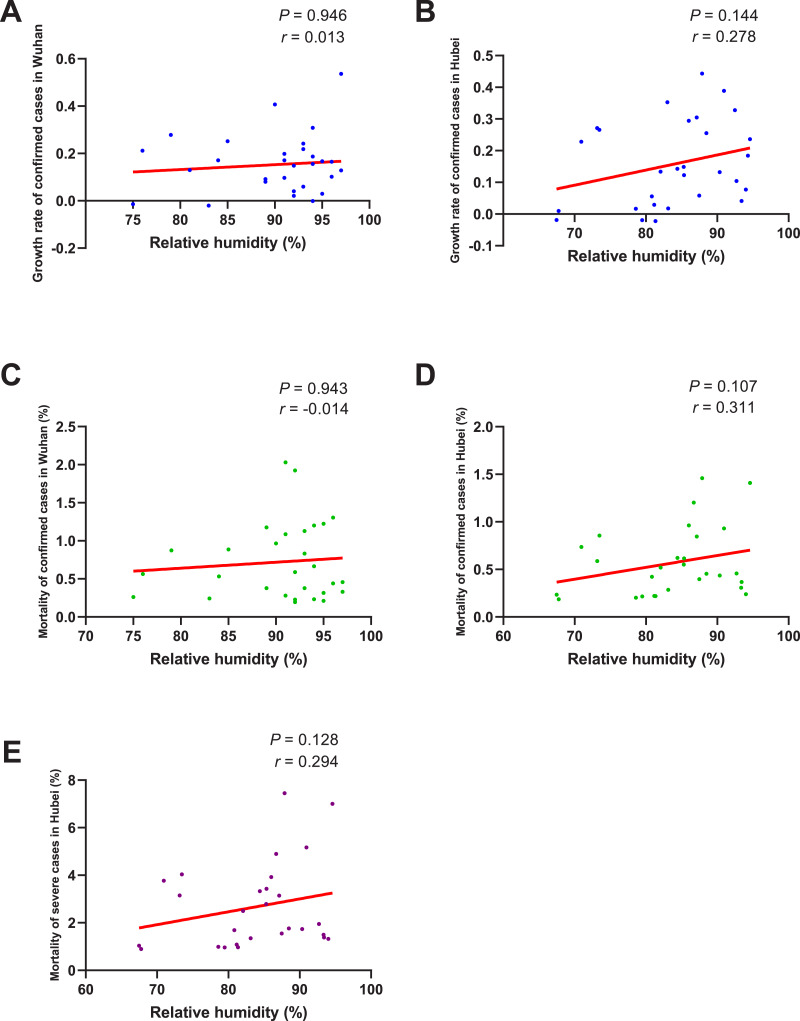
Eight days after the use of MSHs, the mortality of confirmed cases was significantly decreased both in Wuhan ( = 4.5, < 0.001) and Hubei ( = 0, < 0.001), (t and U are the test statistic used to test the significance of the difference). In contrast, the mortality of confirmed cases remained unchanged in non-Hubei regions ( = 76, = 0.106). While on day 12 and day 16 after the use of MSHs, the reduce in mortality was still significant both in Wuhan and Hubei; but in non-Hubei regions, the reduce also became significant this time ( = 123, = 0.036; = 171, = 0.015, respectively). Mortality of confirmed cases was found to be negatively correlated with AT both in Wuhan ( = - 0.441, = 0.012) and Hubei ( = - 0.440, = 0.012). Also, both the growth rate and the mortality of COVID-19 cases were found to be significantly correlated with AQI in Wuhan and Hubei. However, no significant correlation between RH and the growth rate/mortality of COVID-19 cases was found in our study.
Our findings indicated that both the use of MSHs, the rise of AT, and the improvement of air quality were beneficial to the survival of COVID-19 patients.
2019年12月,中国武汉爆发了新型冠状病毒病(COVID-19);然而,影响COVID-19死亡率的因素仍不清楚。
两位作者独立收集了中国国家卫生健康委员会和中国天气网共享的32天数据(COVID-19病例的增长率/死亡率)。采用学生t检验或曼-惠特尼U检验来检验使用“方舱、火神山和雷神山”临时医院(MSHs)前后确诊/重症病例死亡率的差异。我们还通过进行Pearson分析或Spearman分析研究了COVID-19病例的上述结果是否与气温(AT)、相对湿度(RH)或空气质量指数(AQI)相关。
使用MSHs八天后,武汉(t = 4.5,P < 0.001)和湖北(U = 0,P < 0.001)确诊病例的死亡率均显著下降(t和U是用于检验差异显著性的检验统计量)。相比之下,非湖北地区确诊病例的死亡率没有变化(U = 76,P = 0.106)。在使用MSHs后的第12天和第16天,武汉和湖北的死亡率下降仍然显著;但在非湖北地区,这次下降也变得显著(分别为U = 123,P = 0.036;U = 171,P = 0.015)。发现武汉(r = -0.441,P = 0.012)和湖北(r = -0.440,P = 0.012)确诊病例的死亡率与AT均呈负相关。此外,在武汉和湖北,COVID-19病例的增长率和死亡率均与AQI显著相关。然而,在我们的研究中未发现RH与COVID-19病例的增长率/死亡率之间存在显著相关性。
我们的研究结果表明,使用MSHs、气温升高和空气质量改善均有利于COVID-19患者的存活。