Adashek Jacob J, Redding David
Internal Medicine, University of South Florida, Tampa, USA.
Neuromusculoskeletal Medicine/Osteopathic Manipulative Medicine/Family Medicine, Western University of Health Sciences, Pomona, USA.
Cureus. 2020 Jun 24;12(6):e8798. doi: 10.7759/cureus.8798.
Cardiovascular disease (CVD) is a leading cause of morbidity and mortality in the United States and changes in lifestyle can minimize the likelihood of succumbing to heart disease. Anti-inflammatory agents are commonly used to reduce the chronic inflammatory state behind the pathogenesis of CVD. Multiple studies have been published correlating nut consumption with a reduction in both heart attacks and strokes. The goal of this study is to determine to what extent the consumption of almonds, hazelnuts, and walnuts have on the blood markers associated with cardiac disease and inflammation.
This was a six-week study in which subject's baseline values act as controls. Fasting blood draws occurred at week 0, week 2, and after four weeks of intervention (week 6). All participants had undesirable lipid profiles and no medications related to heart disease.
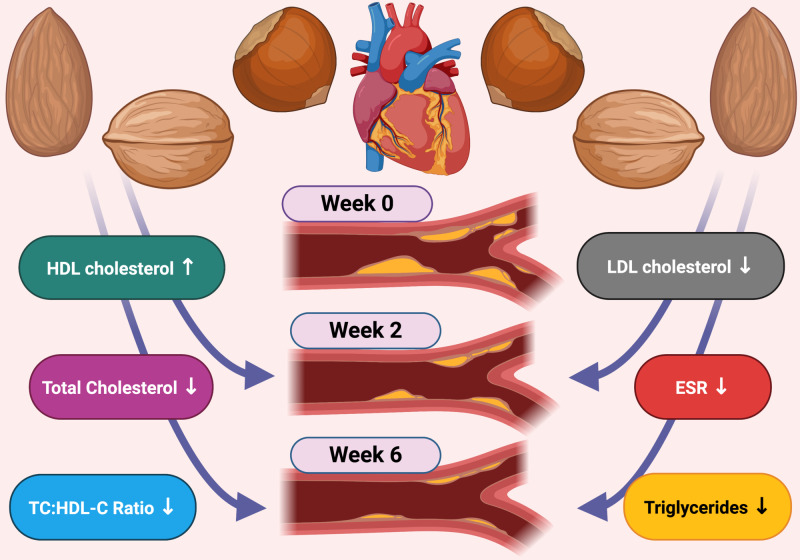
Total cholesterol (TC): high-density lipoprotein (HDL-C) ratio was lowered a statistically significant amount at the six-week time point (3.89 ± 0.74) compared to both the zero-week (4.93 ± 1.16, p < 0.01) and two-week (4.63 ± 1.20, p < 0.5) timepoints. Low-density lipoprotein (LDL) measurements were lowered a statistically significant amount at the six-week time point (135.6 ± 15.0 mg/dL) compared to the zero-week (159.7 ± 12.3 mg/dL, p < 0.01). Erythrocyte sedimentation rate (ESR) was lowered a statistically significant amount at six-week time point (10.44 ± 5.05 mm/h) compared to the zero-week (14.44 ± 5.12 mm/h, p < 0.01).
Blood markers associated with CVD specifically and the general marker for inflammation associated with many chronic diseases can be favorably modified with the consumption of specific nuts as demonstrated by this study.
心血管疾病(CVD)是美国发病和死亡的主要原因,生活方式的改变可以降低患心脏病的可能性。抗炎药常用于减轻CVD发病机制背后的慢性炎症状态。多项研究表明,食用坚果与减少心脏病发作和中风有关。本研究的目的是确定食用杏仁、榛子和核桃对与心脏病和炎症相关的血液标志物有多大影响。
这是一项为期六周的研究,受试者的基线值作为对照。在第0周、第2周和干预四周后(第6周)进行空腹抽血。所有参与者的血脂状况都不理想,且未服用与心脏病相关的药物。
与第0周(4.93±1.16,p<0.01)和第2周(4.63±1.20,p<0.5)相比,六周时间点的总胆固醇(TC)与高密度脂蛋白(HDL-C)比值显著降低(3.89±0.74)。与第0周(159.7±12.3mg/dL,p<0.01)相比,六周时间点的低密度脂蛋白(LDL)测量值显著降低(135.6±15.0mg/dL)。与第0周(14.44±5.12mm/h,p<0.01)相比,六周时间点的红细胞沉降率(ESR)显著降低(10.44±5.05mm/h)。
本研究表明,食用特定坚果可以有效改善与CVD相关的血液标志物以及与许多慢性疾病相关的炎症通用标志物。