Kim Kyoung Jin, Shin Jinyoung, Choi Jaekyung, Won Chang Won
Department of Family Medicine, Konkuk University Medical Center, Konkuk University School of Medicine, Seoul, Korea.
Department of Family Medicine, College of Medicine, Kyung Hee University, Seoul, Korea.
Ann Geriatr Med Res. 2018 Sep;22(3):137-144. doi: 10.4235/agmr.2018.22.3.137. Epub 2018 Sep 30.
The identification of frailty is considered an effective means of enhancing healthy aging. The definition of frailty affects its prevalence and associated institutionalization and mortality. This study aimed to identify the prevalence of frailty among community-dwelling older Korean adults according to different frailty scales.
This cross-sectional study based on the Korean Frailty and Aging Cohort Study represents a population of 1,318 people aged 70 years and older. Discrepancies in the prevalence of frailty were evaluated among six validated assessment tools. Multivariate logistic regression analysis was used to evaluate the prevalence of frailty according to its predictors (age, sex, and socioeconomic status).
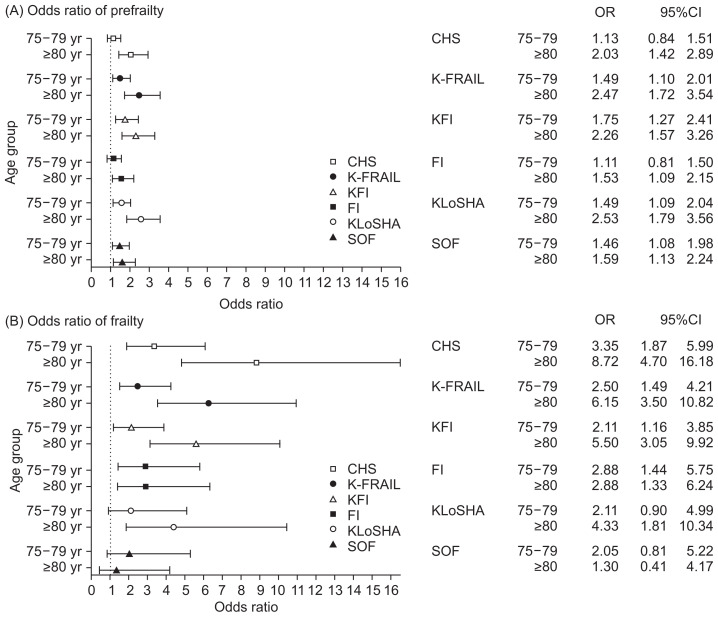
The mean age of the participants was 76.1 (standard deviation, 3.9) years, and females comprised 51.0%. The prevalence of frailty varied from 2.5% to 12.4% using the Study of Osteoporotic Fracture frailty index and the Korean version of the Fatigue, Resistance, Ambulation, Illnesses, and Loss of Weight scale, respectively. The prevalence of frailty was higher among women and frailty rates increased with age on all scales. The risks of prefrailty and frailty were increased among participants with a low education level after adjusting for age, sex, residence, and income level.
In this study, the prevalence of frailty was found to vary depending on the scale used. Efforts aimed at screening and providing intervention for frailty and frail adults at risk, respectively, are needed to improve health outcomes considering the characteristics of each frailty scale and the determined prevalence.
衰弱的识别被认为是促进健康老龄化的有效手段。衰弱的定义会影响其患病率、相关的机构化程度和死亡率。本研究旨在根据不同的衰弱量表确定韩国社区居住的老年成年人中衰弱的患病率。
这项基于韩国衰弱与老龄化队列研究的横断面研究纳入了1318名70岁及以上的人群。在六种经过验证的评估工具中评估衰弱患病率的差异。采用多变量逻辑回归分析根据衰弱的预测因素(年龄、性别和社会经济地位)评估衰弱的患病率。
参与者的平均年龄为76.1岁(标准差为3.9岁),女性占51.0%。使用骨质疏松性骨折研究衰弱指数和韩文版的疲劳、抵抗力、行走、疾病和体重减轻量表时,衰弱的患病率分别为2.5%至12.4%。在所有量表中,女性衰弱的患病率更高,且衰弱率随年龄增长而增加。在调整年龄、性别、居住和收入水平后,低教育水平参与者发生衰弱前期和衰弱的风险增加。
在本研究中,发现衰弱的患病率因所使用的量表而异。考虑到每个衰弱量表的特点和确定的患病率,需要分别针对衰弱和有衰弱风险的成年人进行筛查并提供干预措施,以改善健康结局。