Liebrand Luka C, Natarajan Samuel J, Caan Matthan W A, Schuurman P Richard, van den Munckhof Pepijn, de Kwaasteniet Bart, Luigjes Judy, Bergfeld Isidoor O, Denys Damiaan, van Wingen Guido A
Amsterdam UMC, University of Amsterdam, Department of Psychiatry, Amsterdam Neuroscience, Meibergdreef 9, Amsterdam, Netherlands; Amsterdam UMC, University of Amsterdam, Department of Biomedical Engineering and Physics, Meibergdreef 9, Amsterdam, Netherlands; Amsterdam Brain and Cognition, Nieuwe Achtergracht 129 B, Amsterdam, Netherlands.
Amsterdam UMC, University of Amsterdam, Department of Psychiatry, Amsterdam Neuroscience, Meibergdreef 9, Amsterdam, Netherlands; Amsterdam Brain and Cognition, Nieuwe Achtergracht 129 B, Amsterdam, Netherlands.
Neuroimage Clin. 2020;28:102363. doi: 10.1016/j.nicl.2020.102363. Epub 2020 Jul 25.
Deep brain stimulation (DBS) is an innovative treatment for treatment-refractory depression. DBS is usually targeted at specific anatomical landmarks, with patients responding to DBS in approximately 50% of cases. Attention has recently shifted to white matter tracts to explain DBS response, with initial open-label trials targeting white matter tracts yielding much higher response rates (>70%).
OBJECTIVE/HYPOTHESIS: Our aim was to associate distance to individual white matter tracts around the stimulation target in the ventral anterior limb of the internal capsule to treatment response.
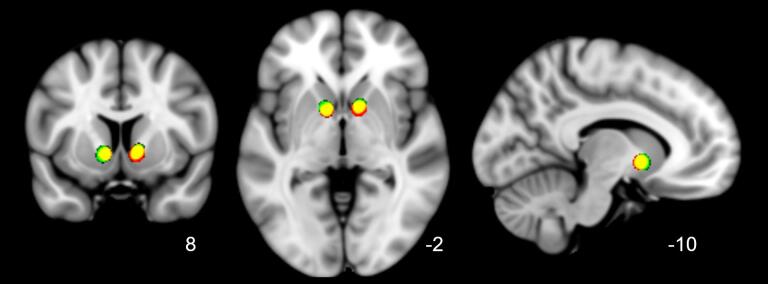
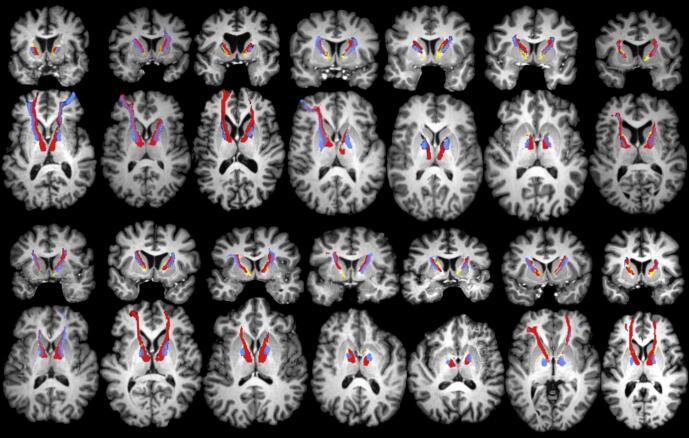
We performed diffusion magnetic resonance tractography of the superolateral branch of the medial forebrain bundle and the anterior thalamic radiation in fourteen patients that participated in our randomized clinical trial. We combined the tract reconstructions with the postoperative images to identify the DBS leads and estimated the distance between tracts and leads, which we subsequently associated with treatment response.
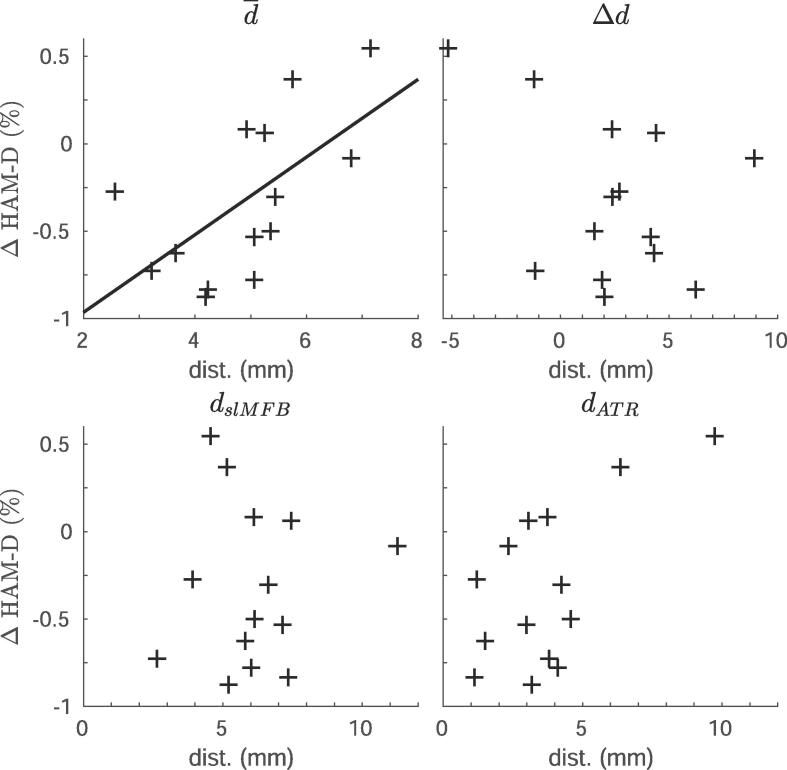
Stimulation closer to both tracts was significantly correlated to a larger symptom decrease (r = 0.61, p = 0.02), suggesting that stimulation more proximal to the tracts was beneficial. Biophysical modelling indicated that 37.5% of tracts were even outside the volume of activated tissue. There was no difference in lead placement with respect to anatomical landmarks, which could mean that differences in treatment response were driven by individual differences in white matter anatomy.
Our results suggest that deep brain stimulation of the ventral anterior limb of the internal capsule could benefit from targeting white matter bundles. We recommend acquiring diffusion magnetic resonance data for each individual patient.
深部脑刺激(DBS)是一种用于治疗难治性抑郁症的创新疗法。DBS通常针对特定的解剖标志,约50%的患者对DBS有反应。最近,人们的注意力已转向白质束以解释DBS反应,最初针对白质束的开放标签试验产生了更高的反应率(>70%)。
目的/假设:我们的目的是将内囊腹侧前肢刺激靶点周围与各个白质束的距离与治疗反应联系起来。
我们对14名参与我们随机临床试验的患者进行了内侧前脑束超外侧分支和丘脑前辐射的扩散磁共振纤维束成像。我们将纤维束重建与术后图像相结合,以识别DBS电极,并估计纤维束与电极之间的距离,随后我们将其与治疗反应联系起来。
更靠近两个纤维束的刺激与更大程度的症状减轻显著相关(r = 0.61,p = 0.02),这表明更靠近纤维束的刺激是有益的。生物物理模型表明,37.5%的纤维束甚至在激活组织体积之外。电极放置在解剖标志方面没有差异,这可能意味着治疗反应的差异是由白质解剖结构的个体差异驱动的。
我们的结果表明,内囊腹侧前肢的深部脑刺激可能受益于靶向白质束。我们建议为每位患者获取扩散磁共振数据。