Moeng Sokviseth, Son Seung Wan, Lee Jong Sun, Lee Han Yeoung, Kim Tae Hee, Choi Soo Young, Kuh Hyo Jeong, Park Jong Kook
Department of Biomedical Science and Research Institute for Bioscience & Biotechnology, Hallym University, Chunchon 24252, Korea.
Department of Medical Life Sciences, College of Medicine, The Catholic University of Korea, Seoul 06591, Korea.
Biomedicines. 2020 Aug 3;8(8):267. doi: 10.3390/biomedicines8080267.
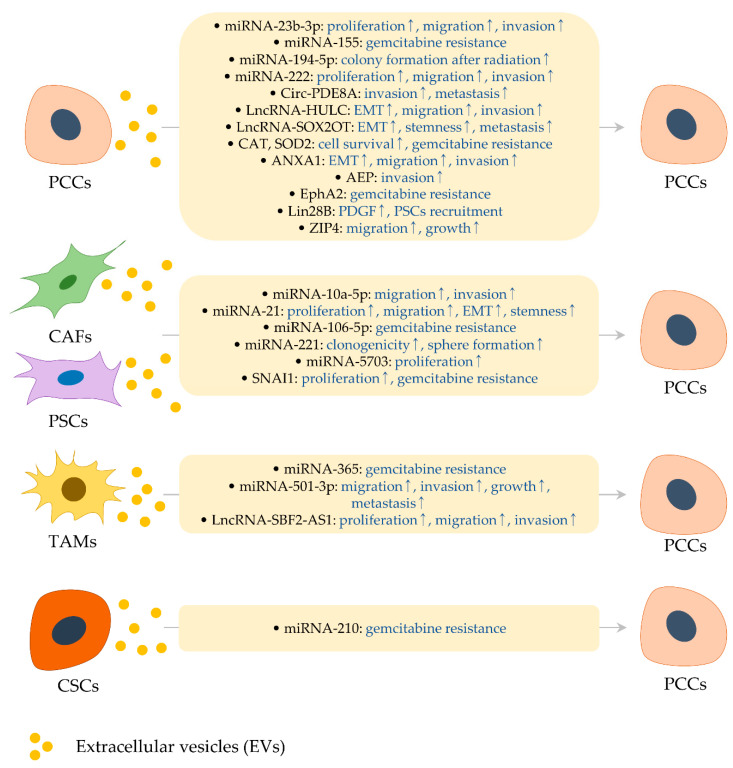
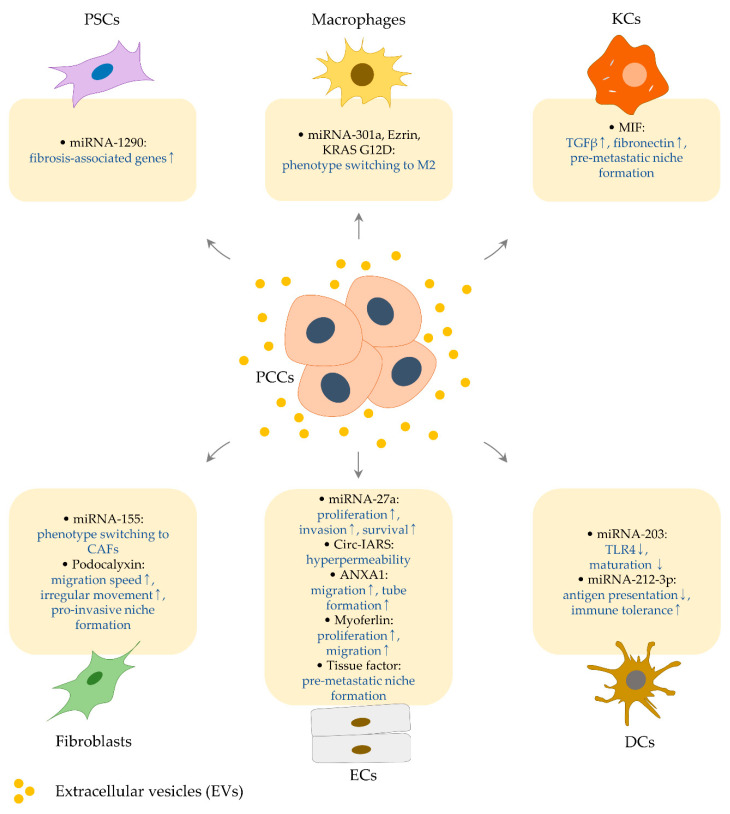
Pancreatic cancer is malignant and the seventh leading cause of cancer-related deaths worldwide. However, chemotherapy and radiotherapy are-at most-moderately effective, indicating the need for new and different kinds of therapies to manage this disease. It has been proposed that the biologic properties of pancreatic cancer cells are finely tuned by the dynamic microenvironment, which includes extracellular matrix, cancer-associated cells, and diverse immune cells. Accumulating evidence has demonstrated that extracellular vesicles (EVs) play an essential role in communication between heterogeneous subpopulations of cells by transmitting multiplex biomolecules. EV-mediated cell-cell communication ultimately contributes to several aspects of pancreatic cancer, such as growth, angiogenesis, metastasis and therapeutic resistance. In this review, we discuss the role of extracellular vesicles and their cargo molecules in pancreatic cancer. We also present the feasibility of the inhibition of extracellular biosynthesis and their itinerary (release and uptake) for a new attractive therapeutic strategy against pancreatic cancer.
胰腺癌是恶性肿瘤,是全球癌症相关死亡的第七大主要原因。然而,化疗和放疗至多只能起到中等程度的效果,这表明需要新的、不同类型的疗法来治疗这种疾病。有人提出,胰腺癌细胞的生物学特性是由动态微环境精细调节的,该微环境包括细胞外基质、癌症相关细胞和多种免疫细胞。越来越多的证据表明,细胞外囊泡(EVs)通过传递多种生物分子在不同细胞亚群之间的通讯中发挥着重要作用。EV介导的细胞间通讯最终促成了胰腺癌的多个方面,如生长、血管生成、转移和治疗抗性。在这篇综述中,我们讨论了细胞外囊泡及其所载分子在胰腺癌中的作用。我们还提出了抑制细胞外生物合成及其行程(释放和摄取)作为一种针对胰腺癌的新的有吸引力的治疗策略的可行性。