Huebbe Patricia, Rimbach Gerald
Institute of Human Nutrition and Food Science, University of Kiel, 24118 Kiel, Germany.
Foods. 2020 Aug 4;9(8):1056. doi: 10.3390/foods9081056.
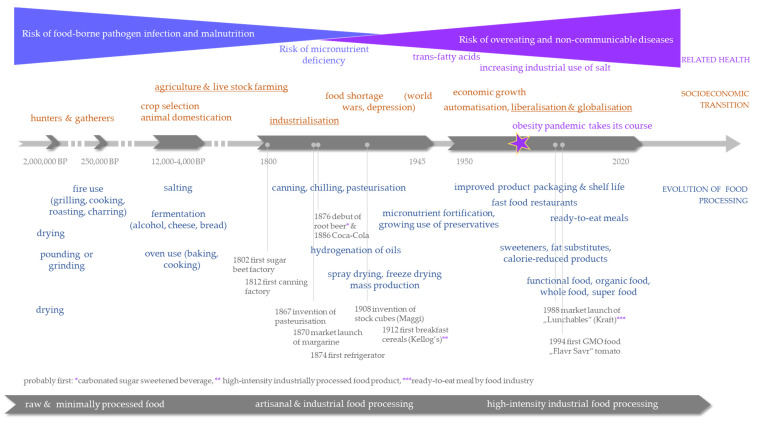
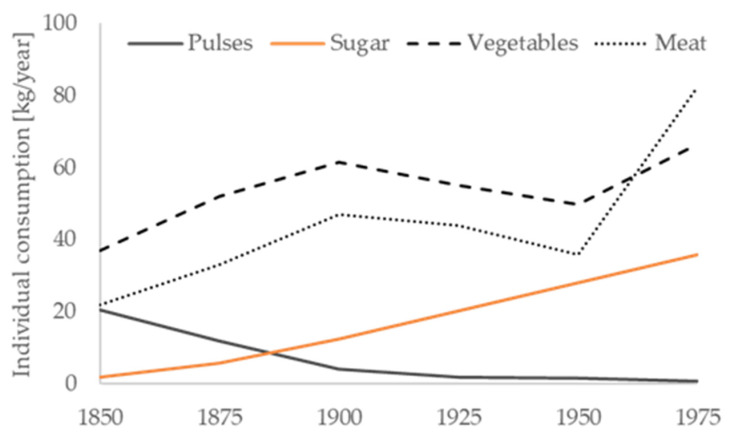
The purpose of food processing has changed over time. High-intensity industrially processed food often exhibits higher concentrations of added sugar, salt, higher energy, and lower micronutrient density than does similar food or meals prepared at home from raw or minimally processed food. Viewing the evolution of food processing from history, one could make out three major transitions related to human socioeconomic changes. The first transition was marked by the change from hunting and gathering to settled societies with agriculture and livestock farming. The second and third transitions were associated with the Industrial Revolution and with market liberalization, global trade and automation, respectively. The next major transition that will influence food processing and shape human nutrition may include the exploitation of sustainable and efficient protein and food sources that will ensure high-quality food production for the growing world population. Apart from novel food sources, traditional food such as legumes and pulses likewise exhibit great potential to contribute to a healthy balanced diet. The promotion of legumes should be intensified in public dietary guidelines because their consumption is rather low in high-income countries and increasingly displaced as a traditional staple by industrially processed food in low- to middle-income countries.
食品加工的目的随时间而改变。与用生的或最少加工的食品在家中制作的类似食品或餐食相比,高强度工业加工食品往往含有更高浓度的添加糖、盐,能量更高,而微量营养素密度更低。从历史角度审视食品加工的演变,可以看出与人类社会经济变化相关的三个主要转变。第一个转变的标志是从狩猎采集社会向有农业和畜牧业的定居社会的转变。第二个和第三个转变分别与工业革命以及市场自由化、全球贸易和自动化有关。下一个将影响食品加工并塑造人类营养的重大转变可能包括开发可持续且高效的蛋白质和食物来源,以确保为不断增长的世界人口提供高质量的食品生产。除了新型食物来源外,诸如豆类等传统食物同样具有极大潜力,有助于实现健康的均衡饮食。在公共膳食指南中应加大对豆类的推广力度,因为在高收入国家豆类的消费量相当低,而在低收入和中等收入国家,豆类作为传统主食正日益被工业加工食品所取代。