Sousa Filipe, Civáň Peter, Foster Peter G, Cox Cymon J
Centro de Ciências do Mar, Universidade do Algarve, Faro, Portugal.
INRA, Université Clermont-Auvergne, Clermont-Ferrand, France.
Front Plant Sci. 2020 Jul 10;11:1062. doi: 10.3389/fpls.2020.01062. eCollection 2020.
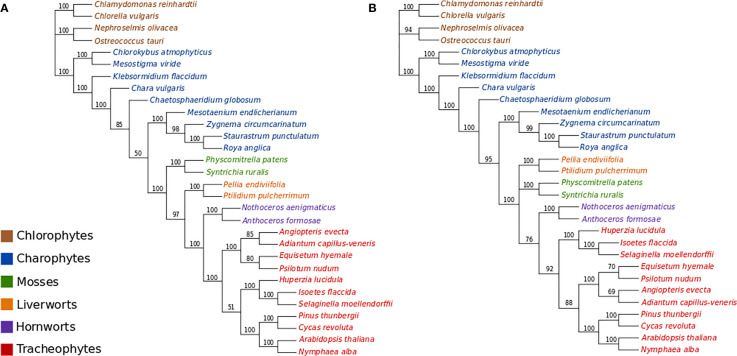
The colonization of land by descendants of charophyte green algae marked a turning point in Earth history that enabled the development of the diverse terrestrial ecosystems we see today. Early land plants diversified into three gametophyte-dominant lineages, namely the hornworts, liverworts, and mosses, collectively known as bryophytes, and a sporophyte-dominant lineage, the vascular plants, or tracheophytes. In recent decades, the prevailing view of evolutionary relationships among these four lineages has been that the tracheophytes were derived from a bryophyte ancestor. However, recent phylogenetic evidence has suggested that bryophytes are monophyletic, and thus that the first split among land plants gave rise to the lineages that today we recognize as the bryophytes and tracheophytes. We present a phylogenetic analysis of chloroplast protein-coding data that also supports the monophyly of bryophytes. This newly compiled data set consists of 83 chloroplast genes sampled across 30 taxa that include chlorophytes and charophytes, including four members of the Zygnematophyceae, and land plants, that were sampled following a balanced representation of the main bryophyte and tracheophyte lineages. Analyses of non-synonymous site nucleotide data and amino acid translation data result in congruent phylogenetic trees showing the monophyly of bryophytes, with the Zygnematophyceae as the charophyte group most closely related to land plants. Analyses showing that bryophytes and tracheophytes evolved separately from a common terrestrial ancestor have profound implications for the way we understand the evolution of plant life cycles on land and how we interpret the early land plant fossil record.
轮藻绿藻的后代在陆地上的定殖标志着地球历史上的一个转折点,使得我们如今所见的多样陆地生态系统得以发展。早期陆地植物分化为三个以配子体为主的谱系,即角苔、叶苔和藓类,统称为苔藓植物,以及一个以孢子体为主的谱系,即维管植物或导管植物。近几十年来,关于这四个谱系之间进化关系的主流观点一直是维管植物起源于苔藓植物祖先。然而,最近的系统发育证据表明苔藓植物是单系的,因此陆地植物的首次分化产生了我们如今所认识的苔藓植物和维管植物谱系。我们展示了一项对叶绿体蛋白质编码数据的系统发育分析,该分析也支持苔藓植物的单系性。这个新汇编的数据集由跨越30个分类群的83个叶绿体基因组成,这些分类群包括绿藻和轮藻,其中包括双星藻科的四个成员,以及陆地植物,这些陆地植物是在主要苔藓植物和维管植物谱系得到平衡代表的情况下进行采样的。对非同义位点核苷酸数据和氨基酸翻译数据的分析得出了一致的系统发育树,显示了苔藓植物的单系性,其中双星藻科是与陆地植物关系最密切的轮藻类群。分析表明苔藓植物和维管植物从一个共同的陆地祖先分别进化,这对我们理解陆地植物生命周期的进化方式以及我们如何解读早期陆地植物化石记录有着深远的影响。