
基于模型到数据的深度学习方法在光学相干断层扫描内视网膜液分割中的应用。
Model-to-Data Approach for Deep Learning in Optical Coherence Tomography Intraretinal Fluid Segmentation.
机构信息
New England Eye Center, Tufts Medical Center, Boston, Massachusetts.
Warren Alpert Medical School of Brown University, Providence, Rhode Island.
出版信息
JAMA Ophthalmol. 2020 Oct 1;138(10):1017-1024. doi: 10.1001/jamaophthalmol.2020.2769.
IMPORTANCE
Amid an explosion of interest in deep learning in medicine, including within ophthalmology, concerns regarding data privacy, security, and sharing are of increasing importance. A model-to-data approach, in which the model itself is transferred rather than data, can circumvent many of these challenges but has not been previously demonstrated in ophthalmology.
OBJECTIVE
To determine whether a model-to-data deep learning approach (ie, validation of the algorithm without any data transfer) can be applied in ophthalmology.
DESIGN, SETTING, AND PARTICIPANTS: This single-center cross-sectional study included patients with active exudative age-related macular degeneration undergoing optical coherence tomography (OCT) at the New England Eye Center from August 1, 2018, to February 28, 2019. Data were primarily analyzed from March 1 to June 20, 2019.
MAIN OUTCOMES AND MEASURES
Training of the deep learning model, using a model-to-data approach, in recognizing intraretinal fluid (IRF) on OCT B-scans.
RESULTS
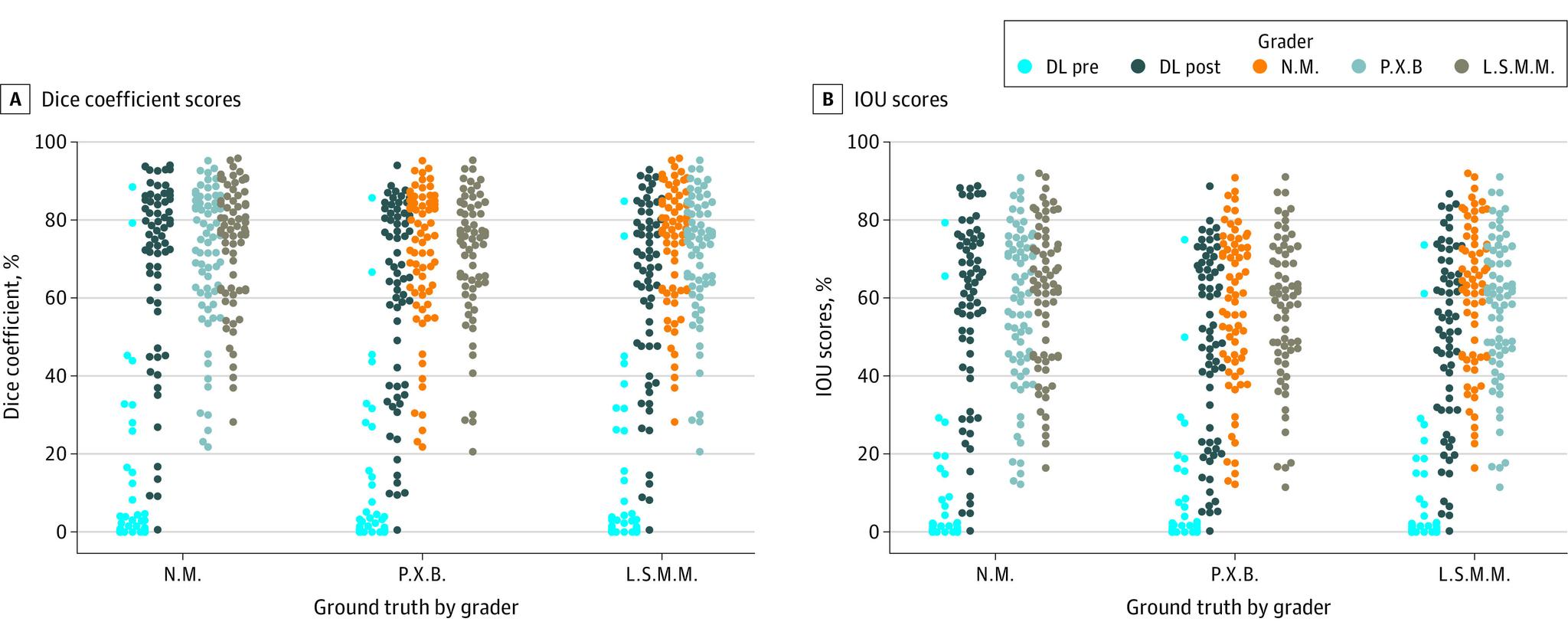
The model was trained (learning curve Dice coefficient, >80%) using 400 OCT B-scans from 128 participants (69 female [54%] and 59 male [46%]; mean [SD] age, 77.5 [9.1] years). In comparing the model with manual human grading of IRF pockets, no statistically significant difference in Dice coefficients or intersection over union scores was found (P > .05).
CONCLUSIONS AND RELEVANCE
A model-to-data approach to deep learning applied in ophthalmology avoided many of the traditional hurdles in large-scale deep learning, including data sharing, security, and privacy concerns. Although the clinical relevance of these results is limited at this time, this proof-of-concept study suggests that such a paradigm should be further examined in larger-scale, multicenter deep learning studies.
重要性
在医学领域(包括眼科学领域)深度学习兴趣激增的背景下,人们对数据隐私、安全和共享的关注度日益提高。模型到数据的方法(即传输模型本身而非数据)可以规避许多此类挑战,但以前在眼科学中尚未得到证明。
目的
确定在眼科学中是否可以应用模型到数据的深度学习方法(即无需任何数据传输即可验证算法)。
设计、设置和参与者:这是一项单中心横断面研究,纳入了 2018 年 8 月 1 日至 2019 年 2 月 28 日期间在新英格兰眼中心接受光学相干断层扫描(OCT)的活动性渗出性年龄相关性黄斑变性患者。主要数据分析时间为 2019 年 3 月 1 日至 6 月 20 日。
主要结局和测量指标
使用模型到数据的方法,对 OCT B 扫描上的视网膜内液(IRF)进行深度学习模型训练。
结果
该模型(学习曲线 Dice 系数,>80%)使用 128 名参与者(69 名女性[54%]和 59 名男性[46%])的 400 个 OCT B 扫描进行了训练(平均[标准差]年龄,77.5[9.1]岁)。将模型与 IRF 口袋的手动人工分级进行比较,Dice 系数或交集比分数无统计学显著差异(P > .05)。
结论和相关性
应用于眼科学的深度学习模型到数据方法避免了大型深度学习中的许多传统障碍,包括数据共享、安全和隐私问题。尽管目前这些结果的临床相关性有限,但这项概念验证研究表明,这种范例应在更大规模、多中心的深度学习研究中进一步研究。


 Zotero 插件