Graduate Program in Electrical Engineering and Industrial Informatics (CPGEI), Federal University of Technology-Paraná (UTFPR), Curitiba (PR) 80230-901, Brazil.
Graduate Program in Electrical Engineering (PPGEE), Federal University of Technology-Paraná (UTFPR), Ponta Grossa (PR) 84017-220, Brazil.
Sensors (Basel). 2020 Aug 5;20(16):4359. doi: 10.3390/s20164359.
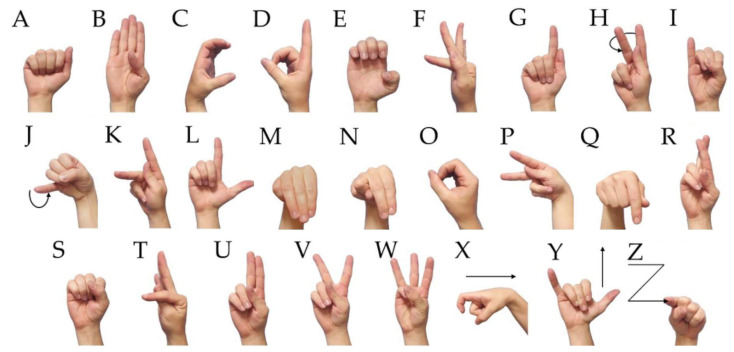
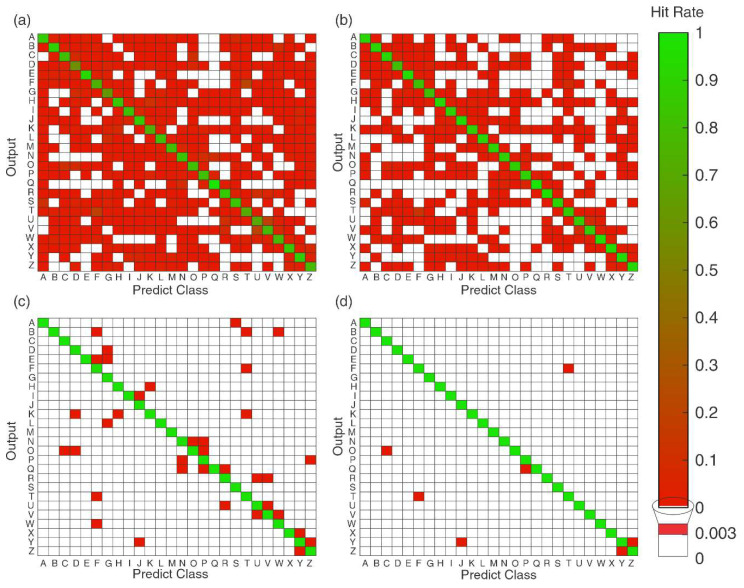
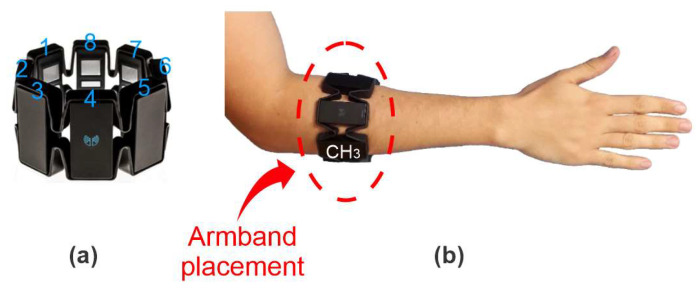
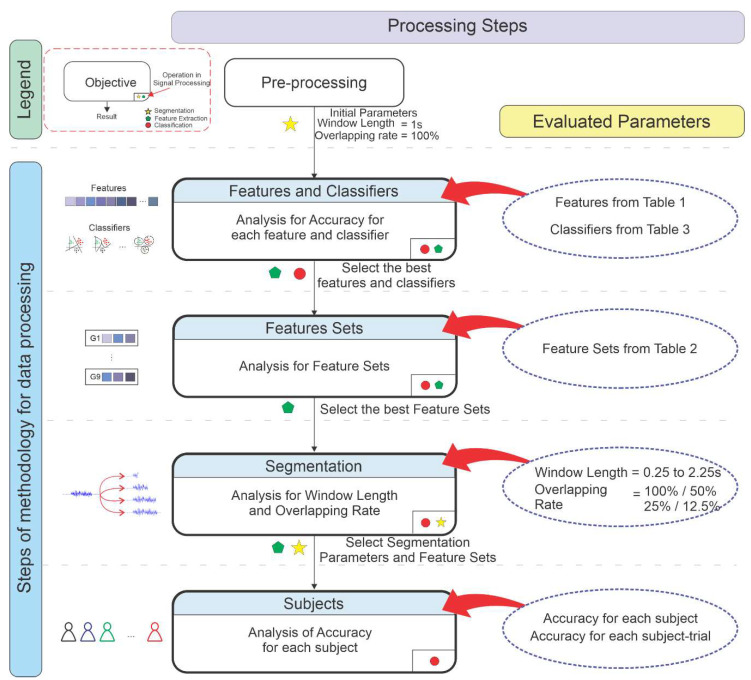
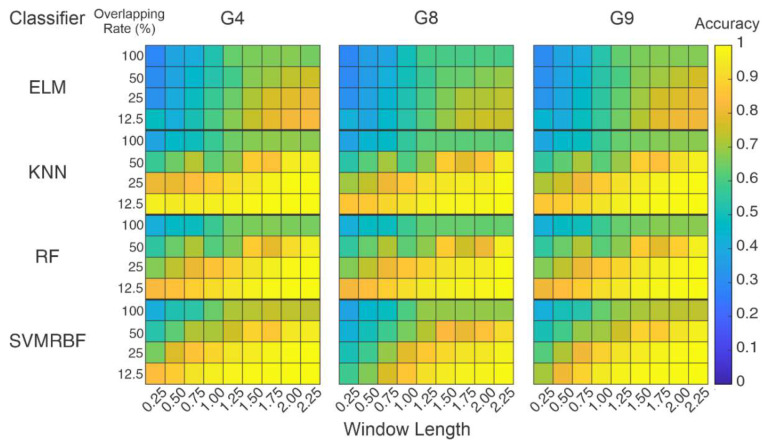
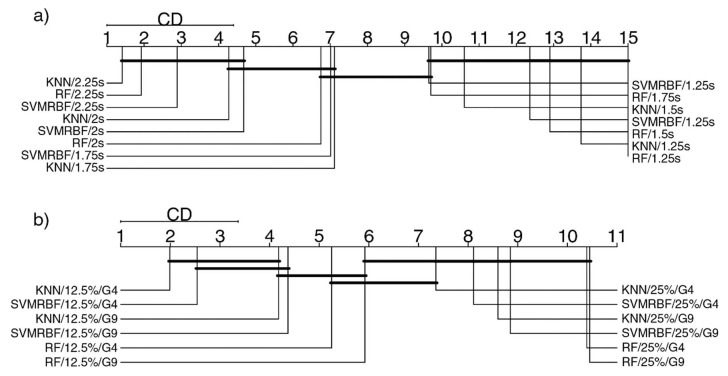
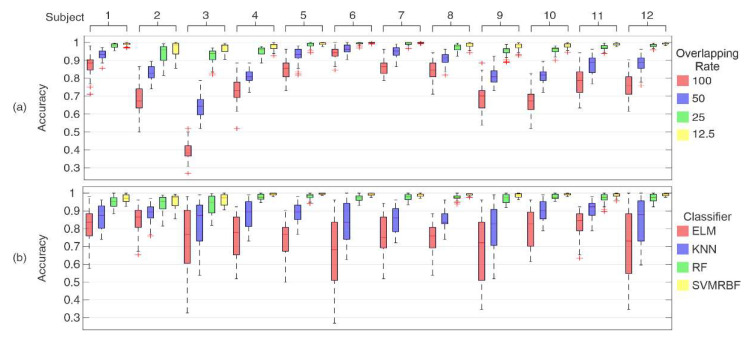
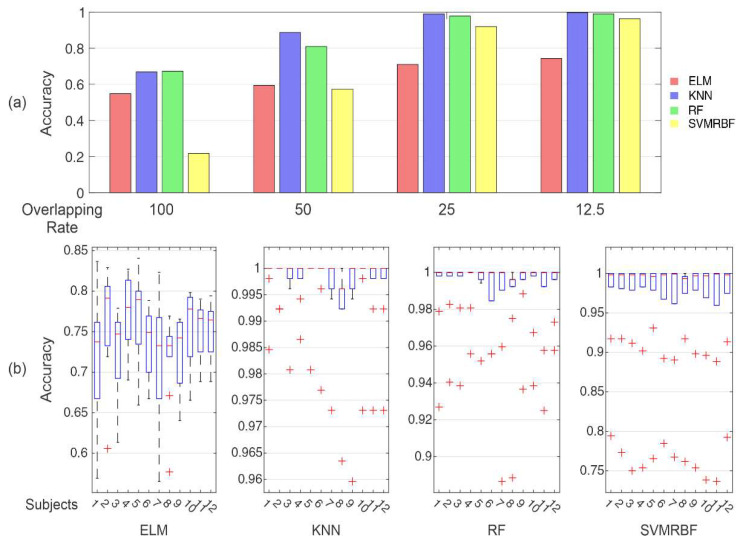
Sign Language recognition systems aid communication among deaf people, hearing impaired people, and speakers. One of the types of signals that has seen increased studies and that can be used as input for these systems is surface electromyography (sEMG). This work presents the recognition of a set of alphabet gestures from Brazilian Sign Language (Libras) using sEMG acquired from an armband. Only sEMG signals were used as input. Signals from 12 subjects were acquired using a Myo armband for the 26 signs of the Libras alphabet. Additionally, as the sEMG has several signal processing parameters, the influence of segmentation, feature extraction, and classification was considered at each step of the pattern recognition. In segmentation, window length and the presence of four levels of overlap rates were analyzed, as well as the contribution of each feature, the literature feature sets, and new feature sets proposed for different classifiers. We found that the overlap rate had a high influence on this task. Accuracies in the order of 99% were achieved for the following factors: segments of 1.75 s with a 12.5% overlap rate; the proposed set of four features; and random forest (RF) classifiers.
手语识别系统有助于聋人、听力障碍者和说话者之间的交流。已经有越来越多的研究关注到一种类型的信号,即表面肌电图(sEMG),可以将其作为这些系统的输入。本工作使用从臂带采集的表面肌电图(sEMG)识别一套巴西手语(Libras)字母手势。仅使用 sEMG 信号作为输入。使用 Myo 臂带来采集 12 名受试者的信号,用于 Libras 字母表的 26 个符号。此外,由于 sEMG 具有多个信号处理参数,因此在模式识别的每个步骤中都考虑了分段、特征提取和分类的影响。在分段中,分析了窗口长度和四个重叠率级别,以及每个特征、文献特征集和针对不同分类器提出的新特征集的贡献。我们发现,重叠率对此任务有很大影响。对于以下因素,可以达到 99%左右的准确率:1.75 秒的段长,重叠率为 12.5%;提出的四个特征集;以及随机森林(RF)分类器。