Luo Lingli, Wang Min, Li Xianping, Luo Can, Tan Shan, Yin Sheng, Liu Lei, Zhu Xiaolin
Department of Laboratory Medicine, The Second Xiangya Hospital, Central South University, Changsha, 410011 Hunan China.
Cancer Cell Int. 2020 Aug 5;20:372. doi: 10.1186/s12935-020-01471-w. eCollection 2020.
Long non-coding RNAs (LncRNAs) have been increasingly confirmed to be abnormally expressed in human cancer and closely related to tumorigenesis. LncRNA ACTA2-AS1 is abnormally expressed in multiple tumors and participates in their development. However, whether ACTA2-AS1 plays a role in the development of cervical cancer (CC) and the exact mechanism of its role has not been elucidated.
Quantitative real-time PCR (qRT-PCR) was conducted to detect the expression level of messenger RNA of ACTA2-AS1, miR-143-3p and SMAD3 in tumor tissues and cells. Additionally, SMAD3 protein expression by western blots in cells. Small interference RNA against ACTA2-AS1 or SMAD3 and miR-143-3p mimic/inhibitor was designed and transfected into CC cell lines to investigate their correlations and potential impacts on cell function. Cell Counting Kit-8 (CCK-8) assay, colony formation, cell cycle assay, transwell assay and flow cytometry analysis were performed to detect the specific effects on cell line proliferation, metastasis and apoptosis.
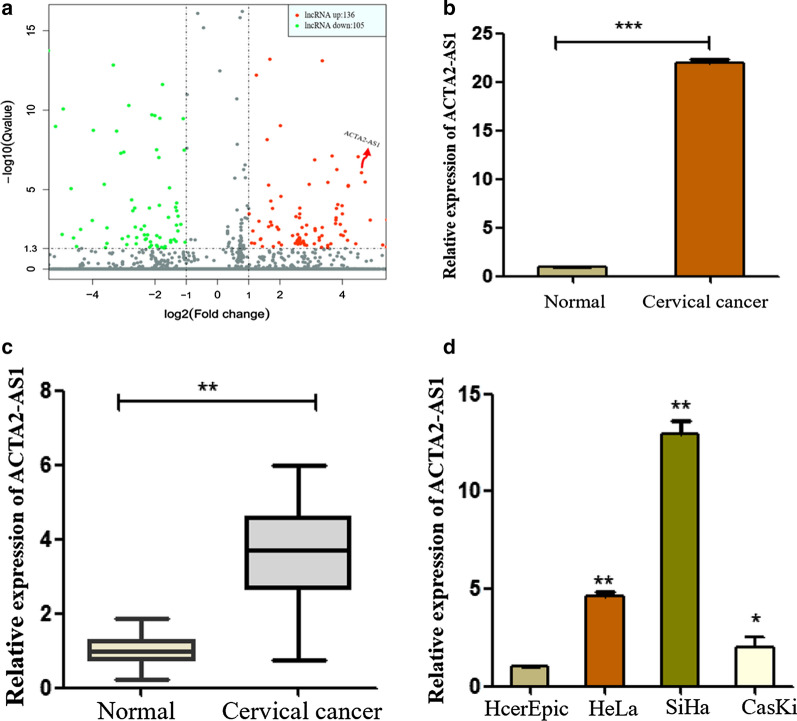
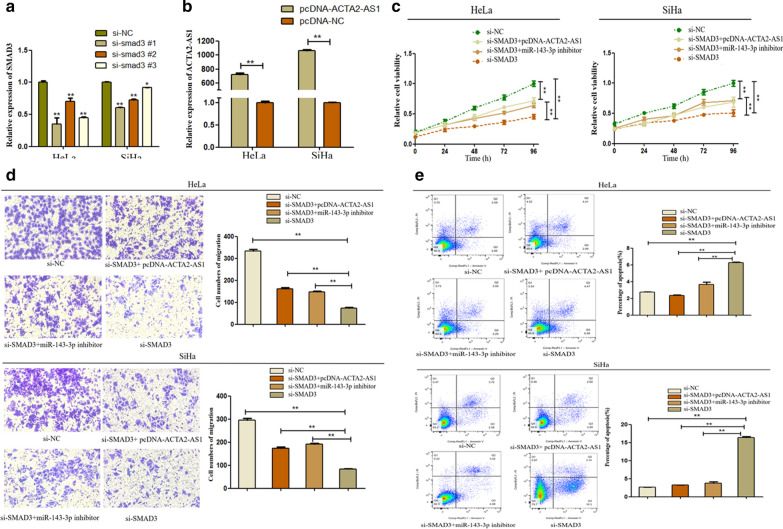
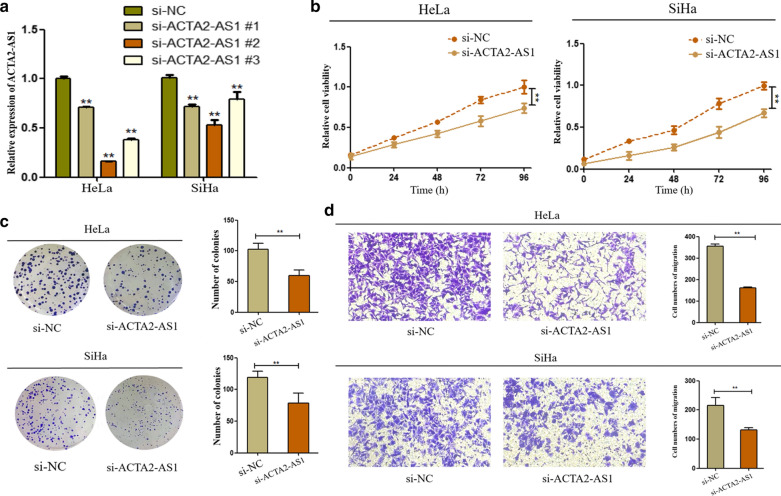
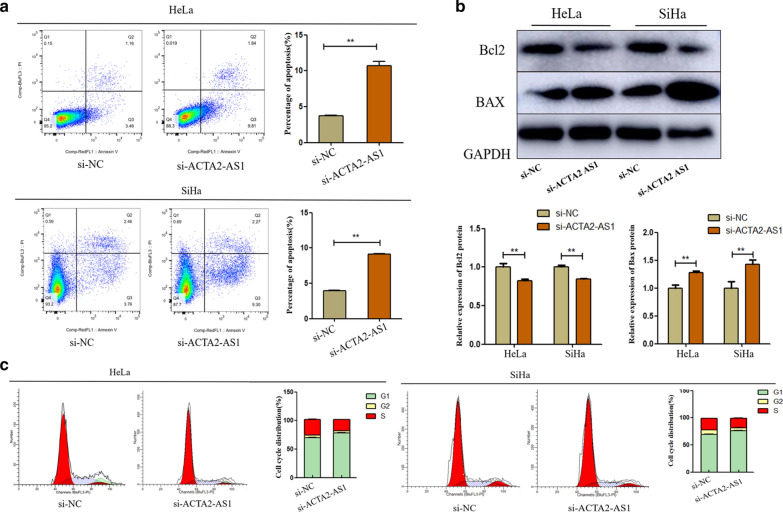
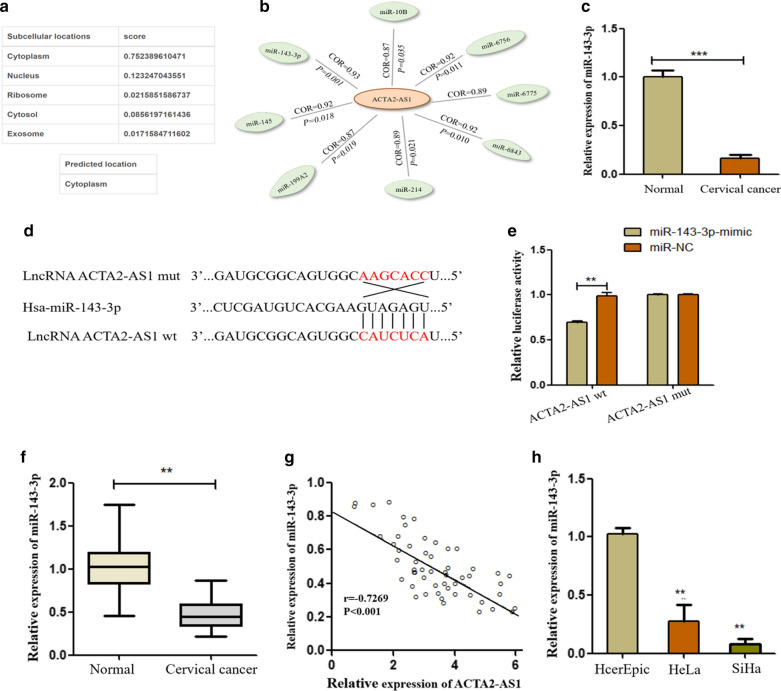
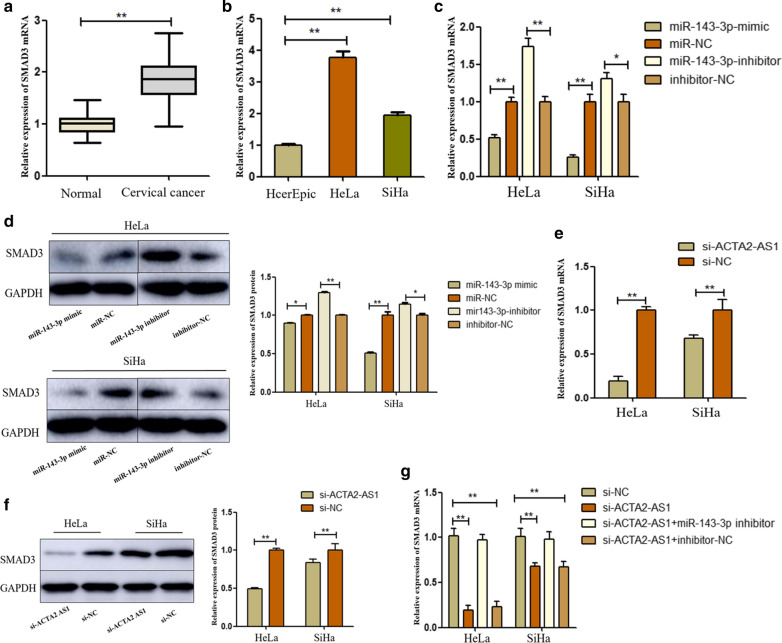
ACTA2-AS1 was significantly increased in CC tissues and cells and miR-143-3p was down-regulated. Clinically, the higher expression of ACTA2-AS1 was significantly correlated with higher FIGO stage. Loss-of-function assay revealed that silencing of ACTA2-AS1 inhibited cell proliferation, colony formation, migration and promoted apoptosis in CC. Additionally, Pearson correlation analysis showed that the expression of ACTA2-AS1 and miR-143-3p were negatively correlated. Dual-luciferase reporter assay and further mechanistic experiments confirmed that ACTA2-AS1 could sponge and regulate the expression of miR-143-3p. Furthermore, SMAD3 was the target gene of miR-143-3p and ACTA2-AS1 could upregulate SMAD3 through acting as a competitive endogenous RNA (ceRNA) of miR-143-3p. Finally, rescue assay demonstrated that the ACTA2-AS1/miR-143-3p/SMAD3 axis played an important role in the proliferation, migration and apoptosis of CC cells.
In summary, our study revealed that ACTA2-AS1 upregulates SMAD3 by competitively binding miR-143-3p, thereby accelerating CC progression. The ACTA2-AS1/miR-143-3p/SMAD3 axis can play a crucial role in cervical carcinogenesis, providing new clues for the early diagnosis and treatment of CC.
长链非编码RNA(LncRNAs)已越来越多地被证实于人类癌症中异常表达,且与肿瘤发生密切相关。LncRNA ACTA2-AS1在多种肿瘤中异常表达并参与其发展。然而,ACTA2-AS1是否在宫颈癌(CC)发展中发挥作用及其确切作用机制尚未阐明。
采用定量实时PCR(qRT-PCR)检测肿瘤组织和细胞中ACTA2-AS1、miR-143-3p和SMAD3信使RNA的表达水平。此外,通过蛋白质免疫印迹法检测细胞中SMAD3蛋白表达。设计针对ACTA2-AS1或SMAD3的小干扰RNA以及miR-143-3p模拟物/抑制剂,并转染至CC细胞系,以研究它们之间的相关性及其对细胞功能的潜在影响。进行细胞计数试剂盒-8(CCK-8)检测、集落形成实验、细胞周期检测、Transwell检测和流式细胞术分析,以检测对细胞系增殖、转移和凋亡的具体影响。
ACTA2-AS1在CC组织和细胞中显著升高,而miR-143-3p下调。临床上,ACTA2-AS1的高表达与较高的国际妇产科联盟(FIGO)分期显著相关。功能丧失实验表明,沉默ACTA2-AS1可抑制CC细胞的增殖、集落形成、迁移并促进凋亡。此外,Pearson相关性分析显示,ACTA2-AS1与miR-143-3p的表达呈负相关。双荧光素酶报告基因检测及进一步的机制实验证实,ACTA2-AS1可吸附并调节miR-143-3p的表达。此外,SMAD3是miR-143-3p的靶基因,ACTA2-AS1可作为miR-143-3p的竞争性内源RNA(ceRNA)上调SMAD3。最后,拯救实验表明,ACTA2-AS1/miR-143-3p/SMAD3轴在CC细胞的增殖、迁移和凋亡中起重要作用。
总之,我们的研究表明,ACTA2-AS1通过竞争性结合miR-143-3p上调SMAD3,从而加速CC进展。ACTA2-AS1/miR-143-3p/SMAD3轴在宫颈癌发生中起关键作用,为CC的早期诊断和治疗提供了新线索。