Fioretti Alessandra, Natalini Eleonora, Riedl David, Moschen Roland, Eibenstein Alberto
Tinnitus Center, European Hospital, Rome, Italy.
University Clinic of Medical Psychology, Medical University of Innsbruck, Innsbruck, Austria.
Front Neurosci. 2020 Jul 7;14:704. doi: 10.3389/fnins.2020.00704. eCollection 2020.
In the last decades, research focused on gender-related features in patients with tinnitus has often led to controversial results. The complex clinical picture of tinnitus patients often consists of an interdependent relationship between audiological symptoms and co-occurrent psychological disorders, which can complicate the diagnostic evaluation.
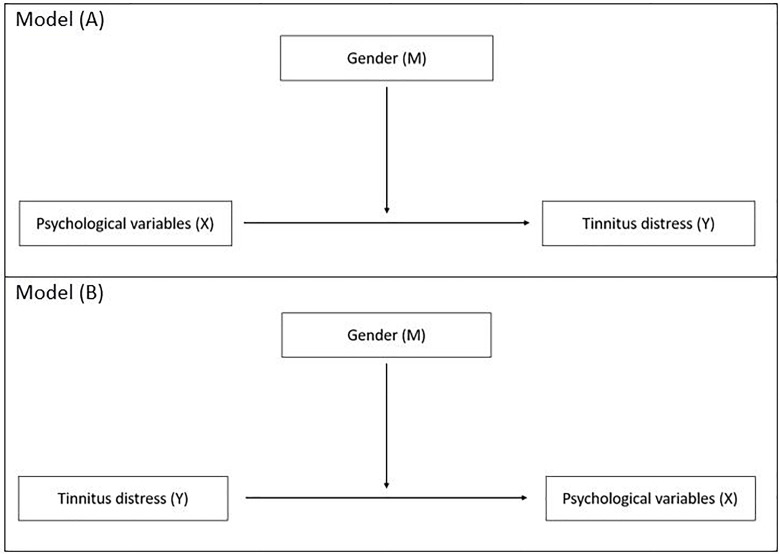
Therefore, we studied 107 patients with tinnitus, investigating their psychological comorbidities in the light of gender differences. All patients were evaluated with ENT/audiological and psychological examination to consider presence/absence, type and gender distribution of psychopathological comorbidities. Patients completed questionnaires on tinnitus distress (Tinnitus Handicap Inventory, THI), anxiety (Beck Anxiety Inventory, BAI), depression (Beck Depression Inventory, BDI), metacognition (Metacognition Questionnaire-30, MCQ-30) and worry (Penn State Worry Questionnaire). The influence of gender on the relationship between tinnitus distress and psychological comorbidities was investigated with simple moderation analyses using the SPSS PROCESS macro.
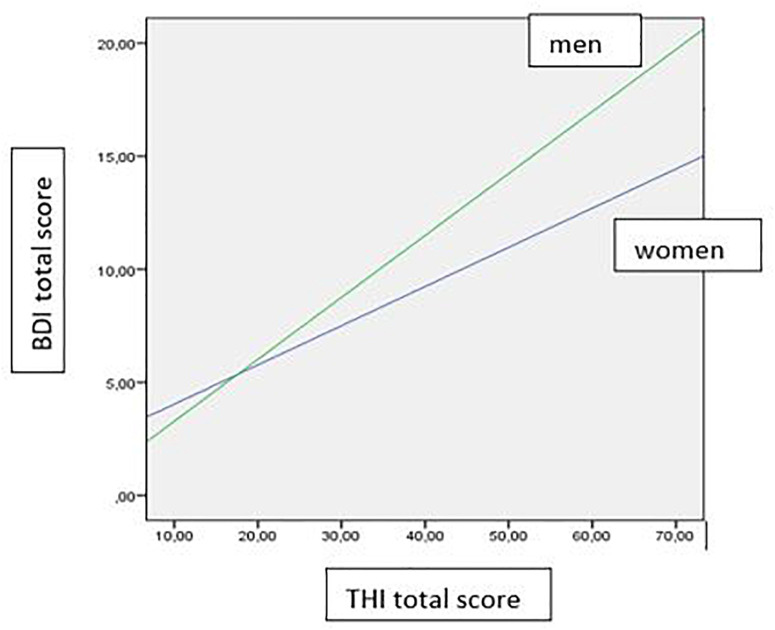
The total sample included 65 male and 42 female patients (60.7 vs. 39.3%), matched for age and duration of tinnitus. We found no significant differences for tinnitus distress (THI total score, THI subscales) and MCQ-30 subscales, except for the control over thoughts, where men showed significantly higher scores than women ( = 0.045). Also, in our sample women showed significantly higher values for depression (BDI total score, = 0.019), anxiety (BAI total score, = 0.010) and worries (PSQW total score, = 0.015). Moderation analyses revealed a significant influence of gender on the relationship of tinnitus distress with depression: higher scores of tinnitus distress were associated with significantly elevated levels of depression amongst men. No further gender influences could be observed in our sample.
In conclusion, our results indicate general gender differences for psychological comorbidities in tinnitus patients, with women reporting more depression, anxiety and worries. Men, on the other hand, showed a higher need to control their thoughts. Additionally, our results indicate that men might have more coping problems with increasing levels of tinnitus distress, leading to increased depressive symptoms. Nevertheless, several gender related aspects in tinnitus patients remain unclear, thus warranting the need future studies in this field.
在过去几十年中,针对耳鸣患者性别相关特征的研究常常得出相互矛盾的结果。耳鸣患者复杂的临床症状通常包括听力症状与并发心理障碍之间的相互依存关系,这会使诊断评估变得复杂。
因此,我们研究了107例耳鸣患者,根据性别差异调查他们的心理共病情况。所有患者均接受耳鼻喉科/听力和心理检查,以考虑心理病理共病的存在与否、类型及性别分布。患者完成了关于耳鸣困扰(耳鸣障碍量表,THI)、焦虑(贝克焦虑量表,BAI)、抑郁(贝克抑郁量表,BDI)、元认知(元认知问卷-30,MCQ-30)和担忧(宾夕法尼亚州立大学担忧问卷)的问卷调查。使用SPSS PROCESS宏通过简单调节分析研究性别对耳鸣困扰与心理共病之间关系的影响。
总样本包括65例男性和42例女性患者(60.7%对39.3%),年龄和耳鸣持续时间相匹配。我们发现耳鸣困扰(THI总分、THI子量表)和MCQ-30子量表没有显著差异,但在对思维的控制方面,男性得分显著高于女性(P = 0.045)。此外,在我们的样本中,女性在抑郁(BDI总分,P = 0.019)、焦虑(BAI总分,P = 0.010)和担忧(PSQW总分,P = 0.015)方面得分显著更高。调节分析显示性别对耳鸣困扰与抑郁之间的关系有显著影响:耳鸣困扰得分越高,男性中的抑郁水平显著升高。在我们的样本中未观察到进一步的性别影响。
总之,我们的结果表明耳鸣患者心理共病存在一般性别差异,女性报告的抑郁、焦虑和担忧更多。另一方面,男性表现出更高的控制思维的需求。此外,我们的结果表明,随着耳鸣困扰程度的增加,男性可能有更多的应对问题,导致抑郁症状增加。然而,耳鸣患者中几个与性别相关的方面仍不清楚,因此有必要在该领域进行未来研究。