Department of Physics & Astronomy, Texas Christian University, Fort Worth, TX, United States of America.
PLoS One. 2020 Aug 10;15(8):e0236976. doi: 10.1371/journal.pone.0236976. eCollection 2020.
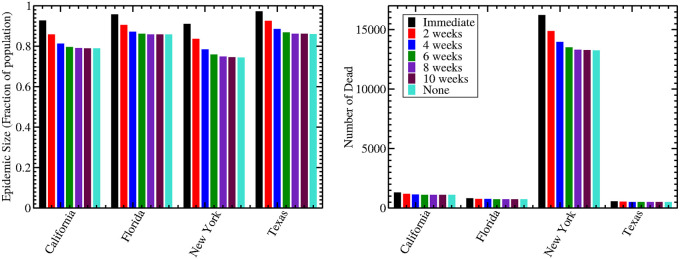
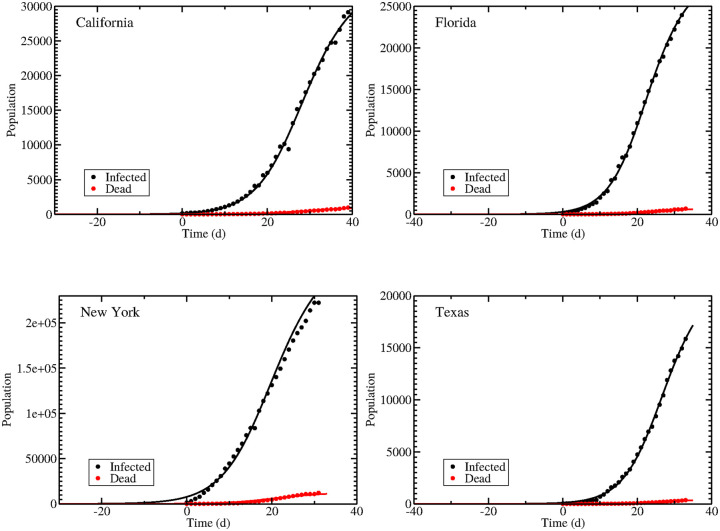
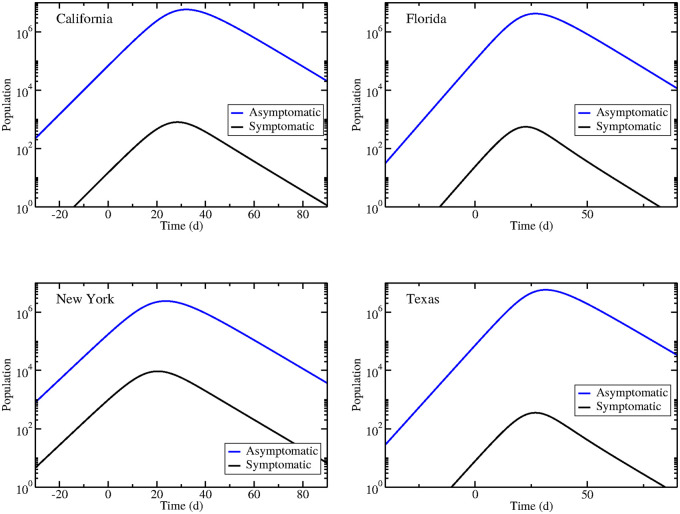
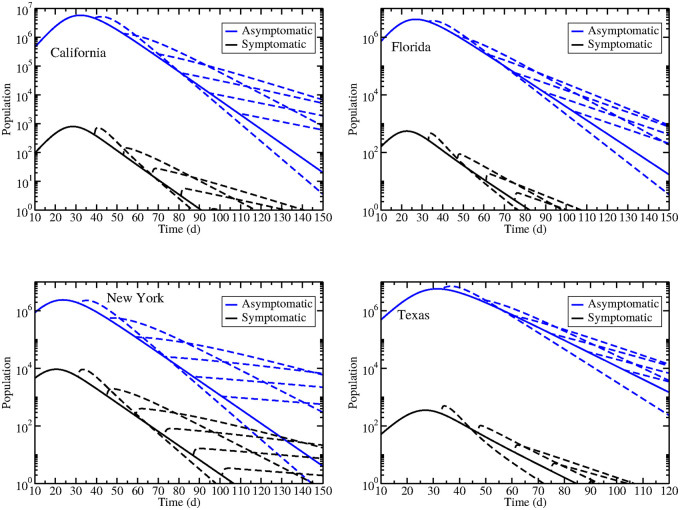
SARS-CoV-2 started causing infections in humans in late 2019 and has spread rapidly around the world. While the number of symptomatically infected and severely ill people is high and has overwhelmed the medical systems of many countries, there is mounting evidence that some of the rapid spread of this virus has been driven by asymptomatic infections. In this study, we use a compartmental mathematical model of a viral epidemic that includes asymptomatic infection to examine the role of asymptomatic individuals in the spread of the infection. We apply the model to epidemics in California, Florida, New York, and Texas, finding that asymptomatic infections far outnumber reported symptomatic infections at the peak of the epidemic in all four states. The model suggests that relaxing of social distancing measures too quickly could lead to a rapid rise in the number of cases, driven in part by asymptomatic infections.
SARS-CoV-2 于 2019 年末开始在人类中引发感染,并迅速在全球范围内传播。虽然症状感染和重症患者的数量很高,已经使许多国家的医疗系统不堪重负,但越来越多的证据表明,这种病毒的快速传播部分是由无症状感染驱动的。在这项研究中,我们使用了一个包含无症状感染的病毒流行的房室数学模型来研究无症状个体在感染传播中的作用。我们将该模型应用于加利福尼亚、佛罗里达、纽约和得克萨斯州的流行疫情,发现无症状感染的数量远远超过了这四个州疫情高峰期报告的有症状感染数量。该模型表明,过快放宽社会距离措施可能导致病例数量迅速上升,部分原因是无症状感染。