Lim Hee-Sook, Choi Joungyun, Lee Bora, Kim Sang Gyune, Kim Young Seok, Yoo Jeong-Ju
Department of Food Sciences & Nutrition, Yeonsung University, Anyang 14011, Korea.
Department of Health and Nutrition Survey, Korean Centers for Disease Control & Prevention, Cheongju 28159, Korea.
Clin Nutr Res. 2020 Jul 28;9(3):182-194. doi: 10.7762/cnr.2020.9.3.182. eCollection 2020 Jul.
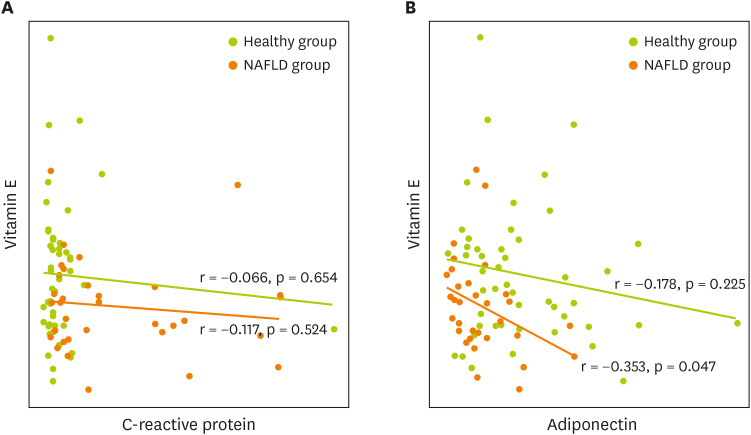
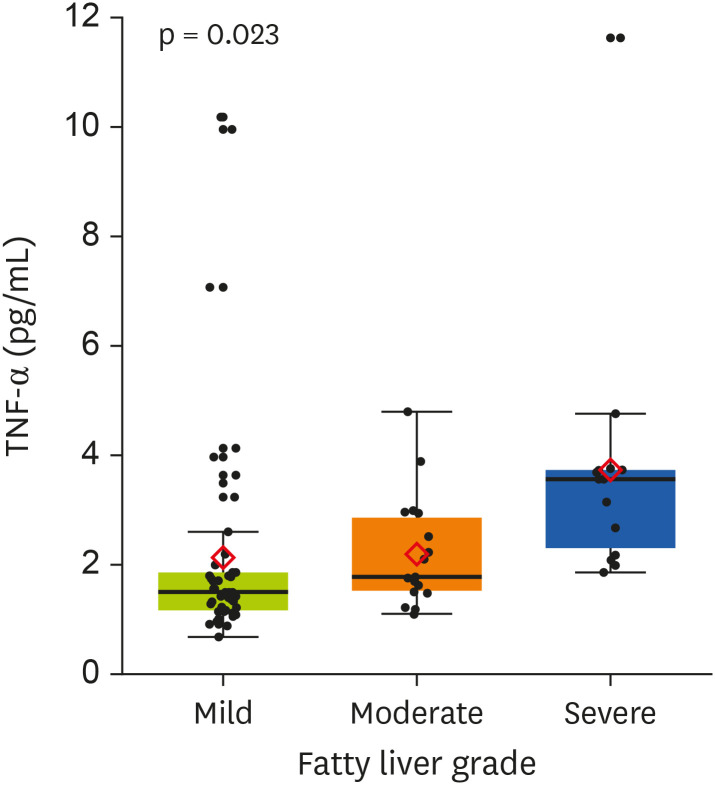
The prevalence and progression of non-alcoholic fatty liver disease (NAFLD) is mediated via several factors correlating with hepatic necroinflammation (adipokines/cytokines). This study was performed to analyze the level of inflammatory markers according to the presence of NAFLD and to identify related nutritional factors. A total of 80 adults were classified into 2 groups (healthy and NAFLD), and their body composition, blood tests, and eating habits were evaluated. In addition, inflammatory markers (adiponectin, high-sensitivity C-reactive protein [CRP], and tumor necrosis factor-alpha [TNF-α]), nutrient intake status, and dietary quality were compared. The quality of diet was assessed according to the nutrient adequacy ratio and the mean adequacy ratio (MAR). The NAFLD group had a higher body mass index (p < 0.001) than the healthy group and also carried significantly higher CRP levels (p < 0.001) but lower adiponectin (p = 0.001). TNF-α levels increased significantly with fatty liver grade (p = 0.023). The NAFLD group showed significantly higher intake of energy, carbohydrates, iron, sodium, vitamin A and saturated fatty acids, but significantly lower intake of zinc and vitamin E than the healthy group. The MAR values were slightly higher in the NAFLD group but without any significant difference. The levels of adiponectin and vitamin E showed a significant inverse correlation (p < 0.05). Nutritional management of NAFLD patients is important, and the intake of antioxidant and anti-inflammatory nutrients such as zinc and vitamin E should be emphasized.
非酒精性脂肪性肝病(NAFLD)的患病率和进展是由与肝脏坏死性炎症相关的几个因素(脂肪因子/细胞因子)介导的。本研究旨在根据NAFLD的存在情况分析炎症标志物水平,并确定相关的营养因素。总共80名成年人被分为两组(健康组和NAFLD组),评估了他们的身体成分、血液检查和饮食习惯。此外,还比较了炎症标志物(脂联素、高敏C反应蛋白[CRP]和肿瘤坏死因子-α[TNF-α])、营养摄入状况和饮食质量。根据营养素充足率和平均充足率(MAR)评估饮食质量。NAFLD组的体重指数高于健康组(p<0.001),CRP水平也显著更高(p<0.001),但脂联素水平更低(p=0.001)。TNF-α水平随脂肪肝分级显著升高(p=0.023)。与健康组相比,NAFLD组的能量、碳水化合物、铁、钠、维生素A和饱和脂肪酸摄入量显著更高,但锌和维生素E摄入量显著更低。NAFLD组的MAR值略高,但无显著差异。脂联素水平与维生素E水平呈显著负相关(p<0.05)。NAFLD患者的营养管理很重要,应强调摄入抗氧化和抗炎营养素,如锌和维生素E。