Institute of Ethnology and Anthropology, Russian Academy of Sciences, Leninsky Prospect 32a, 119991, Moscow, Russia.
National Research University Higher School of Economics, Moscow, Russia.
J Physiol Anthropol. 2020 Aug 14;39(1):20. doi: 10.1186/s40101-020-00232-y.
The specific role of the oxytocin receptor (OXTR) gene polymorphisms in emotional support seeking, related to social norms and culturally normative behavior, has been discussed in several studies. Evidence on the association between aggression and OXTR polymorphisms has also been reported. The goal of the current study was to analyze the effect of the OXTR rs53576 polymorphism, prenatal testosterone effect (second-to-fourth digit ratio, or 2D:4D), and culture on aggression assessed with the Buss-Perry Aggression Questionnaire (BPAQ).
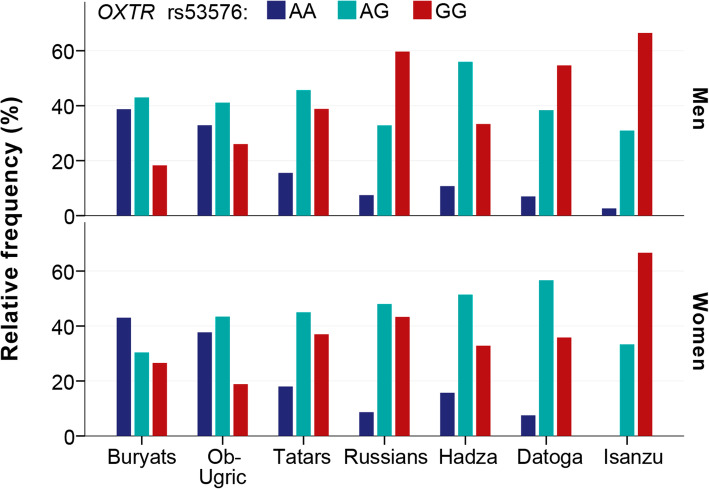
The data were collected in Russia and Tanzania and included seven ethnic groups of European, Asian, and African origin. The total sample included 1705 adults (837 males, 868 females). All the subjects were evaluated with the BPAQ. As a measure of prenatal androgenization, the second and fourth digits were measured directly from hand, and the digit ratios were calculated. All the participants provided buccal samples, from which genomic DNA was extracted, and the OXTR gene rs53576 polymorphism was genotyped. Statistical analysis was performed using SPSS version 23.0; the alpha level for all analyses was set at 0.05.
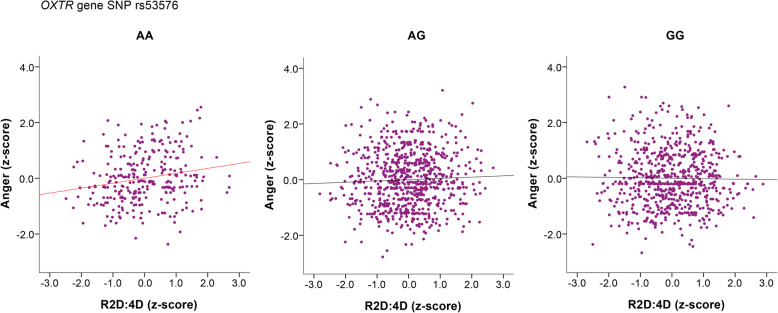
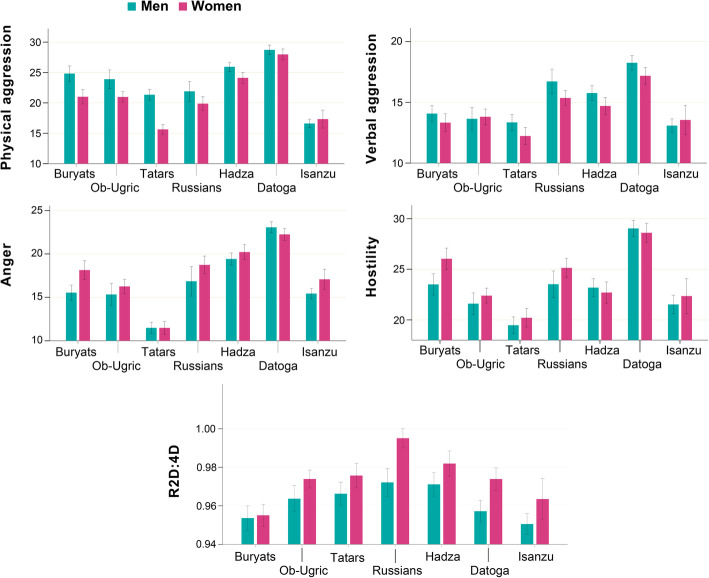
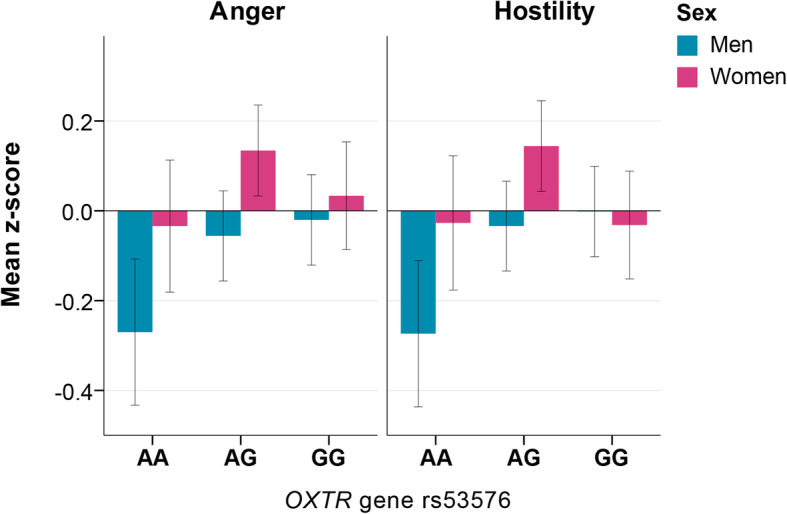
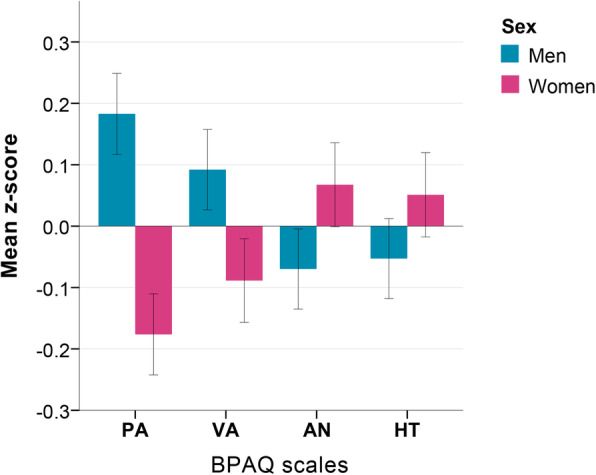
The ethnic group factor was the most significant predictor of ratings on BPAQ (medium effect size for physical aggression, anger and hostility scales, and low for verbal aggression). To study the effect of sex, the OXTR polymorphism, and prenatal androgenization, we conducted the z-score transformation for BPAQ scales and 2D:4D for each ethnic group and pooled these data into new z-score variables. According to the GLM analysis after leveling the effects of culture (z-transformation), all four scales of BPAQ demonstrated association with sex (main effects), with men scoring higher on physical and verbal aggression and women scoring higher on anger and hostility. Anger and hostility scales were also associated with OXTR polymorphism and 2D:4D of the right hand. The lowest levels of anger and hostility were observed in individuals with the AA genotype, especially in men.
Our data suggest that both oxytocin (OXTR gene polymorphism) and fetal testosterone (2D:4D) may significantly affect emotional (anger) and cognitive (hostility) aggression in humans, given the leveling the role of culture.
催产素受体(OXTR)基因多态性在情感支持寻求中的特定作用与社会规范和文化规范行为有关,已在多项研究中进行了讨论。也有研究报道了攻击行为与 OXTR 多态性之间的关系。本研究的目的是分析 OXTR rs53576 多态性、产前睾酮效应(第二到第四指比,或 2D:4D)和文化对 Buss-Perry 攻击问卷(BPAQ)评估的攻击性的影响。
数据来自俄罗斯和坦桑尼亚,包括欧洲、亚洲和非洲血统的七个民族群体。总样本包括 1705 名成年人(837 名男性,868 名女性)。所有受试者均接受 BPAQ 评估。作为产前雄激素化的衡量标准,直接从手部测量第二和第四指,并计算指比率。所有参与者均提供口腔样本,从中提取基因组 DNA,并对 OXTR 基因 rs53576 多态性进行基因分型。使用 SPSS 版本 23.0 进行统计分析;所有分析的 alpha 水平均设为 0.05。
民族群体因素是 BPAQ 评分的最显著预测因子(身体攻击、愤怒和敌意量表的中等效应大小,言语攻击的低效应大小)。为了研究性别的影响、OXTR 多态性和产前雄激素化,我们对每个民族群体的 BPAQ 量表和 2D:4D 进行了 z 分数转换,并将这些数据合并为新的 z 分数变量。根据 GLM 分析(在文化影响水平化后),BPAQ 的四个量表均与性别(主效应)相关,男性在身体和言语攻击方面得分较高,女性在愤怒和敌意方面得分较高。愤怒和敌意量表也与 OXTR 多态性和右手的 2D:4D 相关。AA 基因型个体的愤怒和敌意水平最低,尤其是男性。
我们的数据表明,催产素(OXTR 基因多态性)和胎儿睾酮(2D:4D)都可能显著影响人类的情感(愤怒)和认知(敌意)攻击,这取决于文化的作用水平。