KBR, 511147, Cologne, Germany.
Space Medicine Team, European Astronaut Centre, European Space Agency, 51147, Cologne, Germany.
Sci Rep. 2020 Aug 14;10(1):13836. doi: 10.1038/s41598-020-70054-6.
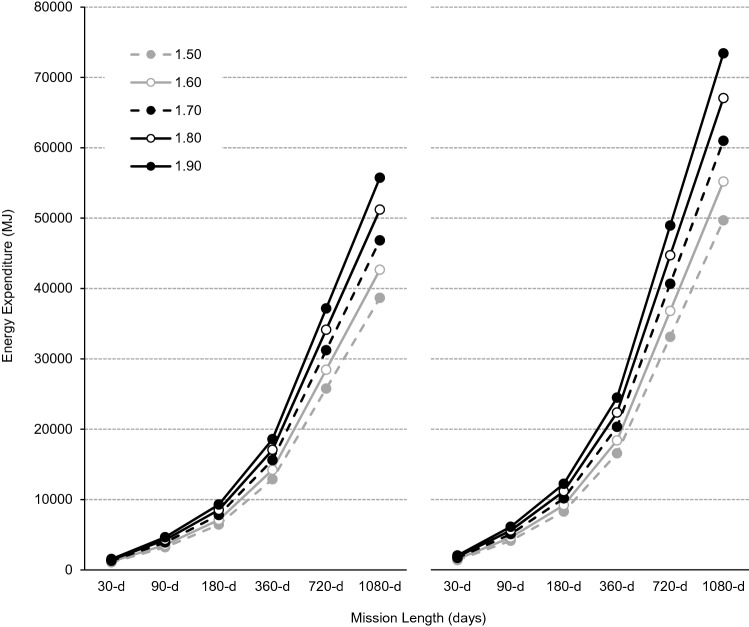
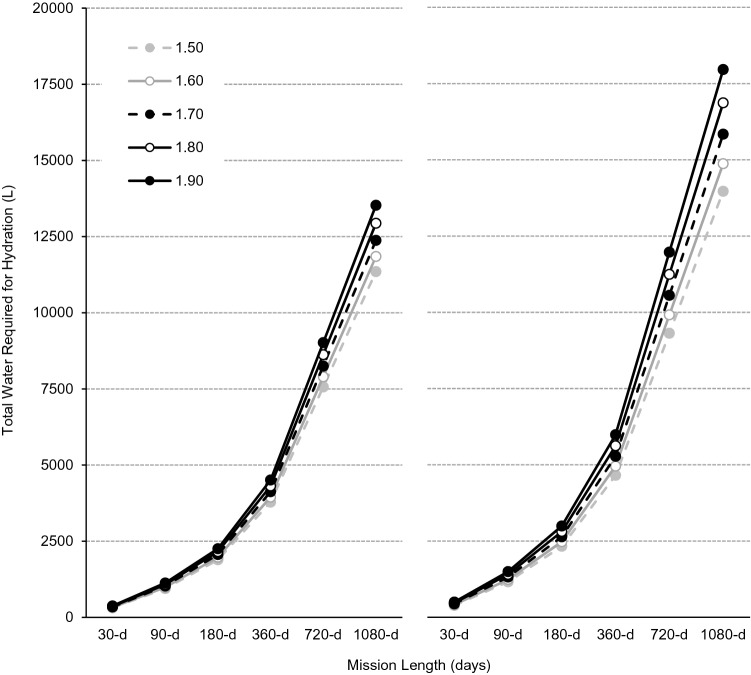
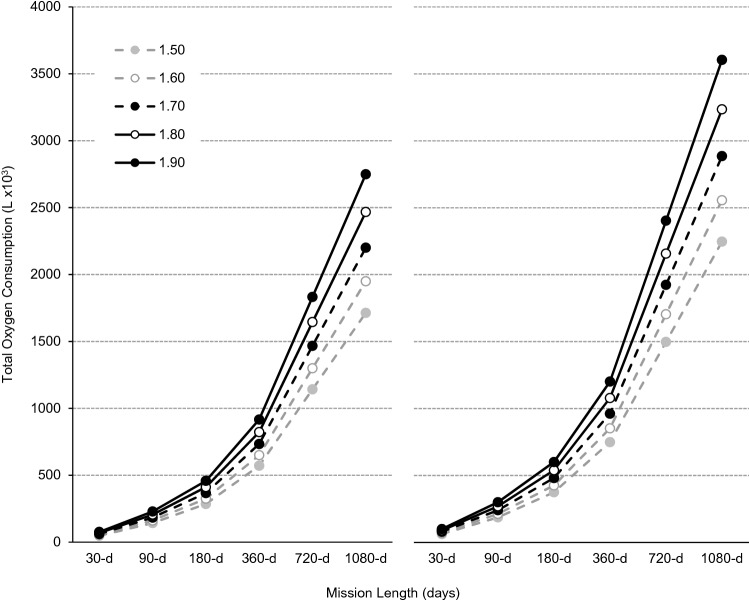
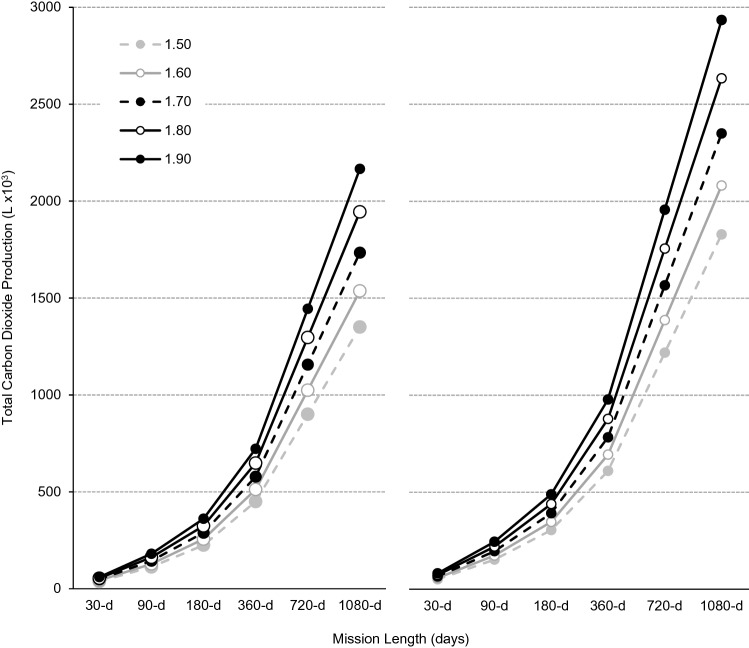
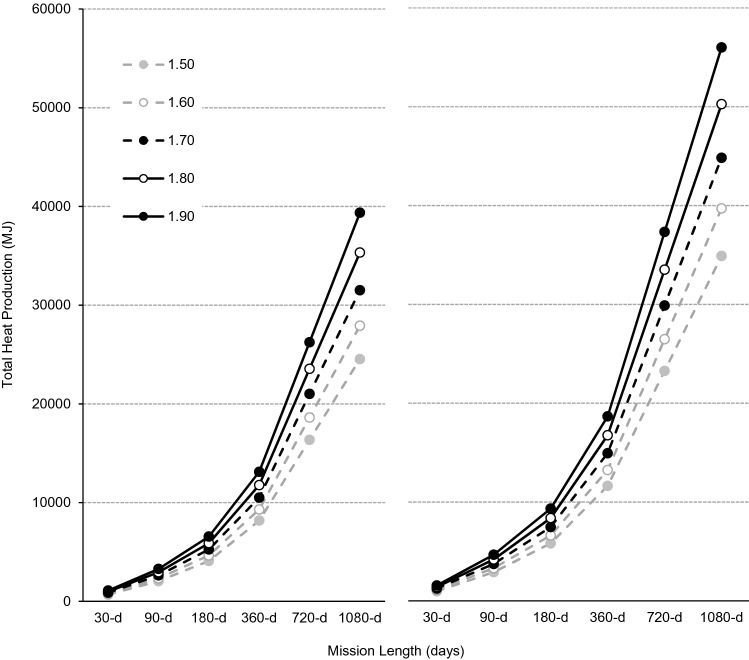
The purpose of this theoretical study was to estimate the effects of body size and countermeasure (CM) exercise in an all-male crew composed of individuals drawn from a height range representative of current space agency requirements upon total energy expenditure (TEE), oxygen (O) consumption, carbon dioxide (CO) and metabolic heat (H) production, and water requirements for hydration, during space exploration missions. Using a height range of 1.50- to 1.90-m, and assuming geometric similarity across this range, estimates were derived for a four-person male crew (age: 40-years; BMI: 26.5-kg/m; resting VO and VO: 3.3- and 43.4-mL/kg/min) on 30- to 1,080-d missions, without and with, ISS-like CM exercise (modelled as 2 × 30-min aerobic exercise at 75% VO, 6-d/week). Where spaceflight-specific data/equations were not available, terrestrial data/equations were used. Body size alone increased 24-h TEE (+ 44%), O consumption (+ 60%), CO (+ 60%) and H (+ 60%) production, and water requirements (+ 19%). With CM exercise, the increases were + 29 to 32%, + 31%, + 35%, + 42% and + 23 to 33% respectively, across the height range. Compared with a 'small-sized' (1.50-m) crew without CM exercise, a 'large-sized' (1.90-m) crew exercising would require an additional 996-MJ of energy, 52.5 × 10-L of O and 183.6-L of water, and produce an additional 44.0 × 10-L of CO and 874-MJ of heat each month. This study provides the first insight into the potential implications of body size and the use of ISS-like CM exercise upon the provision of life-support during exploration missions. Whilst closed-loop life-support (O, water and CO) systems may be possible, strategies to minimize and meet crew metabolic energy needs, estimated in this study to increase by 996-MJ per month with body size and CM exercise, are required.
本理论研究的目的是估算个体身高在当前航天局要求范围内的全男性机组人员的体型大小和对策(CM)运动对总能量消耗(TEE)、氧气(O)消耗、二氧化碳(CO)和代谢热(H)产生以及水合所需的水的影响,在太空探索任务期间。使用 1.50 至 1.90 米的身高范围,并假设在此范围内存在几何相似性,根据 4 名年龄为 40 岁、BMI 为 26.5-kg/m2、静息 VO 和 VO2 为 3.3-和 43.4-mL/kg/min 的男性机组人员的 30 至 1080 天任务,得出了没有和有国际空间站(ISS)类似 CM 运动的估计值(模拟为 2x30 分钟的 75% VO 有氧运动,每周 6 天)。在没有可用的太空飞行特定数据/方程的情况下,使用了地球数据/方程。仅体型大小就使 24 小时 TEE(增加 44%)、O 消耗(增加 60%)、CO(增加 60%)和 H(增加 60%)的产生以及水的需求(增加 19%)增加。如果进行 CM 运动,在整个身高范围内,增加幅度分别为 29%至 32%、31%、35%、42%和 23%至 33%。与没有 CM 运动的“小体型”(1.50 米)机组人员相比,“大体型”(1.90 米)机组人员在进行 CM 运动时将需要额外的 996-MJ 能量、52.5x10-L 的 O 和 183.6-L 的水,并且每月会产生额外的 44.0x10-L 的 CO 和 874-MJ 的热量。这项研究首次深入了解了体型大小和使用类似于国际空间站的 CM 运动对探索任务期间生命支持的潜在影响。虽然闭环生命支持(O、水和 CO)系统可能是可行的,但需要制定策略来最小化和满足机组人员的代谢能量需求,本研究估计这种需求每月会增加 996-MJ,与体型大小和 CM 运动有关。