Choi Maro, Suh Chunhui, Choi Seong Pil, Lee Chae Kwan, Son Byung Chul
Department of Occupational and Environmental Medicine & Institute of Environmental and Occupational Medicine, Inje University Pusan Paik Hospital, Busan, Korea.
Ann Occup Environ Med. 2020 Jul 16;32:e27. doi: 10.35371/aoem.2020.32.e27. eCollection 2020.
The purpose of this study was to assess the reliability and validity of the 3-item version of the Work Engagement Scale (WES-3), which is based on the Job Demands-Resources (JD-R) model and was used in the 5 Korean Working Conditions Survey (KWCS).
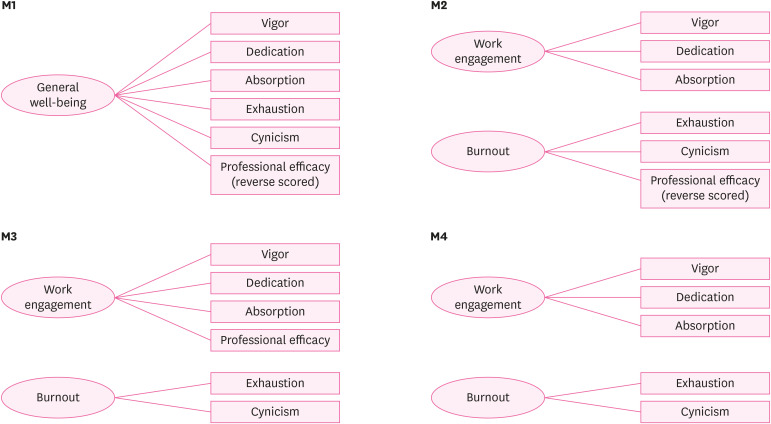
This study used data from the 5th KWCS (n = 50,205), which was conducted in 2017 with a sample of the Korean working population. The survey gathered comprehensive information on working conditions to define workforce changes and the quality of work and life. The reliability and internal consistency of the WES-3 were assessed using the corrected item-total correlation and Cronbach's alpha coefficient. Confirmatory factor analysis (CFA) was used to test the construct validity of work engagement. The convergent validity was assessed using the correlation with the WHO-5 well-being index. Correlations between work engagement and JD-R factors were also calculated.
The Cronbach's alpha for work engagement was 0.776, indicating acceptable internal consistency. The model comprising 3 work engagement and 2 burnout items showed an excellent fit (χ: 382.05, Tucker-Lewis index: 0.984, comparative fit index: 0.994, root mean square error of approximation: 0.043). The convergent validity was significant (correlation coefficient: 0.42). Correlations with burnout and job demands were negligible, whereas correlations with job resources and job satisfaction were weakly positive.
The results of our study confirm that the WES-3 has acceptable reliability and validity.
本研究旨在评估工作投入量表3项版本(WES-3)的信度和效度,该量表基于工作要求-资源(JD-R)模型,用于第五次韩国工作条件调查(KWCS)。
本研究使用了第五次KWCS(n = 50,205)的数据,该调查于2017年对韩国工作人群样本进行。该调查收集了关于工作条件的全面信息,以确定劳动力变化以及工作和生活质量。使用校正的项目-总分相关系数和克朗巴哈α系数评估WES-3的信度和内部一致性。采用验证性因素分析(CFA)来检验工作投入的结构效度。使用与世界卫生组织5项幸福指数的相关性评估收敛效度。还计算了工作投入与JD-R因素之间的相关性。
工作投入的克朗巴哈α系数为0.776,表明内部一致性可接受。由3项工作投入和2项倦怠项目组成的模型显示出良好的拟合度(χ:382.05,塔克-刘易斯指数:0.984,比较拟合指数:0.994,近似均方根误差:0.043)。收敛效度显著(相关系数:0.42)。与倦怠和工作要求的相关性可忽略不计,而与工作资源和工作满意度的相关性呈弱正相关。
我们的研究结果证实WES-3具有可接受的信度和效度。