Park Bo Gi, Kim Yu Jin, Min Ji Hyun, Cheong Taek-Chin, Nam Sang Hwan, Cho Nam-Hyuk, Kim Young Keun, Lee Kyu Back
Department of Biomedical Engineering, College of Health Science, Korea University, Seoul, 02841, South Korea.
Institute for High Technology Materials and Devices, College of Engineering, Korea University, Seoul, 02841, South Korea.
Nanoscale Res Lett. 2020 Aug 17;15(1):165. doi: 10.1186/s11671-020-03395-w.
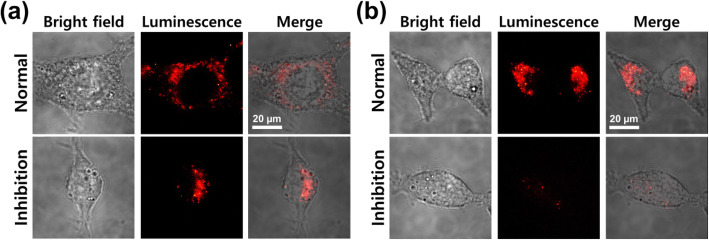
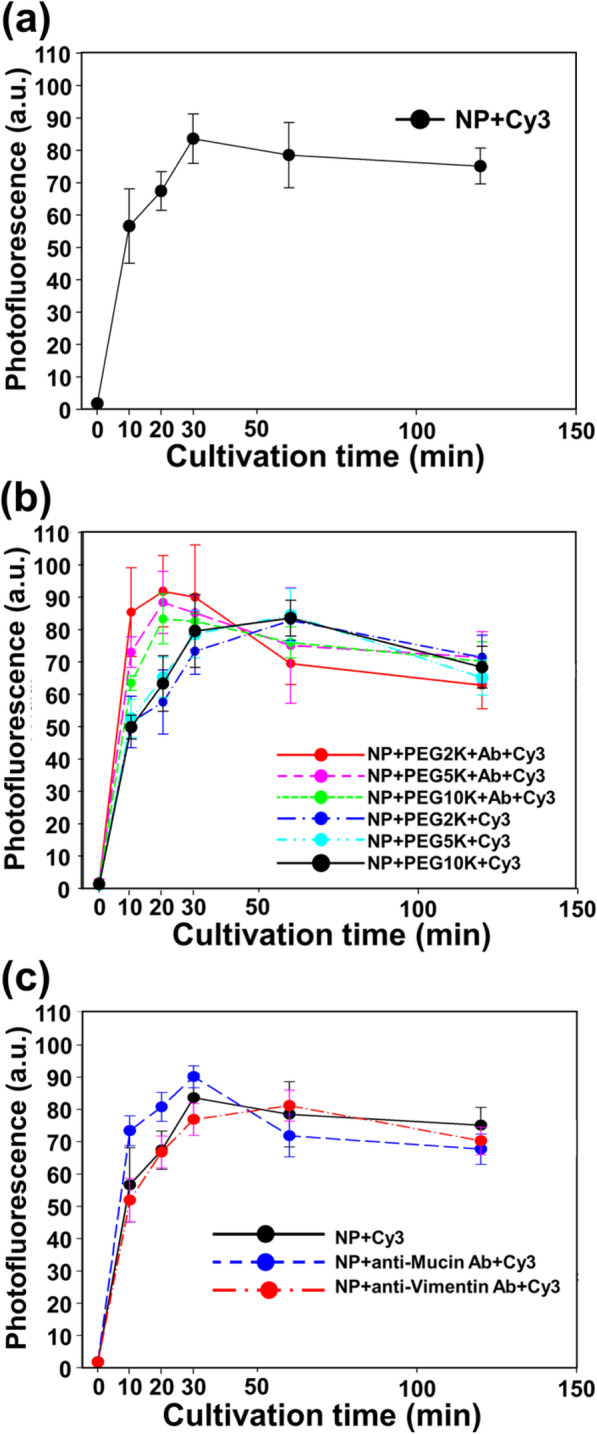
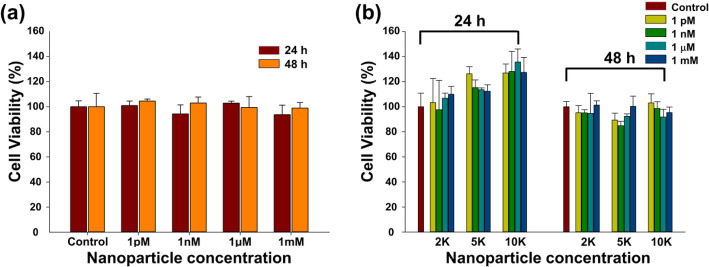
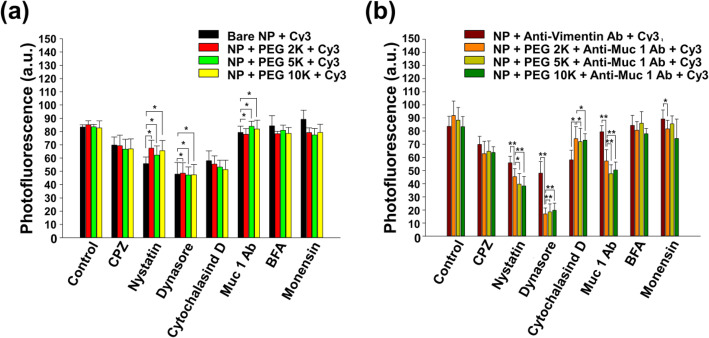
Magnetite (FeO)-gold (Au) core-shell nanoparticles (NPs) have unique magnetic and optical properties. When combined with biological moieties, these NPs can offer new strategies for biomedical applications, such as drug delivery and cancer targeting. Here, we present an effective method for the controllable cellular uptake of magnetic core-shell NP systems combined with biological moieties. Vimentin, which is the structural protein, has been biochemically confirmed to affect phagocytosis potently. In addition, vimentin affects exogenic materials internalization into cells even though under multiple inhibitions of biological moieties. In this study, we demonstrate the cellular internalization performance of FeO-Au core-shell NPs with surface modification using a combination of biological moieties. The photofluorescence of vimentin-tagged NPs remained unaffected under multiple inhibition tests, indicating that the NPs were minimally influenced by nystatin, dynasore, cytochalasin D, and even the Muc1 antibody (Ab). Consequently, this result indicates that the Muc1 Ab can target specific molecules and can control specific endocytosis. Besides, we show the possibility of controlling specific endocytosis in colorectal cancer cells.
磁铁矿(FeO)-金(Au)核壳纳米颗粒(NPs)具有独特的磁性和光学特性。当与生物部分结合时,这些纳米颗粒可为生物医学应用提供新策略,如药物递送和癌症靶向。在此,我们提出一种有效方法,用于可控地将磁性核壳NP系统与生物部分结合并使其被细胞摄取。波形蛋白作为一种结构蛋白,已通过生物化学方法证实其能有效影响吞噬作用。此外,波形蛋白即使在生物部分的多种抑制作用下,仍会影响外源性物质进入细胞。在本研究中,我们展示了通过结合生物部分对表面进行修饰的FeO-Au核壳纳米颗粒的细胞内化性能。在多次抑制试验下,波形蛋白标记的纳米颗粒的光荧光保持不变,这表明纳米颗粒受制霉菌素、dynasore、细胞松弛素D甚至Muc1抗体(Ab)的影响极小。因此,该结果表明Muc1抗体可靶向特定分子并能控制特定的内吞作用。此外,我们展示了在结肠癌细胞中控制特定内吞作用的可能性。