Department of Pharmacy, Pharmaceutical Technology and Biopharmaceutics, Ludwig-Maximilians-University Munich, Butenandtstr. 5-13, Munich 81377, Germany.
University of Stuttgart, Institute of Polymer Chemistry, Chair of Macromolecular Materials and Fiber Chemistry, Pfaffenwaldring 55, Stuttgart 70569, Germany.
Mol Pharm. 2023 Sep 4;20(9):4505-4516. doi: 10.1021/acs.molpharmaceut.3c00206. Epub 2023 Aug 14.
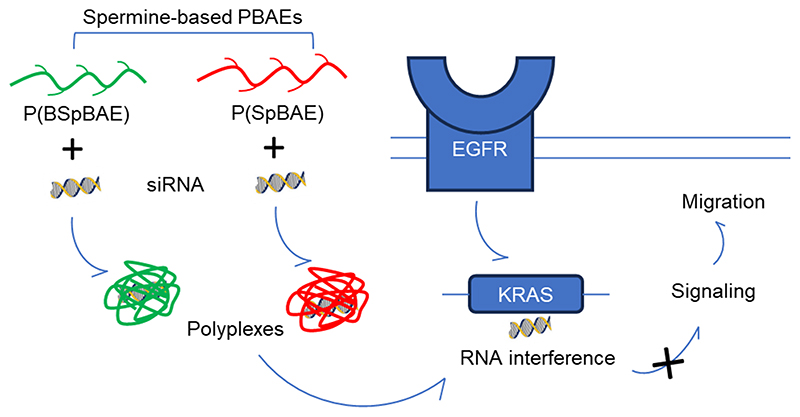
Polyethylenimine (PEI) is a highly efficient cationic polymer for nucleic acid delivery, and although it is commonly used in preclinical studies, its clinical application is limited because of concerns regarding its cytotoxicity. Poly(β-amino ester)s are a new group of biodegradable and biocompatible cationic polymers that can be used for siRNA delivery. In this study, we synthesized Boc-protected and deprotected poly(β-amino ester)s, P(BSpBAE) and P(SpBAE), respectively, based on spermine and 1,4-butanediol diacrylate to deliver siRNA. The polymers were synthesized by Michael addition in a step-growth polymerization and characterized via H NMR spectroscopy and size-exclusion chromatography (SEC). The polymers can encapsulate siRNA as determined by SYBR gold assays. Both polymers and polyplexes were biocompatible in vitro. Furthermore, the cellular uptake of P(BSpBAE) and P(SpBAE) polyplexes was more efficient than for branched PEI (25 kDa) polyplexes at the same N/P ratios. P(BSpBAE) polyplexes achieved 60% eGFP knockdown in vitro, which indicates that the Boc-protection can improve the siRNA delivery and gene silencing efficiency of PBAEs. P(BSpBAE) polyplexes and P(SpBAE) polyplexes showed different cellular uptake mechanisms, and P(BSpBAE) polyplexes demonstrated decreased endosomal entrapment, which could explain why P(BSpBAE) polyplexes more efficiently mediated gene silencing than P(SpBAE) polyplexes. Furthermore, transfection of an siRNA against mutated KRAS in KRAS-mutated lung cancer cells led to around 35% (P(BspBAE)) to 45% (P(SpBAE)) inhibition of KRAS expression and around 33% (P(SpBAE)) to 55% (P(BspBAE)) decreased motility in a migration assay. These results suggest that the newly developed spermine-based poly(β-amino ester)s are promising materials for therapeutic siRNA delivery.
聚乙烯亚胺(PEI)是一种高效的阳离子聚合物,可用于核酸递送,尽管它在临床前研究中被广泛应用,但由于其细胞毒性问题,其临床应用受到限制。聚(β-氨基酯)是一类新型的可生物降解和生物相容的阳离子聚合物,可用于 siRNA 的递送。在这项研究中,我们分别基于 spermine 和 1,4-丁二醇二丙烯酸酯合成了 Boc 保护和去保护的聚(β-氨基酯),P(BSpBAE)和 P(SpBAE),以递送 siRNA。聚合物通过迈克尔加成逐步聚合合成,并通过 H NMR 光谱和凝胶渗透色谱(SEC)进行了表征。聚合物可以通过 SYBR gold 测定法包封 siRNA。两种聚合物及其聚合物复合物在体外均具有生物相容性。此外,与相同 N/P 比的支化 PEI(25 kDa)聚合物复合物相比,P(BSpBAE)和 P(SpBAE)聚合物复合物的细胞摄取效率更高。P(BSpBAE)聚合物复合物在体外实现了 60%的 eGFP 敲低,这表明 Boc 保护可以提高 PBAEs 的 siRNA 递送和基因沉默效率。P(BSpBAE)聚合物复合物和 P(SpBAE)聚合物复合物表现出不同的细胞摄取机制,并且 P(BSpBAE)聚合物复合物显示出减少的内体捕获,这可以解释为什么 P(BSpBAE)聚合物复合物比 P(SpBAE)聚合物复合物更有效地介导基因沉默。此外,在 KRAS 突变型肺癌细胞中转染针对突变型 KRAS 的 siRNA 导致 KRAS 表达抑制约 35%(P(BspBAE))至 45%(P(SpBAE))和迁移测定中迁移率降低约 33%(P(SpBAE))至 55%(P(BspBAE))。这些结果表明,新开发的基于 spermine 的聚(β-氨基酯)是有前途的治疗性 siRNA 递送材料。