Department of Neurology, National Neuroscience Institute, Singapore, Singapore.
Translational and Clinical Research Institute, Newcastle University, Newcastle upon Tyne, UK.
J Neurol. 2021 Jan;268(1):312-320. doi: 10.1007/s00415-020-10140-x. Epub 2020 Aug 17.
Sleep disorders can occur in early Parkinson's disease (PD). However, the relationship between different sleep disturbances and their longitudinal evolution has not been fully explored.
To describe the frequency, coexistence, and longitudinal change in excessive daytime sleepiness (EDS), insomnia, and probable REM sleep behavior disorder (pRBD) in early PD.
Data were obtained from the Parkinson's Progression Markers Initiative (PPMI). EDS, insomnia, and pRBD were defined using the Epworth Sleepiness Scale, MDS-UPDRS Part I sub-item 1.7, and RBD screening questionnaire.
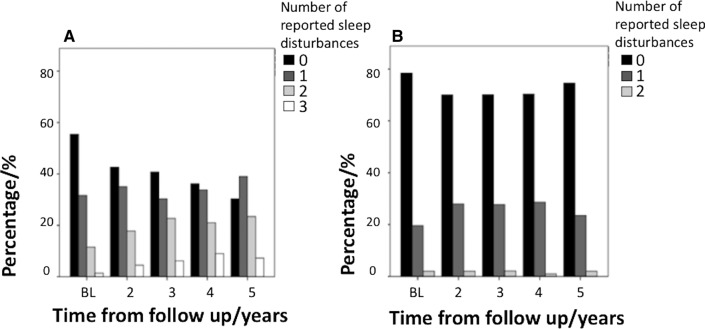
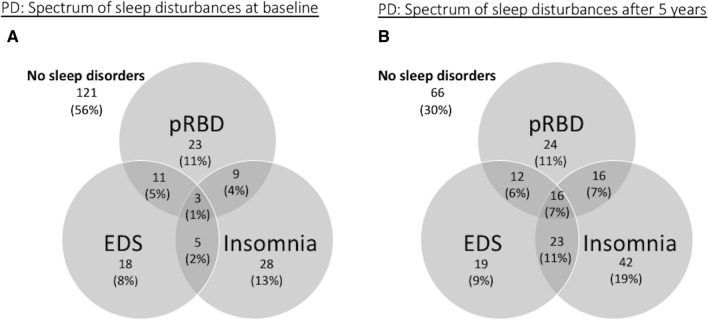
218 PD subjects and 102 controls completed 5 years of follow-up. At baseline, 69 (31.7%) PD subjects reported one type of sleep disturbance, 25 (11.5%) reported two types of sleep disturbances, and three (1.4%) reported all three types of sleep disturbances. At 5 years, the number of PD subjects reporting one, two, and three types of sleep disturbances was 85 (39.0%), 51 (23.4%), and 16 (7.3%), respectively. Only 41(18.8%) patients were taking sleep medications. The largest increase in frequency was seen in insomnia (44.5%), followed by EDS (32.1%) and pRBD (31.2%). Insomnia was the most common sleep problem at any time over the 5-year follow-up. The frequency of sleep disturbances in HCs remained stable.
There is a progressive increase in the frequency of sleep disturbances in PD, with the number of subjects reporting multiple sleep disturbances increasing over time. Relatively a few patients reported multiple sleep disturbances, suggesting that they can have different pathogenesis. A large number of patients were not treated for their sleep disturbances.
睡眠障碍可发生于帕金森病(PD)早期。然而,不同睡眠障碍之间的关系及其纵向演变尚未得到充分探讨。
描述早期 PD 患者中日间过度嗜睡(EDS)、失眠和可能 REM 睡眠行为障碍(pRBD)的频率、共存和纵向变化。
数据来自帕金森病进展标志物倡议(PPMI)。EDS、失眠和 pRBD 使用 Epworth 嗜睡量表、MDS-UPDRS 第 I 部分项目 1.7 和 RBD 筛查问卷进行定义。
218 名 PD 患者和 102 名对照完成了 5 年的随访。基线时,69 名(31.7%)PD 患者报告了一种类型的睡眠障碍,25 名(11.5%)报告了两种类型的睡眠障碍,3 名(1.4%)报告了三种类型的睡眠障碍。5 年后,报告一种、两种和三种睡眠障碍的 PD 患者人数分别为 85 名(39.0%)、51 名(23.4%)和 16 名(7.3%)。只有 41 名(18.8%)患者服用睡眠药物。频率增加最大的是失眠(44.5%),其次是 EDS(32.1%)和 pRBD(31.2%)。失眠是 5 年随访期间任何时候最常见的睡眠问题。HC 中的睡眠障碍频率保持稳定。
PD 患者的睡眠障碍频率逐渐增加,报告多种睡眠障碍的患者人数随时间增加而增加。相对较少的患者报告有多种睡眠障碍,这表明它们可能有不同的发病机制。大量患者未对其睡眠障碍进行治疗。