Department of Systems Biology, Columbia University, New York, New York, United States of America.
Integrated Program in Cellular, Molecular, and Biomedical Studies, Columbia University, New York, New York, United States of America.
PLoS Biol. 2020 Aug 17;18(8):e3000838. doi: 10.1371/journal.pbio.3000838. eCollection 2020 Aug.
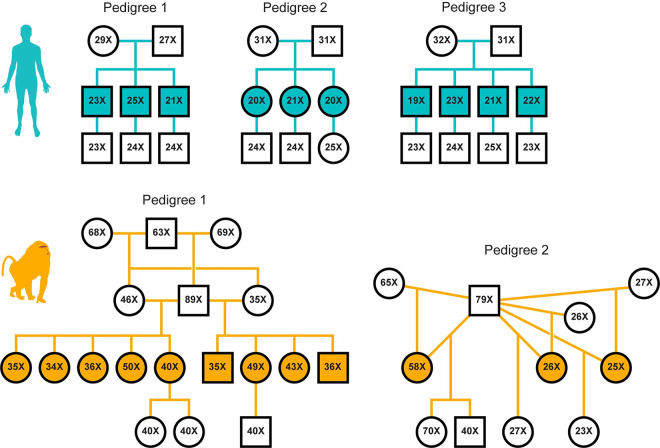
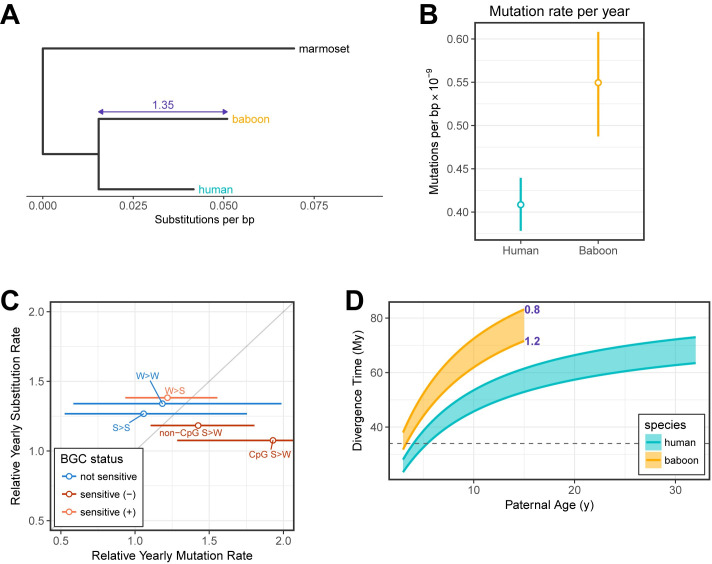
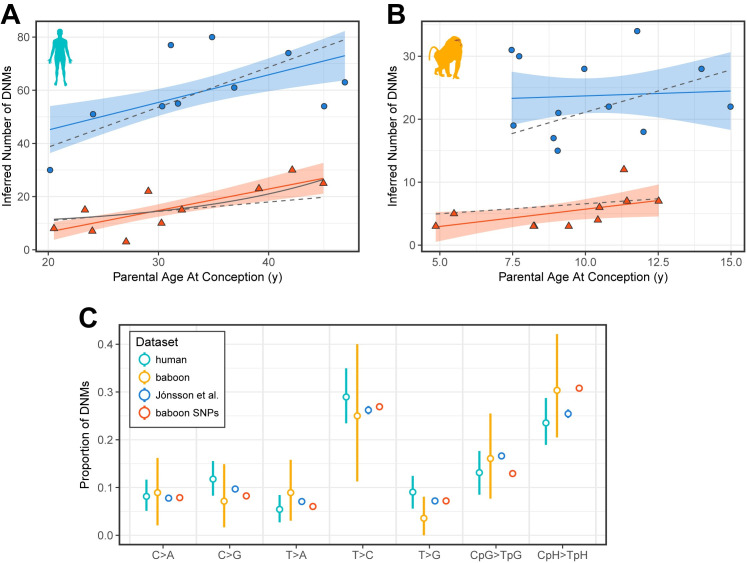
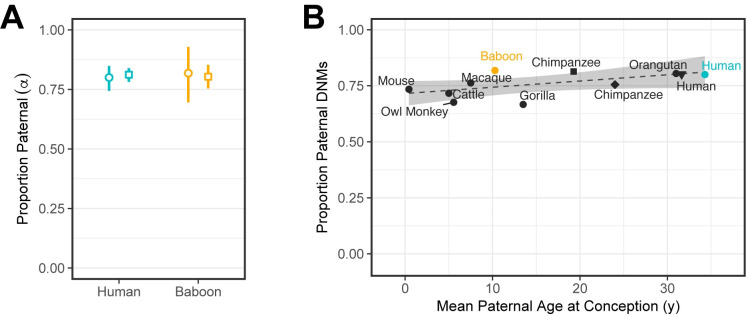
In humans, most germline mutations are inherited from the father. This observation has been widely interpreted as reflecting the replication errors that accrue during spermatogenesis. If so, the male bias in mutation should be substantially lower in a closely related species with similar rates of spermatogonial stem cell divisions but a shorter mean age of reproduction. To test this hypothesis, we resequenced two 3-4 generation nuclear families (totaling 29 individuals) of olive baboons (Papio anubis), who reproduce at approximately 10 years of age on average, and analyzed the data in parallel with three 3-generation human pedigrees (26 individuals). We estimated a mutation rate per generation in baboons of 0.57×10⁻⁸ per base pair, approximately half that of humans. Strikingly, however, the degree of male bias in germline mutations is approximately 4:1, similar to that of humans-indeed, a similar male bias is seen across mammals that reproduce months, years, or decades after birth. These results mirror the finding in humans that the male mutation bias is stable with parental ages and cast further doubt on the assumption that germline mutations track cell divisions. Our mutation rate estimates for baboons raise a further puzzle, suggesting a divergence time between apes and Old World monkeys of 65 million years, too old to be consistent with the fossil record; reconciling them now requires not only a slowdown of the mutation rate per generation in humans but also in baboons.
在人类中,大多数种系突变是从父亲那里遗传的。这一观察结果被广泛解释为反映了在精子发生过程中积累的复制错误。如果是这样,那么在具有相似精原干细胞分裂率但繁殖平均年龄较短的密切相关物种中,突变的雄性偏倚应该大大降低。为了检验这一假设,我们对 29 只橄榄狒狒(Papio anubis)的两个 3-4 代核家族(共 29 只个体)进行了重测序,这些狒狒的平均繁殖年龄约为 10 岁,并与三个 3 代人类家系(26 个个体)平行分析了数据。我们估计狒狒每代的突变率为 0.57×10⁻⁸ 个碱基对,约为人类的一半。然而,令人惊讶的是,种系突变的雄性偏倚程度约为 4:1,与人类相似——事实上,在出生后数月、数年或数十年繁殖的哺乳动物中,也可以看到类似的雄性偏倚。这些结果反映了人类的发现,即雄性突变偏倚与父母年龄稳定,进一步怀疑种系突变与细胞分裂有关。我们对狒狒的突变率估计提出了另一个难题,表明猿类和旧世界猴的分歧时间为 6500 万年,这与化石记录不一致;要解决这个问题,不仅需要人类和狒狒的每代突变率都减缓,而且还需要减缓。