Grotto Rejane Maria Tommasini, Santos Lima Rodrigo, de Almeida Gabriel Berg, Ferreira Claudia Pio, Guimarães Raul Borges, Pronunciate Micheli, Azevedo Edmur, Catão Rafael de Castro, Fortaleza Carlos Magno Castelo Branco
School of Agriculture, São Paulo State University (Unesp), Botucatu, Brazil.
Botucatu Medical School, São Paulo State University (Unesp), Botucatu, Brazil.
Epidemiol Infect. 2020 Aug 18;148:e178. doi: 10.1017/S0950268820001818.
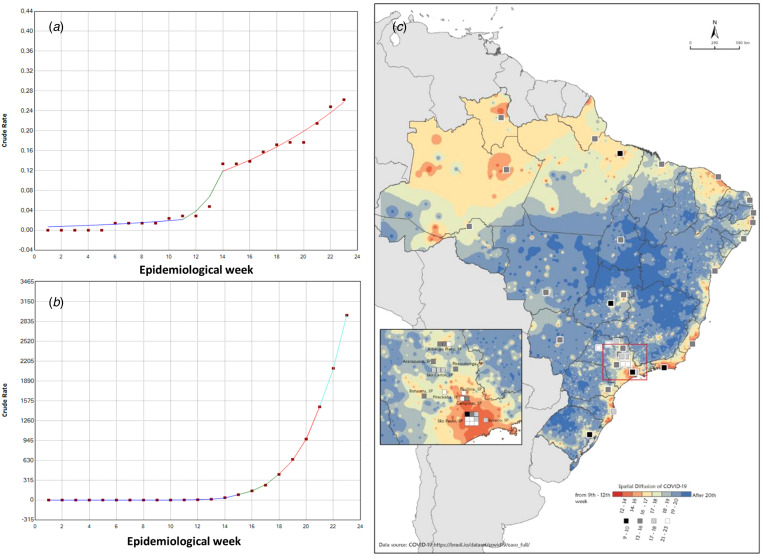
Different countries have adopted strategies for the early detection of SARS-CoV-2 since the declaration of community transmission by the World Health Organization (WHO) and timely diagnosis has been considered one of the major obstacles for surveillance and healthcare. Here, we report the increase of the number of laboratories to COVID-19 diagnosis in Brazil. Our results demonstrate an increase and decentralisation of certified laboratories, which does not match the much higher increase in the number of COVID-19 cases. Also, it becomes clear that laboratories are irregularly distributed over the country, with a concentration in the most developed state, São Paulo.
自世界卫生组织(WHO)宣布社区传播以来,不同国家都采取了早期检测严重急性呼吸综合征冠状病毒2(SARS-CoV-2)的策略,及时诊断一直被视为监测和医疗保健的主要障碍之一。在此,我们报告了巴西进行2019冠状病毒病(COVID-19)诊断的实验室数量的增加。我们的结果表明,获得认证的实验室数量有所增加且分布更为分散,但这与COVID-19病例数的大幅增加并不匹配。此外,很明显实验室在该国分布不均,集中在最发达的圣保罗州。