• 文献检索
  • 文档翻译
  • 深度研究
  • 学术资讯
  • Suppr Zotero 插件Zotero 插件
  • 邀请有礼
  • 套餐&价格
  • 历史记录
应用&插件
Suppr Zotero 插件Zotero 插件浏览器插件Mac 客户端Windows 客户端微信小程序
定价
高级版会员购买积分包购买API积分包
服务
文献检索文档翻译深度研究API 文档MCP 服务
关于我们
关于 Suppr公司介绍联系我们用户协议隐私条款
关注我们

Suppr 超能文献

核心技术专利:CN118964589B侵权必究
粤ICP备2023148730 号-1Suppr @ 2026

文献检索

告别复杂PubMed语法,用中文像聊天一样搜索,搜遍4000万医学文献。AI智能推荐,让科研检索更轻松。

立即免费搜索

文件翻译

保留排版,准确专业,支持PDF/Word/PPT等文件格式,支持 12+语言互译。

免费翻译文档

深度研究

AI帮你快速写综述,25分钟生成高质量综述,智能提取关键信息,辅助科研写作。

立即免费体验

巴西圣保罗州 200 天的 COVID-19 疫情

Two hundred days of COVID-19 in São Paulo State, Brazil.

机构信息

Clinical Hospital of Botucatu Medical School (HCFMB), Botucatu, Brazil.

Department of Infectious Diseases, São Paulo State University (UNESP), Botucatu Medical School, Botucatu, Brazil.

出版信息

Epidemiol Infect. 2020 Dec 2;148:e295. doi: 10.1017/S0950268820002927.

DOI:10.1017/S0950268820002927
PMID:33261679
原文链接:https://pmc.ncbi.nlm.nih.gov/articles/PMC7750657/
Abstract

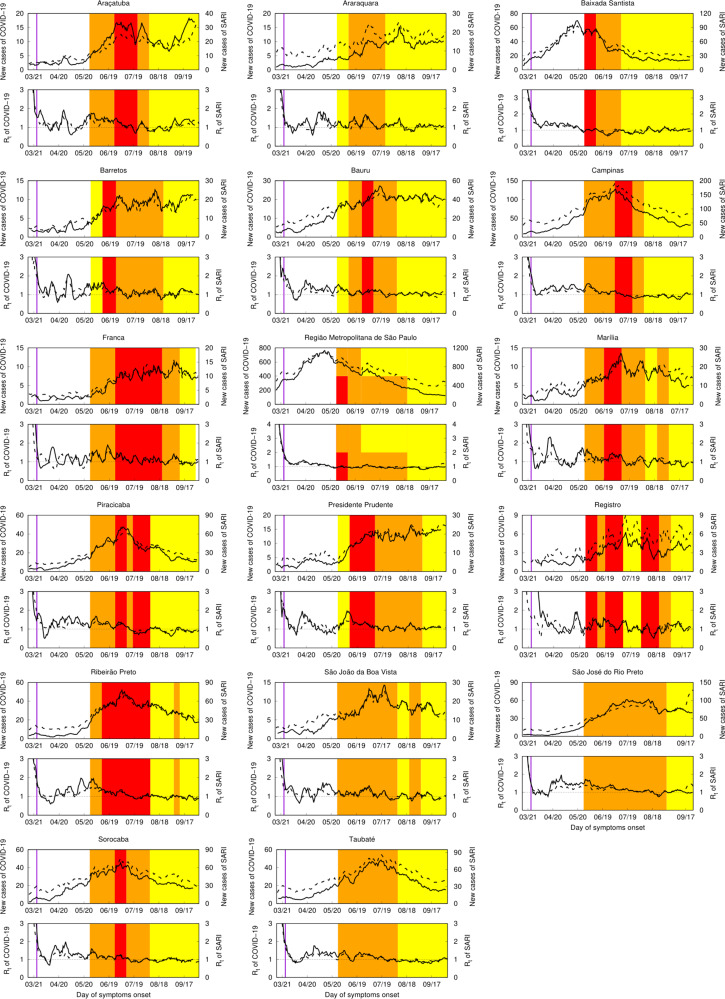
Two hundred days after the first confirmed case of COVID-19 in Brazil, the epidemic has rapidly spread in metropolitan areas and advanced throughout the countryside. We followed the temporal epidemic pattern at São Paulo State, the most populous of the country, the first to have a confirmed case of COVID-19, and the one with the most significant number of cases until now. We analysed the number of new cases per day in each regional health department and calculated the effective reproduction number (Rt) over time. Social distance measures, along with improvement in testing and isolating positive cases, general population mask-wearing and standard health security protocols for essential and non-essential activities, were adopted and impacted on slowing down epidemic velocity but were insufficient to stop transmission.

摘要

巴西出现首例新冠肺炎确诊病例 200 天后,疫情在大都市区迅速蔓延,并向农村地区蔓延。我们跟踪了该国人口最多、首例新冠肺炎确诊病例和迄今为止病例最多的圣保罗州的疫情发展模式。我们分析了每个地区卫生部门每天新增病例数,并计算了随时间变化的有效繁殖数(Rt)。采取了社会距离措施,包括改进检测和隔离阳性病例、全民佩戴口罩以及对基本和非基本活动的标准卫生安全协议,这些措施对减缓疫情传播速度产生了影响,但不足以阻止传播。
https://cdn.ncbi.nlm.nih.gov/pmc/blobs/046d/7750657/815d9f31582e/S0950268820002927_fig1.jpg

相似文献

1
Two hundred days of COVID-19 in São Paulo State, Brazil.巴西圣保罗州 200 天的 COVID-19 疫情
Epidemiol Infect. 2020 Dec 2;148:e295. doi: 10.1017/S0950268820002927.
2
Investigating spatiotemporal patterns of the COVID-19 in São Paulo State, Brazil.研究巴西圣保罗州 COVID-19 的时空模式。
Geospat Health. 2020 Nov 26;15(2). doi: 10.4081/gh.2020.925.
3
The use of health geography modeling to understand early dispersion of COVID-19 in São Paulo, Brazil.利用健康地理学模型了解巴西圣保罗市 COVID-19 的早期传播。
PLoS One. 2021 Jan 7;16(1):e0245051. doi: 10.1371/journal.pone.0245051. eCollection 2021.
4
High prevalence of SARS-CoV-2 infection among symptomatic healthcare workers in a large university tertiary hospital in São Paulo, Brazil.巴西圣保罗一家大型大学附属医院出现症状的医护人员中 SARS-CoV-2 感染的高流行率。
BMC Infect Dis. 2020 Dec 2;20(1):917. doi: 10.1186/s12879-020-05662-8.
5
The first hundred days of COVID-19 in Pernambuco State, Brazil: epidemiology in historical context.巴西伯南布哥州新冠疫情的头一百天:历史背景下的流行病学
Cad Saude Publica. 2020 Dec 18;36(11):e00228220. doi: 10.1590/0102-311X00228220. eCollection 2020.
6
The correspondence between the structure of the terrestrial mobility network and the spreading of COVID-19 in Brazil.陆地流动网络结构与巴西 COVID-19 传播之间的关系。
Cad Saude Publica. 2020 Oct 5;36(9):e00184820. doi: 10.1590/0102-311X00184820. eCollection 2020.
7
COVID-19 pandemic: environmental and social factors influencing the spread of SARS-CoV-2 in São Paulo, Brazil.COVID-19 大流行:影响巴西圣保罗 SARS-CoV-2 传播的环境和社会因素。
Environ Sci Pollut Res Int. 2021 Aug;28(30):40322-40328. doi: 10.1007/s11356-020-10930-w. Epub 2020 Sep 28.
8
[The social geography of AIDS in Brazil].[巴西艾滋病的社会地理学]
Rev Saude Publica. 1995 Feb;29(1):52-62. doi: 10.1590/s0034-89101995000100009.
9
Social distancing in São Paulo State: demonstrating the reduction in cases using time series analysis of deaths due to COVID-19.圣保罗州的社交距离措施:通过对因新冠病毒病死亡病例的时间序列分析来证明病例数的减少。
Rev Bras Epidemiol. 2020 Jun 22;23:e200056. doi: 10.1590/1980-549720200056. eCollection 2020.
10
Genomic monitoring of the SARS-CoV-2 B1.1.7 (WHO VOC Alpha) in the Sao Paulo state, Brazil.巴西圣保罗州对 SARS-CoV-2 B1.1.7(世界卫生组织 VOC Alpha)的基因组监测。
Virus Res. 2022 Jan 15;308:198643. doi: 10.1016/j.virusres.2021.198643. Epub 2021 Nov 27.

引用本文的文献

1
Transformative dimensions of resilience and brittleness during health systems' collapse: a case study in Brazil using the Functional Resonance Analysis Method.韧性和脆性在卫生系统崩溃期间的变革维度:使用功能共振分析方法对巴西的案例研究。
BMC Health Serv Res. 2023 Apr 10;23(1):349. doi: 10.1186/s12913-023-09301-1.
2
Population-based virucidal phthalocyanine gargling/rinsing protocol to reduce the risk of coronavirus disease-2019: a community trial.基于人群的杀病毒酞菁漱口/冲洗方案以降低2019冠状病毒病风险:一项社区试验。
GMS Hyg Infect Control. 2022 Dec 6;17:Doc23. doi: 10.3205/dgkh000426. eCollection 2022.
3
A snapshot of a pandemic: The interplay between social isolation and COVID-19 dynamics in Brazil.

本文引用的文献

1
Increasing molecular diagnostic capacity and COVID-19 incidence in Brazil.巴西分子诊断能力与新冠病毒感染率的上升。
Epidemiol Infect. 2020 Aug 18;148:e178. doi: 10.1017/S0950268820001818.
2
Taking the inner route: spatial and demographic factors affecting vulnerability to COVID-19 among 604 cities from inner São Paulo State, Brazil.走内部路线:影响巴西圣保罗州内部 604 个城市 COVID-19 脆弱性的空间和人口因素。
Epidemiol Infect. 2020 Jun 19;148:e118. doi: 10.1017/S095026882000134X.
3
Real-time monitoring the transmission potential of COVID-19 in Singapore, March 2020.
大流行的一个缩影:巴西社会隔离与新冠疫情动态之间的相互作用
Patterns (N Y). 2021 Oct 8;2(10):100349. doi: 10.1016/j.patter.2021.100349. Epub 2021 Sep 15.
4
COVID-19 in medium-sized municipalities in the 14 health macro-regions of Minas Gerais, Brazil.巴西米纳斯吉拉斯州 14 个卫生大区中型城市的 COVID-19 疫情。
Braz J Med Biol Res. 2021 Aug 20;54(11):e11191. doi: 10.1590/1414-431X2021e11191. eCollection 2021.
5
A simple mathematical model for the evaluation of the long first wave of the COVID-19 pandemic in Brazil.用于评估 COVID-19 大流行在巴西的首个长波的简单数学模型。
Sci Rep. 2021 Aug 12;11(1):16400. doi: 10.1038/s41598-021-95815-9.
6
Addressing the COVID-19 transmission in inner Brazil by a mathematical model.运用数学模型解决巴西内陆地区的 COVID-19 传播问题。
Sci Rep. 2021 May 24;11(1):10760. doi: 10.1038/s41598-021-90118-5.
7
The use of health geography modeling to understand early dispersion of COVID-19 in São Paulo, Brazil.利用健康地理学模型了解巴西圣保罗市 COVID-19 的早期传播。
PLoS One. 2021 Jan 7;16(1):e0245051. doi: 10.1371/journal.pone.0245051. eCollection 2021.
实时监测 2020 年 3 月新加坡 COVID-19 的传播潜力。
BMC Med. 2020 Jun 3;18(1):166. doi: 10.1186/s12916-020-01615-9.
4
Nowcasting by Bayesian Smoothing: A flexible, generalizable model for real-time epidemic tracking.贝叶斯平滑的实时预测:一种用于实时传染病追踪的灵活、可推广的模型。
PLoS Comput Biol. 2020 Apr 6;16(4):e1007735. doi: 10.1371/journal.pcbi.1007735. eCollection 2020 Apr.
5
Routes for COVID-19 importation in Brazil.新冠病毒输入巴西的途径。
J Travel Med. 2020 May 18;27(3). doi: 10.1093/jtm/taaa042.
6
Transmission potential and severity of COVID-19 in South Korea.韩国 COVID-19 的传播潜力和严重程度。
Int J Infect Dis. 2020 Apr;93:339-344. doi: 10.1016/j.ijid.2020.03.031. Epub 2020 Mar 18.
7
COVID-19 in Latin America: The implications of the first confirmed case in Brazil.拉丁美洲的新冠疫情:巴西首例确诊病例的影响。
Travel Med Infect Dis. 2020 May-Jun;35:101613. doi: 10.1016/j.tmaid.2020.101613. Epub 2020 Feb 29.
8
Improved inference of time-varying reproduction numbers during infectious disease outbreaks.改进传染病爆发期间时变繁殖数的推断。
Epidemics. 2019 Dec;29:100356. doi: 10.1016/j.epidem.2019.100356. Epub 2019 Aug 26.
9
How generation intervals shape the relationship between growth rates and reproductive numbers.世代间隔如何塑造增长率与繁殖数之间的关系。
Proc Biol Sci. 2007 Feb 22;274(1609):599-604. doi: 10.1098/rspb.2006.3754.