Vinding Rebecca Kofod, Rago Daniela, Kelly Rachel S, Gürdeniz Gözde, Rasmussen Morten Arendt, Stokholm Jakob, Bønnelykke Klaus, Litonjua Augusto A, Weiss Scott T, Lasky-Su Jessica, Bisgaard Hans, Chawes Bo Lund
COPSAC, Copenhagen Prospective Studies on Asthma in Childhood, Herlev and Gentofte Hospital, University of Copenhagen, 1017 Copenhagen, Denmark.
Channing Division of Network Medicine, Brigham and Women's Hospital and Harvard Medical School, Boston, MA 02115, USA.
Metabolites. 2020 Aug 19;10(9):337. doi: 10.3390/metabo10090337.
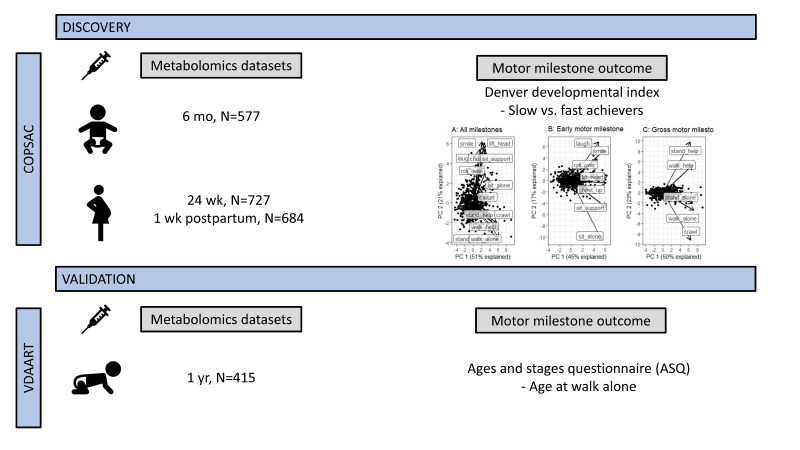
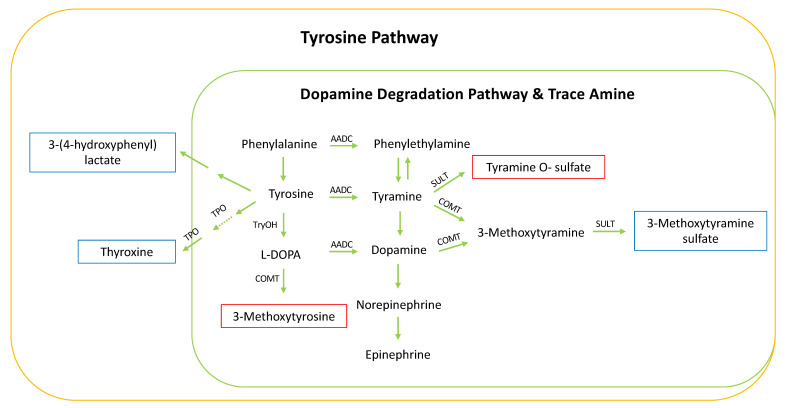
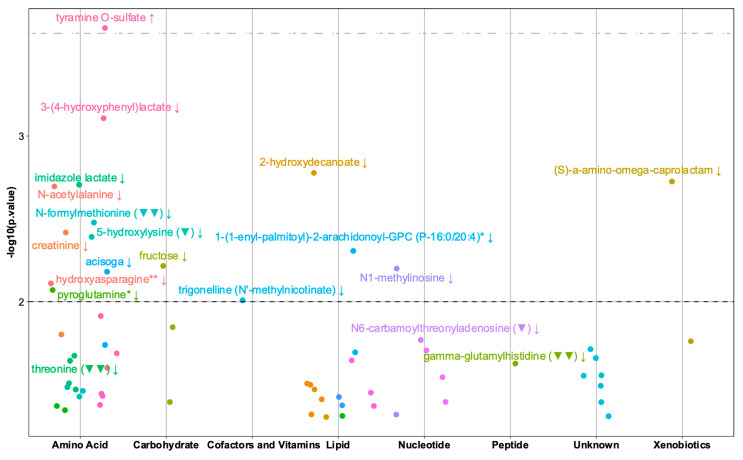
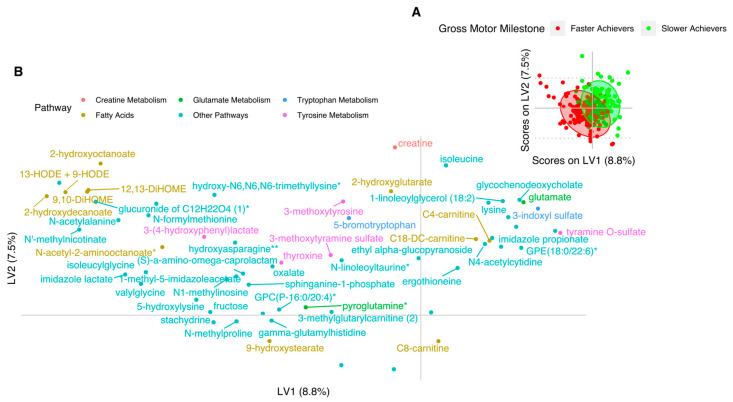
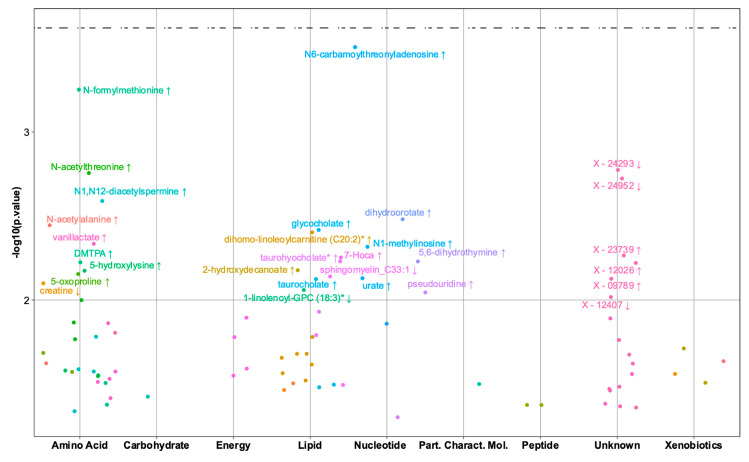
The relationship between developmental milestone achievement in infancy and later cognitive function and mental health is well established, but underlying biochemical mechanisms are poorly described. Our study aims to discover pathways connected to motor milestone achievement during infancy by using untargeted plasma metabolomic profiles from 571 six-month-old children in connection with age of motor milestones achievement (Denver Developmental Index) in the Copenhagen Prospective Studies on Asthma in Childhood 2010 (COPSAC2010) mother-child cohort. We used univariate regression models and multivariate modelling (Partial Least Squares Discriminant Analysis: PLS-DA) to examine the associations and the VDAART (Vitamin D Antenatal Asthma Reduction Trial) cohort for validation. The univariate analyses showed 62 metabolites associated with gross-motor milestone achievement ( < 0.05) as well as the PLS-DA significantly differentiated between slow and fast milestone achievers (AUC = 0.87, = 0.01). Higher levels of tyramine-O-sulfate in the tyrosine pathway were found in the late achievers in COPSAC ( = 0.0002) and in VDAART ( = 0.02). Furthermore, we observed that slow achievers were characterized by higher levels of fatty acids and products of fatty acids metabolism including acyl carnitines. Finally, we also observed changes in the lysine, histidine, glutamate, creatine and tryptophan pathways. Observing these metabolic changes in relation to gross-motor milestones in the first year of life, may be of importance for later cognitive function and mental health.
婴儿期发育里程碑的达成与后期认知功能和心理健康之间的关系已得到充分证实,但其潜在的生化机制却鲜有描述。我们的研究旨在通过使用来自哥本哈根2010年儿童哮喘前瞻性研究(COPSAC2010)母婴队列中571名六个月大儿童的非靶向血浆代谢组学谱,结合运动里程碑达成年龄(丹佛发育指数),来发现与婴儿期运动里程碑达成相关的途径。我们使用单变量回归模型和多变量建模(偏最小二乘判别分析:PLS-DA)来检验这些关联,并使用维生素D产前哮喘减少试验(VDAART)队列进行验证。单变量分析显示62种代谢物与大运动里程碑达成相关(<0.05),并且PLS-DA在里程碑达成慢的儿童和快的儿童之间有显著差异(AUC = 0.87, = 0.01)。在COPSAC队列中( = 0.0002)和VDAART队列中( = 0.02),发现酪氨酸途径中硫酸酪胺水平较高的是里程碑达成较晚的儿童。此外,我们观察到里程碑达成慢的儿童的特征是脂肪酸及其代谢产物(包括酰基肉碱)水平较高。最后,我们还观察到赖氨酸、组氨酸、谷氨酸、肌酸和色氨酸途径的变化。观察生命第一年与大运动里程碑相关的这些代谢变化,可能对后期认知功能和心理健康具有重要意义。