Department of Hygiene, Public Health and Preventive Medicine, Showa University School of Medicine, Shinagawa-ku, Tokyo, Japan (Dr Yoshimoto); Department of Medical Research and Management for Musculoskeletal Pain, 22nd Century Medical & Research Center, Faculty of Medicine, The University of Tokyo, Bunkyo-ku, Tokyo, Japan (Dr Yoshimoto, Dr Oka, Dr Fujii, Dr Matsudaira); Department of Occupational Health Practice and Management, Institute of Industrial Ecological Sciences, University of Occupational and Environmental Health, Kitakyusyu, Fukuoka, Japan (Dr Nagata).
J Occup Environ Med. 2020 Oct;62(10):883-888. doi: 10.1097/JOM.0000000000002001.
To identify the primary health conditions that cause presenteeism, and to estimate the economic cost of lost productivity due to presenteeism in Japan.
We conducted an Internet survey among 10,000 Japanese workers. Participants were asked to answer the health condition most affecting their work. Presenteeism was evaluated using the Quantity and Quality methods, and we estimated an annualized cost per capita and nation.
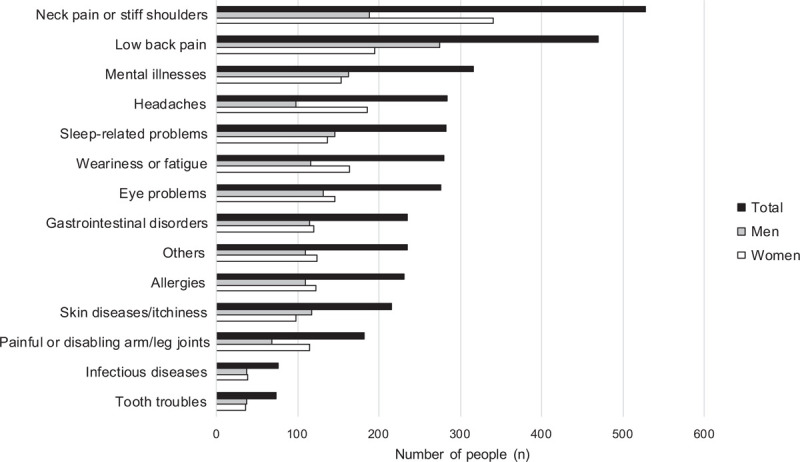
The common health conditions most interfering with work were neck pain or stiff shoulders, low back pain, and mental illnesses. The annualized costs of presenteeism per capita for each were $414.05, $407.59, and $469.67, respectively. The estimated national costs for each were all above $27 billion.
Mental illnesses and musculoskeletal symptoms were the leading causes of presenteeism in Japan, and the economic burden of presenteeism was considerably large.
确定导致出勤主义的主要健康问题,并估计因出勤主义导致日本生产力损失的经济成本。
我们对 10000 名日本工人进行了互联网调查。要求参与者回答最影响其工作的健康状况。使用数量和质量方法评估出勤主义,我们估计了人均和全国的年化成本。
最干扰工作的常见健康状况是颈部疼痛或肩部僵硬、腰痛和精神疾病。每人每年的出勤主义成本分别为 414.05 美元、407.59 美元和 469.67 美元。估计每个国家的成本都在 270 多亿美元以上。
精神疾病和肌肉骨骼症状是日本出勤主义的主要原因,出勤主义的经济负担相当大。