Conservation Genome Resource Bank for Korean Wildlife, College of Veterinary Medicine, Seoul National University, Seoul, Republic of Korea.
National Forensic Service Seoul Institute, Seoul, Republic of Korea.
PLoS One. 2020 Aug 24;15(8):e0238049. doi: 10.1371/journal.pone.0238049. eCollection 2020.
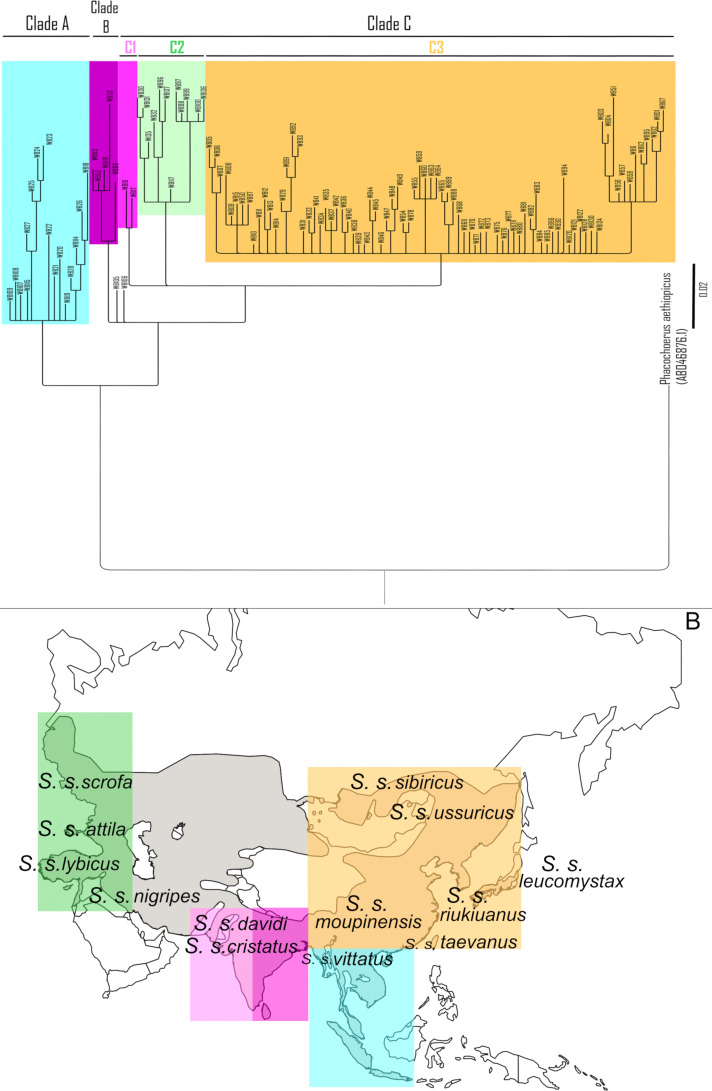
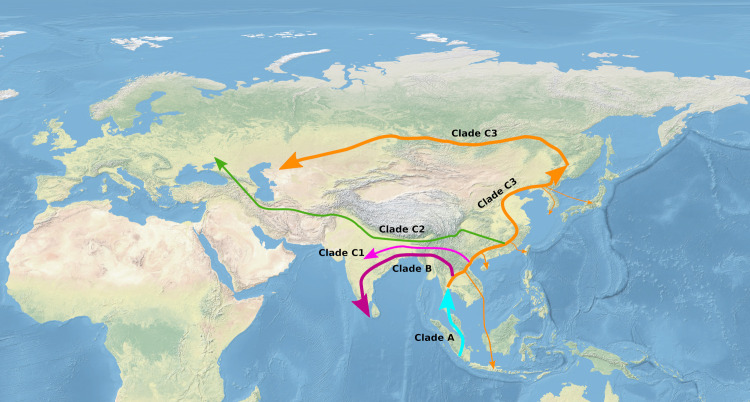
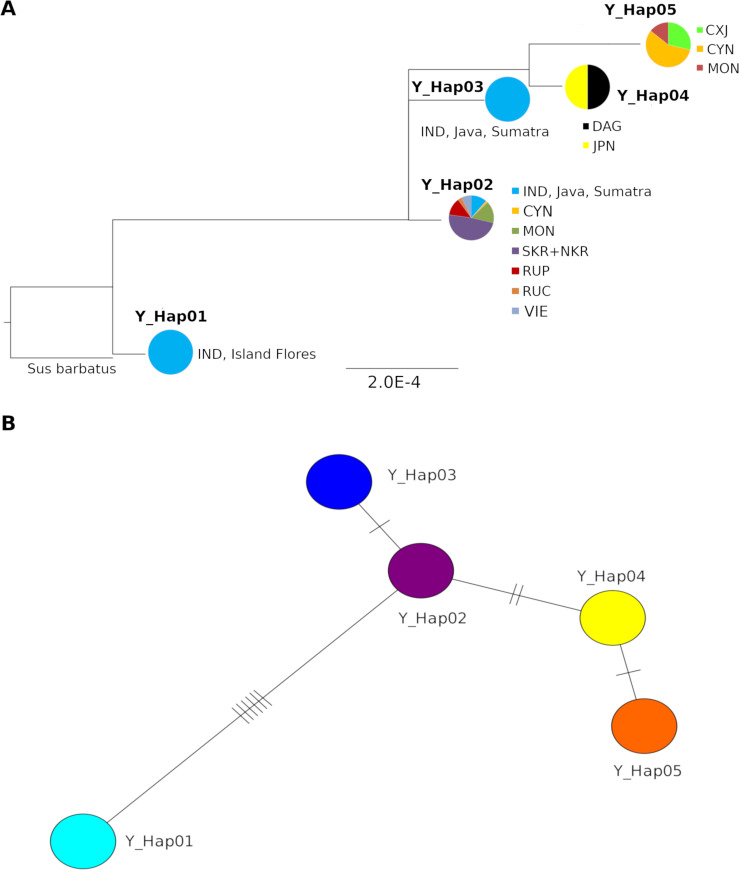
Genetics of pigs has been well studied in Europe and Asia, but most of previous studies of molecular phylogeny of Sus scrofa have been based on sequences of both wild and domestic forms. In this study we analysed genetic traits of Sus scrofa from 13 regions in Asia (including previously undisclosed Eastern Caucasus and Trans-Baikal regions) using purely wild boar samples. Mitochondrial control region and Y-chromosome genes (AMELY & USP9Y) were employed to resolve phylogeographic relationships. We discussed spatio-temporal dynamics of wild boar distribution and compared molecular data to morphological and cytogenetic data on wild boar variability and taxonomy. A total of 51 haplotypes were detected in mtDNA control region and five haplotypes were found in combined sequences of Y-chromosome genes. The phylogeography of Asia-wide wild boars supported a hypothesis of migration from South-East Asia to South Asia, followed by migration to East and West Asia. We present a hypothesis about independent dispersal of wild boars into West Asia from South and North-East Asia. Mitochondrial DNA phylogeny generally fits the morphologically based intraspecies taxonomy. Distribution of chromosomal variants of wild boar presently does not show clear correlation with mtDNA clades.
猪的遗传学在欧洲和亚洲得到了很好的研究,但之前对野猪分子系统发育的研究大多基于野生和家养猪的序列。本研究仅使用野猪样本,分析了亚洲 13 个地区(包括先前未披露的外高加索和跨贝加尔地区)野猪的遗传特征。利用线粒体控制区和 Y 染色体基因(AMELY 和 USP9Y)来解析系统地理学关系。我们讨论了野猪分布的时空动态,并将分子数据与野猪变异性和分类学的形态学和细胞遗传学数据进行了比较。在 mtDNA 控制区共检测到 51 个单倍型,在 Y 染色体基因的组合序列中发现了 5 个单倍型。亚洲范围的野猪的系统地理学支持了从东南亚到南亚的迁移假说,然后再迁移到东亚和西亚。我们提出了一个关于野猪从南亚和东北亚独立向西亚扩散的假说。线粒体 DNA 系统发育总体上符合基于形态的种内分类学。目前,野猪染色体变异的分布与 mtDNA 进化枝没有明显的相关性。