Department of Environment and Health, Istituto Superiore di Sanità, Rome, Italy.
Department of Environment and Health, Istituto Superiore di Sanità, Rome, Italy.
Sci Total Environ. 2021 Jan 1;750:141711. doi: 10.1016/j.scitotenv.2020.141711. Epub 2020 Aug 15.
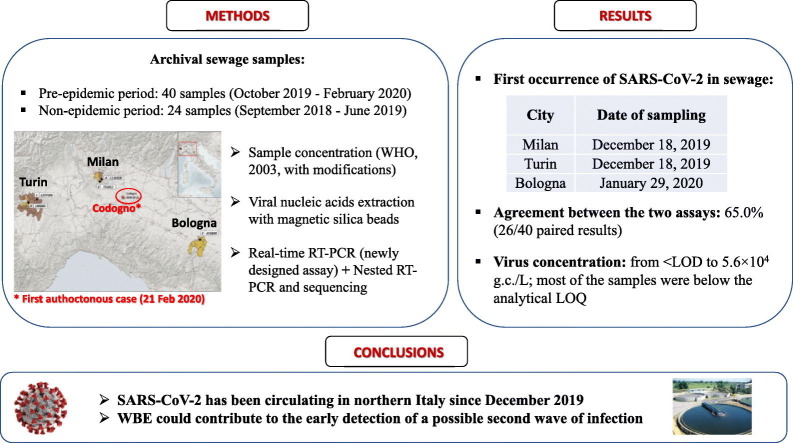
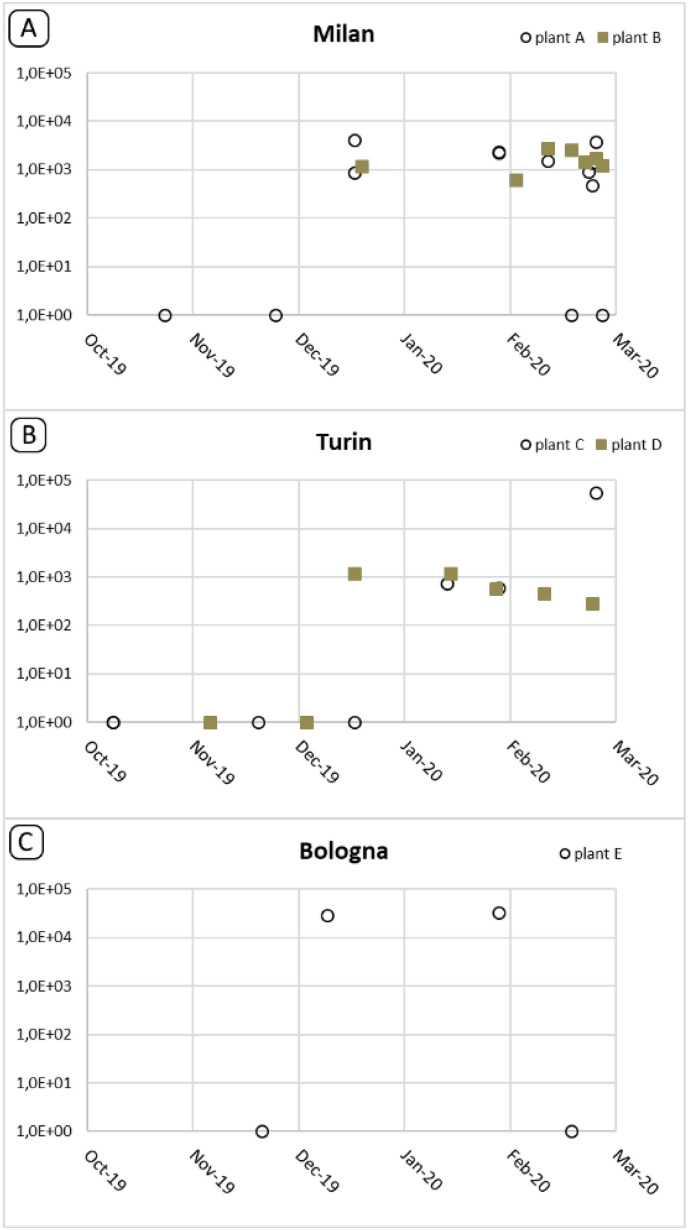
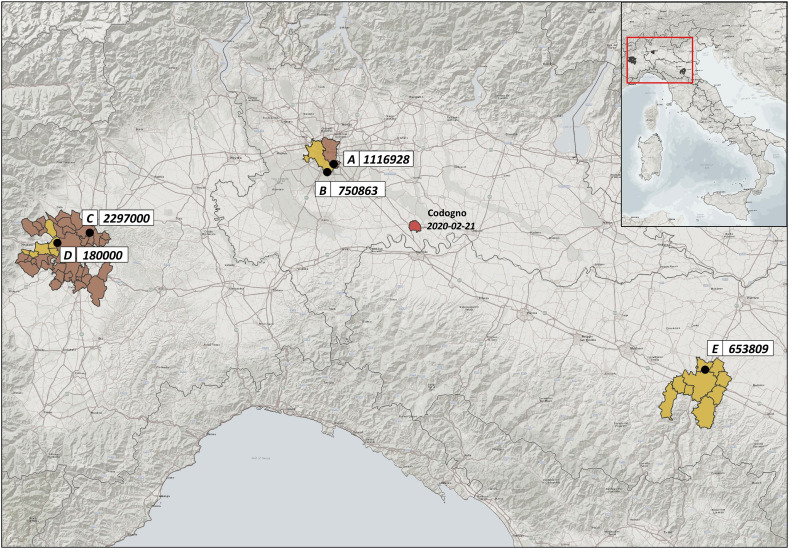
Severe Acute Respiratory Syndrome Coronavirus 2 (SARS-CoV-2) is responsible for the coronavirus disease COVID-19, a public health emergency worldwide, and Italy is among the most severely affected countries. The first autochthonous Italian case of COVID-19 was documented on February 21, 2020. We investigated the possibility that SARS-CoV-2 emerged in Italy earlier than that date, by analysing 40 composite influent wastewater samples collected - in the framework of other wastewater-based epidemiology projects - between October 2019 and February 2020 from five wastewater treatment plants (WWTPs) in three cities and regions in northern Italy (Milan/Lombardy, Turin/Piedmont and Bologna/Emilia Romagna). Twenty-four additional samples collected in the same WWTPs between September 2018 and June 2019 (i.e. long before the onset of the epidemic) were included as 'blank' samples. Viral concentration was performed according to the standard World Health Organization procedure for poliovirus sewage surveillance, with modifications. Molecular analysis was undertaken with both nested RT-PCR and real-rime RT-PCR assays. A total of 15 positive samples were confirmed by both methods. The earliest dates back to 18 December 2019 in Milan and Turin and 29 January 2020 in Bologna. Virus concentration in the samples ranged from below the limit of detection (LOD) to 5.6 × 10 genome copies (g.c.)/L, and most of the samples (23 out of 26) were below the limit of quantification of PCR. Our results demonstrate that SARS-CoV-2 was already circulating in northern Italy at the end of 2019. Moreover, it was circulating in different geographic regions simultaneously, which changes our previous understanding of the geographical circulation of the virus in Italy. Our study highlights the importance of environmental surveillance as an early warning system, to monitor the levels of virus circulating in the population and identify outbreaks even before cases are notified to the healthcare system.
严重急性呼吸综合征冠状病毒 2 (SARS-CoV-2) 是导致全球公共卫生紧急事件的冠状病毒病 (COVID-19) 的病原体,意大利是受影响最严重的国家之一。2020 年 2 月 21 日,意大利首例本土 COVID-19 病例被记录。我们通过分析 2019 年 10 月至 2020 年 2 月期间,来自意大利北部三个城市和地区的五个污水处理厂(WWTP)的 40 个复合进水污水样本,研究了 SARS-CoV-2 在意大利出现日期早于该日期的可能性。我们研究了 SARS-CoV-2 在意大利北部的出现时间,该研究分析了 2019 年 10 月至 2020 年 2 月期间,来自意大利北部三个城市和地区的五个污水处理厂(WWTP)的 40 个复合进水污水样本。2018 年 9 月至 2019 年 6 月期间在同一 WWTP 采集的另外 24 个样本作为“空白”样本。病毒浓度采用世界卫生组织(WHO)规定的脊灰病毒污水监测标准程序进行,并进行了修改。分子分析采用巢式 RT-PCR 和实时 RT-PCR 检测。两种方法均证实共有 15 个样本为阳性。最早的日期是 2019 年 12 月 18 日在米兰和都灵,以及 2020 年 1 月 29 日在博洛尼亚。样本中的病毒浓度从低于检测限(LOD)到 5.6×10 基因组拷贝(g.c.)/L 不等,大部分样本(26 个样本中的 23 个)低于 PCR 的定量限。我们的结果表明,SARS-CoV-2 已于 2019 年底在意大利北部传播。此外,它在不同的地理区域同时传播,这改变了我们之前对意大利病毒地理传播的认识。我们的研究强调了环境监测作为早期预警系统的重要性,以监测人群中病毒的传播水平,并在病例向医疗保健系统报告之前识别疫情。