Department of Environmental Science, Stockholm University, 11418 Stockholm, Sweden.
Bolin Centre for Climate Research, 11418 Stockholm, Sweden.
Environ Sci Technol. 2021 Jul 20;55(14):9489-9497. doi: 10.1021/acs.est.0c03804. Epub 2020 Sep 4.
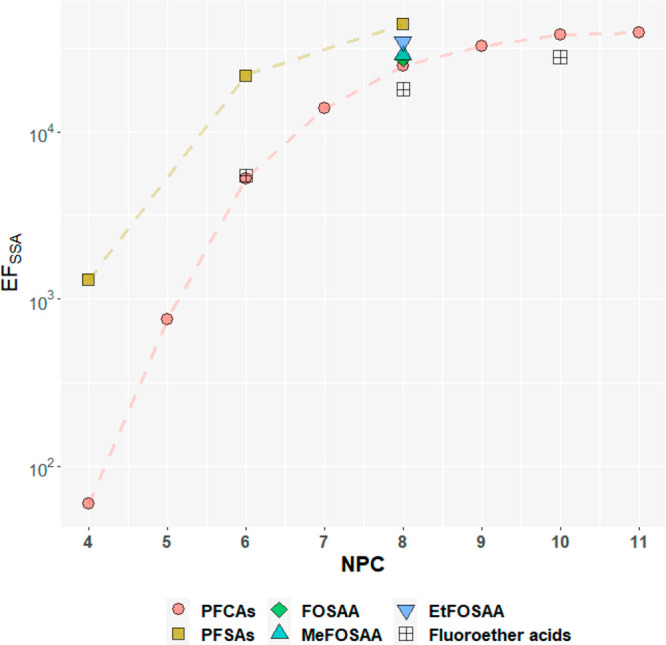
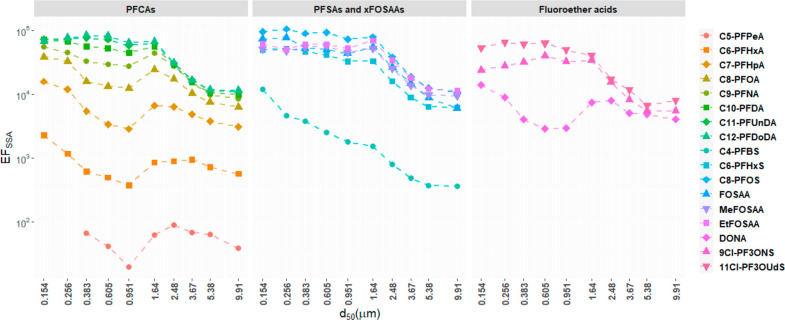
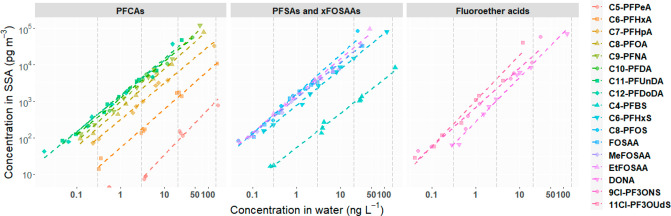
Perfluoroalkyl acids (PFAAs) are persistent organic substances that have been widely detected in the global oceans. Previous laboratory experiments have demonstrated effective enrichment of PFAAs in nascent sea spray aerosols (SSA), suggesting that SSA are an important source of PFAAs to the atmosphere. In the present study, the effects of the water concentration of PFAAs on their size-resolved enrichment in SSA were examined using a sea spray simulation chamber. Aerosolization of the target compounds in almost all sizes of SSA revealed a strong linear relationship with their water concentrations ( < 0.05, r > 0.9). The enrichment factors (EF) of the target compounds showed no correlation with their concentrations in the chamber water, despite the concentrations varying by a factor of 500 (∼0.3 to ∼150 ng L). The particle surface-area-to-volume ratio appeared to be a key predictor of the enrichment of perfluoroalkyl carboxylic acids (PFCAs) with ≥7 perfluorinated carbons and perfluoroalkanesulfonic acids (PFSAs) with ≥6 perfluorinated carbons in supermicron particles ( < 0.05, r > 0.8), but not in submicron particles. The different enrichment behaviors of PFAAs in submicron and supermicron particles might be a result of the different production mechanisms of film droplets and jet droplets. The results suggest that the variability in seawater concentrations of PFAAs has little influence on EFs and that modeling studies designed to quantify the source of PFAAs via SSA emissions do not need to consider this factor.
全氟烷基酸(PFAAs)是持久性有机物质,已在全球海洋中广泛检出。先前的实验室实验表明,PFAAs 可有效地在初生海雾气溶胶(SSA)中浓缩,这表明 SSA 是 PFAAs 向大气输送的重要来源。在本研究中,使用海雾模拟室研究了 PFAAs 的水浓度对其在 SSA 中按粒径分布浓缩的影响。目标化合物在 SSA 的几乎所有粒径气溶胶化均显示出与水浓度之间的强线性关系(<0.05,r>0.9)。尽管室水中的浓度变化了 500 倍(约 0.3 至 150ng L),但目标化合物的浓缩因子(EF)与水中浓度之间没有相关性。颗粒表面积与体积比似乎是预测具有≥7 个全氟化碳原子的全氟羧酸(PFCAs)和具有≥6 个全氟化碳原子的全氟烷磺酸(PFSAs)在超微米颗粒(<0.05,r>0.8)中浓缩的关键指标,但在亚微米颗粒中则不然。PFAAs 在亚微米和超微米颗粒中不同的浓缩行为可能是由于液膜滴和射流滴的不同生成机制所致。结果表明,海水中 PFAAs 浓度的变化对 EF 的影响不大,并且设计用于通过 SSA 排放量化 PFAAs 源的模型研究无需考虑这一因素。