Shnaiderman-Torban Anat, Navon-Venezia Shiri, Kelmer Efrat, Cohen Adar, Paitan Yossi, Arielly Haya, Steinman Amir
Koret School of Veterinary Medicine (KSVM), The Robert H. Smith Faculty of Agriculture, Food and Environment, The Hebrew University of Jerusalem, Rehovot 7610001, Israel.
Department of Molecular Biology, Faculty of Natural Science, Ariel University, Ariel 40700, Israel.
Antibiotics (Basel). 2020 Aug 27;9(9):545. doi: 10.3390/antibiotics9090545.
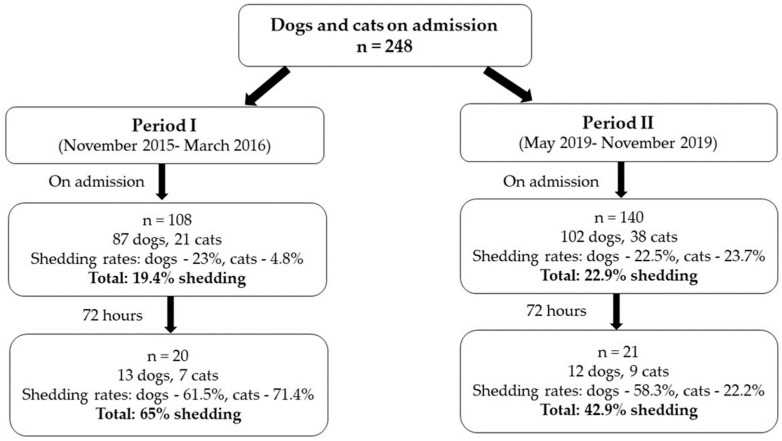
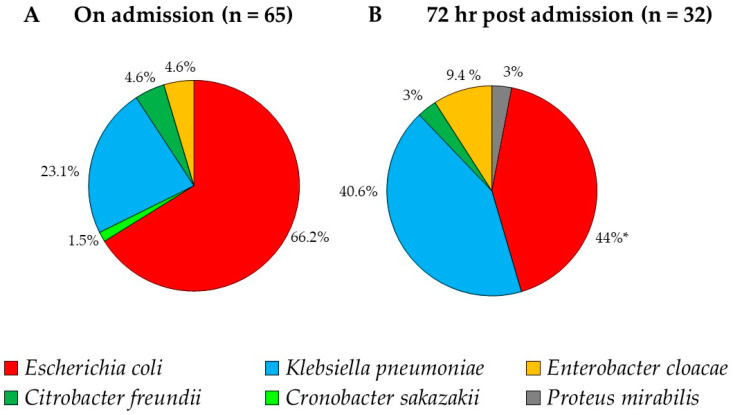
Extended-spectrum β-lactamase-producing (ESBL-PE) gut shedding in human medicine is considered as a major reservoir for ESBL-associated infections in high risk patients. In veterinary medicine, data regarding ESBL-PE gut shedding on admission to emergency and critical care department is scarce. We aimed to determine ESBL-PE shedding rates by dogs and cats in this setting and to determine the risk factors for shedding, at two separate periods, three-years apart. Rectal swabs were collected from animals, on admission and 72 h post admission, enriched and plated on Chromagar ESBL plates, followed by bacterial identification. ESBL phenotype was confirmed and antibiotic susceptibility profiles were determined (Vitek 2). Medical records were reviewed for risk factor analysis (SPSS). Overall, 248 animals were sampled, including 108 animals on period I (2015-2016) and 140 animals on period II (2019). In both periods combined, 21.4% of animals shed ESBL-PE on admission, and shedding rates increased significantly during hospitalization (53.7%, -value < 0.001). The main ESBL-PE species were and , accounting for more than 85% of the isolates. In a multivariable analysis, previous hospitalization was a risk factor for ESBL-PE gut shedding (-value = 0.01, Odds ratio = 3.05, 95% Confidence interval 1.28-7.27). Our findings demonstrate significant ESBL-PE gut shedding among small animals in the emergency and critical care department, posing the necessity to design and implement control measures to prevent transmission and optimize antibiotic therapy in this setting.
在人类医学中,产超广谱β-内酰胺酶(ESBL-PE)的肠道细菌排泄被认为是高危患者ESBL相关感染的主要储存库。在兽医学中,关于急诊和重症监护病房入院时ESBL-PE肠道细菌排泄的数据很少。我们旨在确定在此环境下犬猫的ESBL-PE排泄率,并确定相隔三年的两个不同时期的排泄风险因素。在动物入院时和入院后72小时采集直肠拭子,进行富集并接种在Chromagar ESBL平板上,随后进行细菌鉴定。确认ESBL表型并确定抗生素敏感性谱(Vitek 2)。查阅病历进行风险因素分析(SPSS)。总体而言,共对248只动物进行了采样,其中第一阶段(2015 - 2016年)有108只动物,第二阶段(2019年)有140只动物。在两个阶段合并统计中,21.4%的动物在入院时排泄ESBL-PE,住院期间排泄率显著增加(53.7%,P值<0.001)。主要的ESBL-PE菌种是[具体菌种1]和[具体菌种2],占分离株的85%以上。在多变量分析中,既往住院是ESBL-PE肠道细菌排泄的一个风险因素(P值 = 0.01,优势比 = 3.05,95%置信区间1.28 - 7.27)。我们的研究结果表明,急诊和重症监护病房的小动物中存在显著的ESBL-PE肠道细菌排泄,这表明有必要设计和实施控制措施,以防止在这种环境下的传播并优化抗生素治疗。