• 文献检索
  • 文档翻译
  • 深度研究
  • 学术资讯
  • Suppr Zotero 插件Zotero 插件
  • 邀请有礼
  • 套餐&价格
  • 历史记录
应用&插件
Suppr Zotero 插件Zotero 插件浏览器插件Mac 客户端Windows 客户端微信小程序
定价
高级版会员购买积分包购买API积分包
服务
文献检索文档翻译深度研究API 文档MCP 服务
关于我们
关于 Suppr公司介绍联系我们用户协议隐私条款
关注我们

Suppr 超能文献

核心技术专利:CN118964589B侵权必究
粤ICP备2023148730 号-1Suppr @ 2026

文献检索

告别复杂PubMed语法,用中文像聊天一样搜索,搜遍4000万医学文献。AI智能推荐,让科研检索更轻松。

立即免费搜索

文件翻译

保留排版,准确专业,支持PDF/Word/PPT等文件格式,支持 12+语言互译。

免费翻译文档

深度研究

AI帮你快速写综述,25分钟生成高质量综述,智能提取关键信息,辅助科研写作。

立即免费体验

系统动力学建模分析日本部分地区针对新冠疫情采取的社会措施的有效性。

Effectiveness of Social Measures against COVID-19 Outbreaks in Selected Japanese Regions Analyzed by System Dynamic Modeling.

机构信息

Graduate School of Technology Management, Ritsumeikan University, Osaka 567-8570, Japan.

Discovery Research Laboratories, Nippon Shinyaku Co., Ltd., Kyoto 601-8550, Japan.

出版信息

Int J Environ Res Public Health. 2020 Aug 27;17(17):6238. doi: 10.3390/ijerph17176238.

DOI:10.3390/ijerph17176238
PMID:32867280
原文链接:https://pmc.ncbi.nlm.nih.gov/articles/PMC7503244/
Abstract

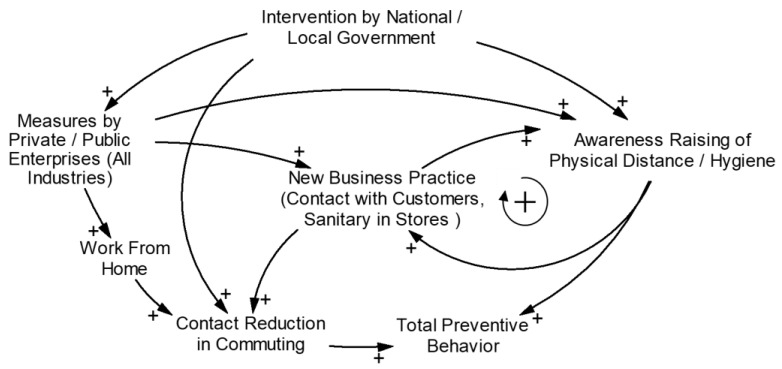
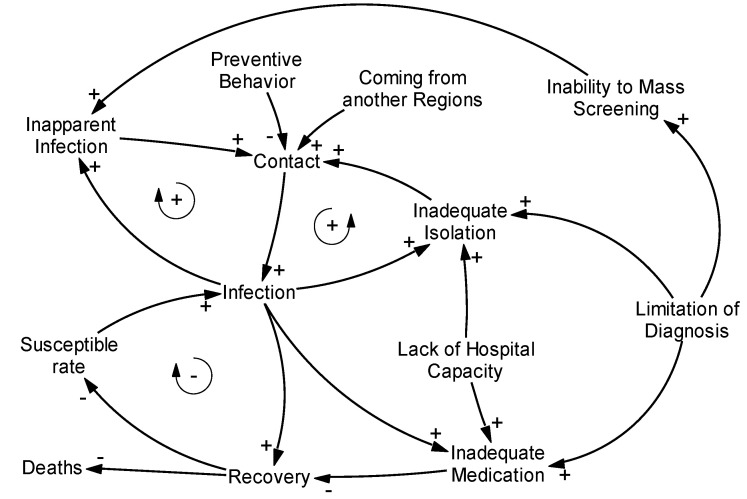
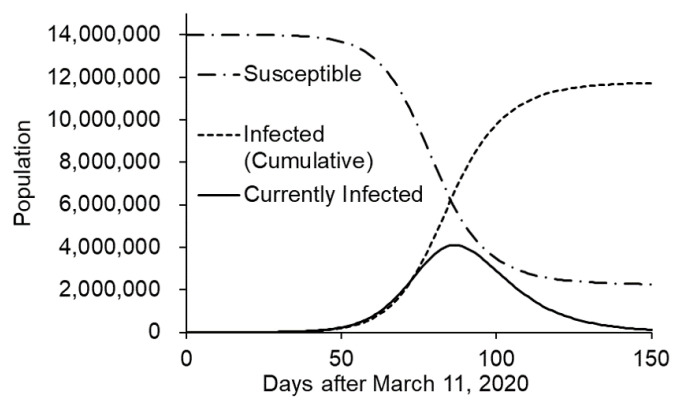
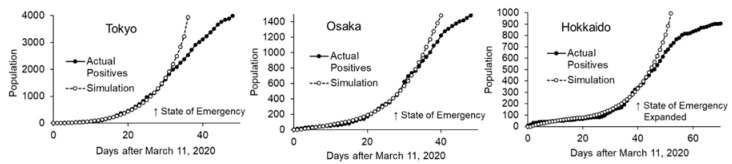
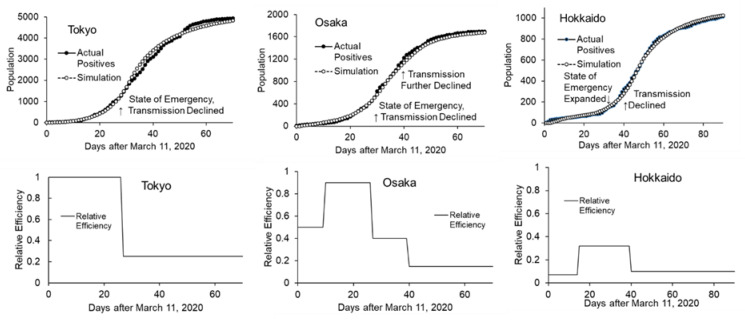
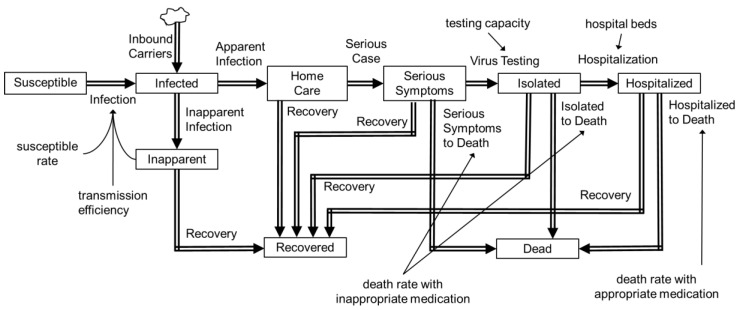
In Japan's response to the coronavirus disease 2019 (COVID-19), virus testing was limited to symptomatic patients due to limited capacity, resulting in uncertainty regarding the spread of infection and the appropriateness of countermeasures. System dynamic modelling, comprised of stock flow and infection modelling, was used to describe regional population dynamics and estimate assumed region-specific transmission rates. The estimated regional transmission rates were then mapped against actual patient data throughout the course of the interventions. This modelling, together with simulation studies, demonstrated the effectiveness of inbound traveler quarantine and resident self-isolation policies and practices. A causal loop approach was taken to link societal factors to infection control measures. This causal loop modelling suggested that the only effective measure against COVID-19 transmission in the Japanese context was intervention in the early stages of the outbreak by national and regional governments, and no social self-strengthening dynamics were demonstrated. These findings may contribute to an understanding of how social resilience to future infectious disease threats can be developed.

摘要

在日本应对 2019 年冠状病毒病(COVID-19)的过程中,由于检测能力有限,病毒检测仅限于有症状的患者,这导致对感染传播和对策的适当性存在不确定性。本研究采用包含存量流量和感染建模的系统动力学模型来描述区域人口动态,并估计假设的特定区域传播率。然后,根据整个干预过程中的实际患者数据,将估计的区域传播率映射到实际患者数据上。该模型以及模拟研究表明,入境旅客检疫和居民自我隔离政策和措施是有效的。采用因果关系图方法将社会因素与感染控制措施联系起来。该因果关系模型表明,在日本的情况下,针对 COVID-19 传播的唯一有效措施是国家和地区政府在疫情早期进行干预,没有显示出任何社会自我强化的动态。这些发现可能有助于了解如何增强社会对未来传染病威胁的抵御能力。
https://cdn.ncbi.nlm.nih.gov/pmc/blobs/3516/7503244/180f1c8a64d2/ijerph-17-06238-g006.jpg
https://cdn.ncbi.nlm.nih.gov/pmc/blobs/3516/7503244/f4076148fa43/ijerph-17-06238-g001.jpg
https://cdn.ncbi.nlm.nih.gov/pmc/blobs/3516/7503244/faa29b7b7cac/ijerph-17-06238-g002.jpg
https://cdn.ncbi.nlm.nih.gov/pmc/blobs/3516/7503244/4ba8d9d2f171/ijerph-17-06238-g003.jpg
https://cdn.ncbi.nlm.nih.gov/pmc/blobs/3516/7503244/67ea9b9032dc/ijerph-17-06238-g004.jpg
https://cdn.ncbi.nlm.nih.gov/pmc/blobs/3516/7503244/2ea57dbda339/ijerph-17-06238-g005.jpg
https://cdn.ncbi.nlm.nih.gov/pmc/blobs/3516/7503244/180f1c8a64d2/ijerph-17-06238-g006.jpg
https://cdn.ncbi.nlm.nih.gov/pmc/blobs/3516/7503244/f4076148fa43/ijerph-17-06238-g001.jpg
https://cdn.ncbi.nlm.nih.gov/pmc/blobs/3516/7503244/faa29b7b7cac/ijerph-17-06238-g002.jpg
https://cdn.ncbi.nlm.nih.gov/pmc/blobs/3516/7503244/4ba8d9d2f171/ijerph-17-06238-g003.jpg
https://cdn.ncbi.nlm.nih.gov/pmc/blobs/3516/7503244/67ea9b9032dc/ijerph-17-06238-g004.jpg
https://cdn.ncbi.nlm.nih.gov/pmc/blobs/3516/7503244/2ea57dbda339/ijerph-17-06238-g005.jpg
https://cdn.ncbi.nlm.nih.gov/pmc/blobs/3516/7503244/180f1c8a64d2/ijerph-17-06238-g006.jpg

相似文献

1
Effectiveness of Social Measures against COVID-19 Outbreaks in Selected Japanese Regions Analyzed by System Dynamic Modeling.系统动力学建模分析日本部分地区针对新冠疫情采取的社会措施的有效性。
Int J Environ Res Public Health. 2020 Aug 27;17(17):6238. doi: 10.3390/ijerph17176238.
2
Epidemic curve and reproduction number of COVID-19 in Iran.伊朗新冠肺炎疫情曲线及再生数
J Travel Med. 2020 Aug 20;27(5). doi: 10.1093/jtm/taaa077.
3
Nonpharmaceutical interventions for tackling the COVID-19 epidemic in Brazil.巴西应对新冠疫情的非药物干预措施。
Epidemiol Serv Saude. 2020 Apr 9;29(2):e2020222. doi: 10.5123/S1679-49742020000200009.
4
Impacts of reopening strategies for COVID-19 epidemic: a modeling study in Piedmont region.新冠肺炎疫情重启策略的影响:皮埃蒙特大区的建模研究。
BMC Infect Dis. 2020 Oct 28;20(1):798. doi: 10.1186/s12879-020-05490-w.
5
The impact of social distancing and public behavior changes on COVID-19 transmission dynamics in the Republic of Korea.社交距离和公众行为改变对韩国 COVID-19 传播动力学的影响。
PLoS One. 2020 Sep 24;15(9):e0238684. doi: 10.1371/journal.pone.0238684. eCollection 2020.
6
Audio Interview: Loosening Covid-19 Restrictions.音频访谈:放宽新冠疫情限制措施
N Engl J Med. 2020 Apr 30;382(18):e67. doi: 10.1056/NEJMe2014793.
7
Interventions to mitigate early spread of SARS-CoV-2 in Singapore: a modelling study.干预措施以减轻 SARS-CoV-2 在新加坡的早期传播:一项建模研究。
Lancet Infect Dis. 2020 Jun;20(6):678-688. doi: 10.1016/S1473-3099(20)30162-6. Epub 2020 Mar 23.
8
Covid-19: social distancing or social isolation?新冠疫情:保持社交距离还是社交隔离?
BMJ. 2020 Jun 18;369:m2399. doi: 10.1136/bmj.m2399.
9
Impact of household quarantine on SARS-Cov-2 infection in mainland China: A mean-field modelling approach.家庭隔离对中国大陆 SARS-CoV-2 感染的影响:一种平均场建模方法。
Math Biosci Eng. 2020 Jun 23;17(5):4500-4512. doi: 10.3934/mbe.2020248.
10
Interrupting transmission of COVID-19: lessons from containment efforts in Singapore.阻断 COVID-19 传播:新加坡封控措施的经验教训。
J Travel Med. 2020 May 18;27(3). doi: 10.1093/jtm/taaa039.

引用本文的文献

1
The future of inbound medical care as gauged from the foreigners undergoing complete medical examinations in Japan.从在日本接受全面体检的外国人来看入境医疗的未来。
Glob Health Med. 2024 Aug 31;6(4):256-258. doi: 10.35772/ghm.2023.01126.
2
Public holidays increased the transmission of COVID-19 in Japan, 2020-2021: a mathematical modelling study.2020-2021 年日本公共假期增加了 COVID-19 的传播:一项数学建模研究。
Epidemiol Health. 2024;46:e2024025. doi: 10.4178/epih.e2024025. Epub 2024 Jan 22.
3
Analysis and prediction of improved SEIR transmission dynamics model: taking the second outbreak of COVID-19 in Italy as an example.

本文引用的文献

1
Association of Social Distancing, Population Density, and Temperature With the Instantaneous Reproduction Number of SARS-CoV-2 in Counties Across the United States.社交距离、人口密度和温度与美国各县 SARS-CoV-2 瞬时繁殖数的关系。
JAMA Netw Open. 2020 Jul 1;3(7):e2016099. doi: 10.1001/jamanetworkopen.2020.16099.
2
COVID-19 mortality rates in the European Union, Switzerland, and the UK: effect of timeliness, lockdown rigidity, and population density.欧盟、瑞士和英国的 COVID-19 死亡率:及时性、封锁僵化程度和人口密度的影响。
Minerva Med. 2020 Aug;111(4):308-314. doi: 10.23736/S0026-4806.20.06702-6. Epub 2020 Jun 2.
3
改进的 SEIR 传播动力学模型分析与预测:以意大利第二次 COVID-19 疫情爆发为例。
Front Public Health. 2023 Aug 24;11:1223039. doi: 10.3389/fpubh.2023.1223039. eCollection 2023.
4
Improvement of the software for modeling the dynamics of epidemics and developing a user-friendly interface.改进用于模拟流行病动态的软件并开发用户友好界面。
Infect Dis Model. 2023 Jul 8;8(3):806-821. doi: 10.1016/j.idm.2023.06.003. eCollection 2023 Sep.
5
Cultivating patient-centered care competence through a telemedicine-based course: An explorative study of undergraduate medical students' self-reflective writing.通过基于远程医疗的课程培养以患者为中心的护理能力:对本科医学生自我反思写作的探索性研究。
Front Public Health. 2023 Apr 5;11:1134496. doi: 10.3389/fpubh.2023.1134496. eCollection 2023.
6
Using simulation modelling and systems science to help contain COVID-19: A systematic review.利用模拟建模和系统科学助力控制2019冠状病毒病:一项系统综述
Syst Res Behav Sci. 2022 Aug 19. doi: 10.1002/sres.2897.
7
System dynamics analysis on the effectiveness of vaccination and social mobilization policies for COVID-19 in the United States.系统动力学分析美国 COVID-19 疫苗接种和社会动员政策的效果。
PLoS One. 2022 Aug 12;17(8):e0268443. doi: 10.1371/journal.pone.0268443. eCollection 2022.
8
The impact of inspection policies on reducing disease prevalence in public buildings: A systems dynamics approach.检查政策对降低公共建筑中疾病患病率的影响:一种系统动力学方法。
Build Environ. 2022 Sep;223:109398. doi: 10.1016/j.buildenv.2022.109398. Epub 2022 Jul 30.
9
Anticipating human resilience and vulnerability on the path to 2030: What can we learn from COVID-19?展望通往2030年道路上的人类恢复力与脆弱性:我们能从新冠疫情中学到什么?
Futures. 2022 May;139:102936. doi: 10.1016/j.futures.2022.102936. Epub 2022 Apr 1.
10
Living Lab for Citizens' Wellness: A Case of Maintaining and Improving a Healthy Diet under the COVID-19 Pandemic.居民健康生活实验室:新冠疫情下维持和改善健康饮食的案例。
Int J Environ Res Public Health. 2022 Jan 23;19(3):1254. doi: 10.3390/ijerph19031254.
Institutional, not home-based, isolation could contain the COVID-19 outbreak.
机构隔离而非居家隔离能够遏制新冠疫情的爆发。
Lancet. 2020 May 16;395(10236):1541-1542. doi: 10.1016/S0140-6736(20)31016-3. Epub 2020 Apr 29.
4
COVID-19 pathophysiology: A review.新型冠状病毒肺炎的病理生理学:综述。
Clin Immunol. 2020 Jun;215:108427. doi: 10.1016/j.clim.2020.108427. Epub 2020 Apr 20.
5
Insight into 2019 novel coronavirus - An updated interim review and lessons from SARS-CoV and MERS-CoV.对 2019 年新型冠状病毒的洞察——来自 SARS-CoV 和 MERS-CoV 的更新中期综述和经验教训。
Int J Infect Dis. 2020 May;94:119-124. doi: 10.1016/j.ijid.2020.03.071. Epub 2020 Apr 1.
6
Projecting hospital utilization during the COVID-19 outbreaks in the United States.预测美国 COVID-19 疫情期间的医院使用情况。
Proc Natl Acad Sci U S A. 2020 Apr 21;117(16):9122-9126. doi: 10.1073/pnas.2004064117. Epub 2020 Apr 3.
7
The First 75 Days of Novel Coronavirus (SARS-CoV-2) Outbreak: Recent Advances, Prevention, and Treatment.新型冠状病毒(SARS-CoV-2)爆发的前 75 天:最新进展、预防和治疗。
Int J Environ Res Public Health. 2020 Mar 30;17(7):2323. doi: 10.3390/ijerph17072323.
8
High population densities catalyse the spread of COVID-19.高人口密度加速了新冠病毒的传播。
J Travel Med. 2020 May 18;27(3). doi: 10.1093/jtm/taaa038.
9
System Dynamics Approaches and Collective Action for Community Health: An Integrative Review.系统动力学方法与社区健康的集体行动:综合述评。
Am J Community Psychol. 2019 Jun;63(3-4):527-545. doi: 10.1002/ajcp.12305. Epub 2019 Feb 1.
10
Obesity trend in the United States and economic intervention options to change it: A simulation study linking ecological epidemiology and system dynamics modeling.美国肥胖趋势及改变该趋势的经济干预选项:一项将生态流行病学与系统动力学模型相结合的仿真研究。
Public Health. 2018 Aug;161:20-28. doi: 10.1016/j.puhe.2018.01.013. Epub 2018 May 29.