Department of Animal Sciences, The Ohio State University, Columbus, OH 43210.
BIOMIN Holding GmbH, Getzersdorf, Austria.
Poult Sci. 2020 Sep;99(9):4235-4241. doi: 10.1016/j.psj.2020.05.017. Epub 2020 Jun 19.
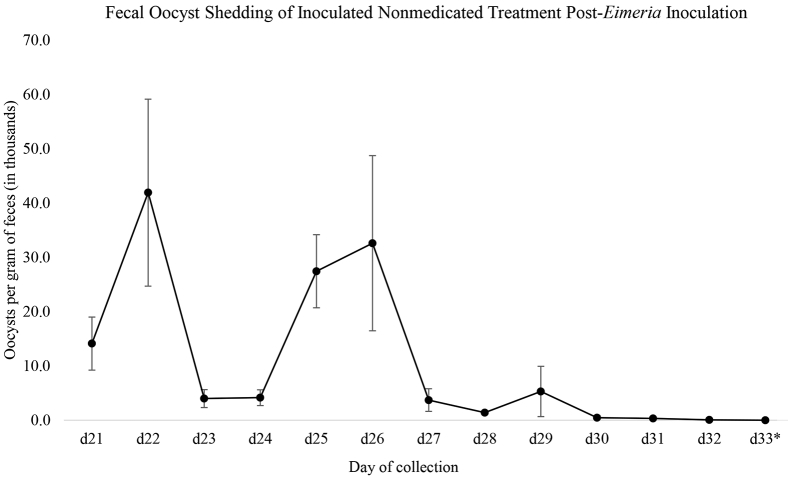
This study examined the effects a synbiotic feed additive (PoultryStar me) on performance and intestinal health parameters in turkey poults administered a mixed Eimeria inoculation. The synbiotic feed additive consisted of Lactobacillus reuteri, Enterococcus faecium, Bifidobacterium animalis, Pediococcus acidilactici and a fructo-oligosaccharide prebiotic. Dietary treatments began on day of hatch, and poults were placed on a normal starter, starter containing Clinacox, or starter containing PoultryStar until the conclusion of the experiment on day 42. In addition, on day of hatch, all poults, with exception of the negative control, were orally inoculated with Salmonella enterica Enteritidis. On day 16, poults in inoculated treatment groups received an oral dose of Eimeria adenoides and Eimeria meleagrimitis oocysts resulting in a 2 × 3 factorial arrangement of treatments. BW were measured at weekly intervals after challenge, and fecal samples were collected from all pens during day 21 to day 33 to monitor fecal shedding and calculate oocyst per gram of feces. Five day after Eimeria inoculation, inoculated PoultryStar-fed (I-PS) and inoculated Clinacox-fed (I-CL) poults, on average, weighed and gained significantly more weight (P < 0.05) than inoculated controls (I-CON) and were similar to uninoculated treatments. Between day 21 and day 28, I-PS and I-CL poults showed a 23% improvement (P < 0.001) in percent change in BW gained relative to I-CON, and overall weight gain as a percentage was similar to the uninoculated control. Overall incidence of macroscopic intestinal lesions on day 21 and day 28 was low, but I-PS and I-CL poults were generally less positive than I-CON, and no oocysts were detected in the feces of any group except I-CON which cycled as expected. From this study, it can be concluded that incorporating PoultryStar into the diet of poults reared to 6 wk ameliorates and prevents aspects of performance loss and negative impacts on gut health seen with mixed Eimeria inoculation.
本研究探讨了合生元饲料添加剂(PoultryStar me)对感染混合艾美耳球虫的火鸡雏鸡的生产性能和肠道健康参数的影响。合生元饲料添加剂由乳酸杆菌、粪肠球菌、动物双歧杆菌、戊糖片球菌和低聚果糖组成。日粮处理于孵化当天开始,雏鸡被置于正常的开食料、含 Clinacox 的开食料或含 PoultryStar 的开食料中,直到第 42 天实验结束。此外,在孵化当天,除阴性对照组外,所有雏鸡均口服接种肠炎沙门氏菌肠炎亚种。在第 16 天,接种处理组的雏鸡口服给予艾美耳球虫肠腺瘤和艾美耳球虫火鸡球虫卵囊,导致处理呈 2×3 析因设计。攻毒后每周测量一次体重,在第 21 天至第 33 天期间从所有鸡舍收集粪便样本,以监测粪便脱落并计算每克粪便中的卵囊数。在艾美耳球虫接种后第 5 天,接种 PoultryStar 组(I-PS)和接种 Clinacox 组(I-CL)的雏鸡平均体重和增重显著高于接种对照组(I-CON),与未接种组相似。在第 21 天至第 28 天期间,I-PS 和 I-CL 雏鸡的 BW 增加百分比比 I-CON 提高了 23%(P<0.001),总体增重百分比与未接种对照组相似。在第 21 天和第 28 天,肉眼观察到的肠道病变总发生率较低,但 I-PS 和 I-CL 雏鸡的阳性率通常低于 I-CON,除了 I-CON 外,其他组的粪便中均未检测到卵囊,而 I-CON 则按预期循环。从这项研究可以得出结论,在饲养至 6 周的火鸡雏鸡日粮中添加 PoultryStar 可以改善和预防混合艾美耳球虫感染引起的生产性能下降和对肠道健康的负面影响。